A Crime Across Four Landscapes
The Premise: A Six-Minute Mystery You'll Still Be Turning Over Hours Later
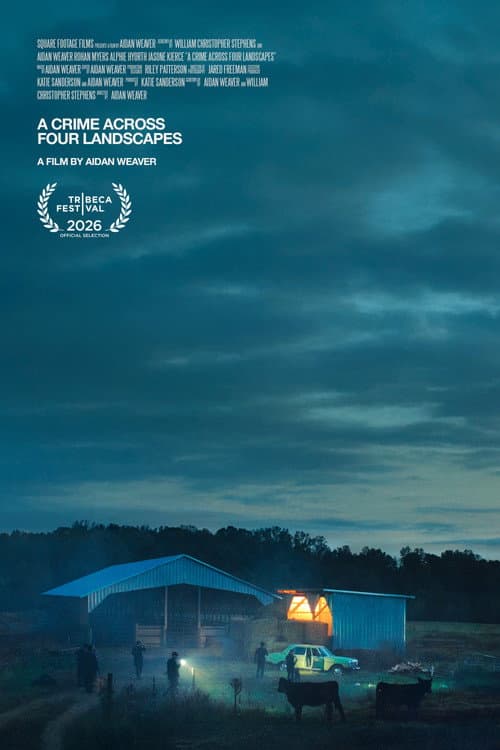
A Crime Across Four Landscapes is a six-minute short that trusts you to piece together what happened — and doesn't apologize for leaving gaps. Director Aidan Weaver plants a small-town crime in the Southern American countryside, then scatters the evidence across four distinct landscapes. No voiceover. No exposition dump. Just four settings, each one holding a fragment of a story that's already gone sideways before you've settled into your seat.
What's striking is how much the film resists over-explanation. Most shorts built around mystery feel the pull to cram in dialogue or narration to compensate for limited runtime. This one doesn't. The landscapes do the talking — the quality of light, the way the terrain itself seems to hold what happened. It's genuinely an example of formal restraint paying off.
Why Tribeca 2026 Selected It (And Why That Matters)
The film had its world premiere at the 2026 Tribeca Festival, one of the most competitive short-film showcases in North American independent cinema. Tribeca draws thousands of submissions annually and selects a comparatively tiny slate — getting in signals that Weaver's work cleared a high bar. The festival's own description nails the hook: "a small-town crime goes awry" and evidence lands scattered across four Southern landscapes.
That dual function — plot summary and formal manifesto — is what makes this thing work. At six minutes, every cut, every location choice, every ambient sound has to carry narrative weight that a feature could spread across ninety minutes. Weaver treats that compression as a challenge, not a limitation.
The 2026 Tribeca lineup leaned into formal experimentation, and this film fits that cohort well. Hard to say whether cast details haven't surfaced because of deliberate secrecy or just early press coverage gaps — but what's clear is the film was shot on location in the Southern American countryside, and those four landscapes function structurally. Each one's a chapter in a story told without conventional exposition.
The Four Landscapes as Structure (Not Just Backdrop)
Here's what I keep coming back to: the four-location architecture is the film's most interesting decision. Each setting carries its own emotional temperature — one feels like aftermath, another like anticipation, another like concealment — and the cumulative effect is of a crime story told in four movements rather than a conventional arc. It's unusual without being difficult to watch. Unusual in the way that makes you reconsider what you just saw.
The Southern setting does specific cultural work too. That geography carries associations — with a particular kind of community, a particular relationship between landscape and concealment — that Weaver seems aware of and uses deliberately rather than as mere atmosphere. It's not just pretty countryside. It's countryside with weight.
Movie OTT editors flagged the film when Tribeca coverage surfaced, precisely because shorts this formally focused rarely make it to streaming platforms with much visibility. This one deserves better than festival-circuit obscurity.
Where to Watch It Right Now
A Crime Across Four Landscapes is currently available on major OTT services following its festival run. Check the where-to-watch widget at the top of this page for the most current platform breakdown — availability shifts without notice, especially for shorts.
Short films in particular tend to move between platforms or arrive as part of curated collections rather than standalone titles. If you're browsing a specific service and can't locate it, search the full canonical title: A Crime Across Four Landscapes. That'll get you further than keyword fragments.
The six-minute runtime also makes it an easy fit around a longer feature, which is worth remembering when you're planning an evening. If you liked experimental short films that trust their audience — things like the better Netflix Shorts selections or the formal precision of festival documentaries — this lands in that same space.
Quick Facts You'll Want to Know
Director: Aidan Weaver
Runtime: 6 minutes
Premiere: 2026 Tribeca Festival
Setting: Southern American countryside (four distinct landscapes)
Streaming: Major OTT platforms (check the widget for current availability)
The basic question: Should you watch it? If you're the kind of viewer who appreciates formal precision over narrative hand-holding — yeah. It's a short film that earns its festival placement through restraint, which is rarer than it sounds. Don't expect answers. Expect to sit with questions.
Is it based on a true story? No verified information suggests that. It presents as an original work set in a recognizable Southern American milieu, though the specificity of the setting gives it an almost documentary texture.
Best watched: On its own, without plot spoilers. Don't scroll the comments first. The mystery is the whole point.
What Makes It Stand Out in 2026 Short Cinema
Six minutes. Four landscapes. One crime that won't resolve cleanly. That's the entire formula, and somehow it works because Weaver understands that withholding is a form of storytelling. Most filmmakers are terrified of silence or ambiguity. They'll cut away to a reaction shot, add a musical cue, anything to telegraph meaning.
This film doesn't flinch from letting you sit with uncertainty — which is exactly what makes it memorable. You'll carry it out of the room with you, turning it over in your mind for hours after the runtime ends. That's the opposite of forgettable.
Look for it through the streaming platforms listed in the where-to-watch widget, and if you want real-time availability updates across services, Movie OTT's tracking system handles that better than scrolling three different apps yourself.
