What Chips Ahoy is really about
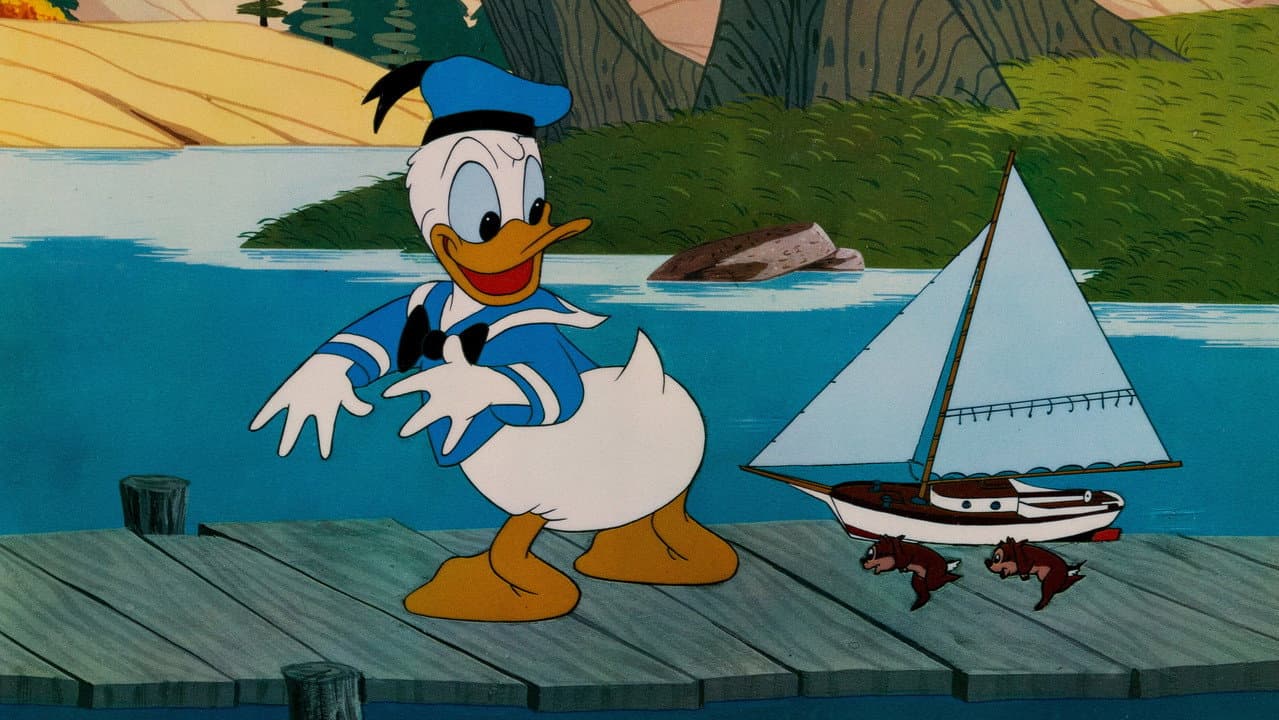
Chips Ahoy opens on a note of desperation—two chipmunks, Chip and Dale, are starving in their tree home when they spot what looks like acorn paradise: a distant island absolutely loaded with food. The problem? It's surrounded by water. The solution they land on is delightfully simple and criminal: borrow Donald Duck's prized miniature model ship and sail across the lake. What follows is six minutes of pure slapstick escalation, where Donald—naturally furious about the theft—turns into an obstacle course all his own, determined to reclaim his vessel and stop the chipmunks' scheme. But Chip and Dale? They're always one step ahead. It's the kind of premise that doesn't need a three-act structure or emotional beats; it just needs chaos, timing, and the kind of physical comedy that made Disney shorts legendary.
Behind the making of Chips Ahoy
Chips Ahoy arrived in theaters on February 24, 1956, as a CinemaScope theatrical release from Walt Disney Productions—a format that let animators stretch their gags across a wider canvas. This wasn't a throwaway short; it was a major studio release, distributed by RKO Radio Pictures at a time when theatrical shorts still commanded real screen time before feature films. The production team understood what audiences wanted: a quick hit of laughter before the main event. What's striking is that this six-minute film carries genuine historical weight. It marked the second-to-last Disney cartoon distributed by RKO, signaling the end of an era in Hollywood distribution. More significantly, Chips Ahoy was the final theatrical appearance of Chip 'n' Dale during animation's Golden Age—a farewell to characters who'd charmed audiences since the late 1940s. The chipmunks wouldn't return to the big screen until the 1959 television special "The Adventures of Chip 'n' Dale," making this short a kind of punctuation mark on a chapter of animation history. Donald Duck, too, was in his twilight as a starring character in theatrical shorts, which adds a bittersweet undertone to watching this trio go at it one last time. The animation itself reflects the technical polish Disney had perfected by the mid-1950s—no corners cut, every frame a miniature painting.
Why Chips Ahoy still lands as comedy
The thing that makes Chips Ahoy work, even now, is that it doesn't rely on dialogue or plot contrivance—it's pure visual storytelling. The gags are built on a simple principle: escalation and reversal. Donald wants his ship back. Chip and Dale want acorns. Each attempt to solve the problem creates a new, more absurd obstacle. Watch the moment where Donald tries to stop them: he's not just angry, he's offended, and that wounded dignity is what animates every frame of his performance. The voice work—though minimal—captures something real about the characters' motivations without spelling anything out. What I keep coming back to is how economical the humor is. There's no wasted movement, no joke that doesn't build on the last one. It's the kind of craftsmanship that modern comedy often overlooks in favor of setup-punchline-repeat. The chipmunks themselves are drawn with genuine personality—Chip's slightly more cautious, Dale's a touch more reckless—and their physical comedy reads clearly even at the small size they're animated at. The backgrounds, rendered in that 1950s Technicolor palette, give the whole thing a storybook warmth that you don't get from watching it on a modern screen without context. But here's what's interesting: the film doesn't punch down. Donald isn't a villain; he's just a guy trying to protect his stuff from two animals who are genuinely hungry. There's empathy baked into the design, which is why you can root for both sides and still laugh when everything goes sideways.
Where to stream Chips Ahoy online
Chips Ahoy is available on major OTT services, and if you're hunting for where to watch it, the Where to Watch widget at the top of this page will show you exactly which platforms currently have it in their library. Movie OTT keeps its streaming database updated across all the major services, so you can find this short—and thousands of other titles—without bouncing between apps. Since this is a Disney production from the studio's vault, it tends to show up on the services that carry classic Disney animation, which means you've got solid options depending on your existing subscriptions. A quick check on Movie OTT's search will save you the frustration of clicking through three different apps only to find it's not there.
Frequently asked questions
Q: Is Chips Ahoy based on a true story?
No, it's a fictional animated comedy. The plot—hungry chipmunks stealing a boat to reach an island—is pure Disney invention, designed entirely for laughs rather than any real-world incident.
Q: Who directed Chips Ahoy?
The short was produced by Walt Disney Productions as a theatrical release. Like most Disney shorts of the era, it was a collaborative effort from the studio's animation teams, though specific directorial credits vary depending on the source documentation from that period.
Q: Why is Chips Ahoy significant in animation history?
It was the final theatrical appearance of Chip 'n' Dale during animation's Golden Age and one of the last Disney shorts distributed by RKO Radio Pictures. It also marked Donald Duck's near-final starring role in a theatrical cartoon, making it a historical milestone for the studio.
Q: How long is Chips Ahoy?
The short runs exactly six minutes, which was standard for theatrical animated shorts in the 1950s. It's designed to play before a feature film, so it packs its comedy into a tight, efficient runtime.
Q: What year was Chips Ahoy released?
Chips Ahoy premiered in theaters on February 24, 1956, in CinemaScope format. It was later re-released on July 24, 1985, as a companion piece to the theatrical release of The Black Cauldron.
Final thoughts on Chips Ahoy
If you're looking for a time capsule of mid-century animation at its most polished, Chips Ahoy delivers. It doesn't overstay its welcome—six minutes is exactly right—and it proves that you don't need elaborate plots or emotional arcs to make something memorable. The chipmunks' final theatrical bow is a reminder of when animation studios trusted audiences to enjoy pure, wordless comedy. That's a philosophy worth revisiting.