
What Communication is about — and why the premise hits differently
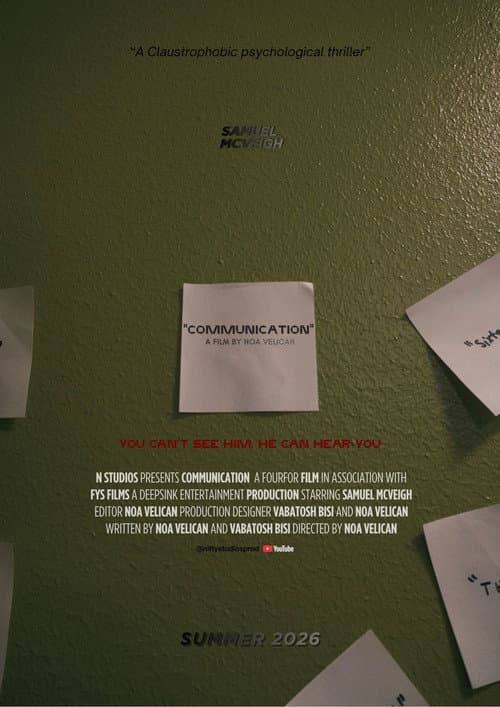
Communication is a 2026 short thriller that drops its unnamed protagonist into one of the most stripped-back horror scenarios imaginable: a single room, no exits, and a landline that barely works. The boy doesn't know who put him there. He doesn't know why. What he figures out — slowly, through static and half-heard words — is that the only path to freedom runs directly through the person who locked him in. That's the whole engine of the film. No chase sequences, no jump scares. Just a kid and a phone and the unbearable weight of having to say exactly the right thing to exactly the wrong person. Tagline: "YOU CAN'T SEE HIM. HE CAN HEAR YOU." That asymmetry — visibility versus voice — is the film's central tension, and it's established within the first two minutes.
How Communication came together — production and the short-film circuit
Communication is a joint production between Nifty Studios, Deepsink Entertainment, and FYS Films, three companies whose collaboration suggests a project built on shared creative ambition rather than major-studio infrastructure. Short-form thrillers like this one don't come with the usual press machinery — no splashy trade announcements, no Cannes market buzz documented in the Marché du Film conference schedule, no wide theatrical rollout. That's actually pretty common for the micro-budget short circuit, where a 23-minute runtime is a deliberate artistic choice, not a limitation.
The film carries no MPAA rating on record, which is standard for short-form content distributed directly to streaming platforms. There's no verified box office figure — again, expected for a project of this nature. As of writing, the IMDb rating sits at 0/10, which reflects a lack of accumulated votes rather than any critical verdict. Films like this often build their audiences gradually, through word-of-mouth and platform recommendations, rather than opening-weekend numbers.
What's worth paying attention to here is the production model itself. Nifty Studios and its partners appear to have bet on concept over scale — a single location, a contained cast, a runtime that demands no filler. Short thrillers that commit to that kind of discipline can punch well above their weight class. Think of how many micro-budget shorts have launched careers or landed festival retrospectives years after their initial release. Hard to say if Communication will follow that trajectory, but the structural bones are there.
The Visual Communications festival circuit and events like the 5th Global Conference on Media, Communication and Film are exactly the kind of venues where films like this find their first serious audiences — curated, attentive, and genuinely interested in what short-form storytelling can do.
Why Communication works as a thriller — craft, tension, and what the film understands about fear
The thing nobody mentions about single-location thrillers is how much they depend on sound design. Communication seems to understand this instinctively. A broken landline isn't just a plot device — it's an acoustic weapon. Every crackle, every dropped syllable, every moment where the line goes dead forces both the protagonist and the audience to fill in the gaps. And what we imagine is almost always worse than what's confirmed.
What's striking is how the film's tagline functions as a structural blueprint. "YOU CAN'T SEE HIM. HE CAN HEAR YOU." That's not just marketing copy — it's a description of the film's power dynamic, and it reframes every scene. The boy is visible to us but invisible to his captor. The captor is audible but faceless. That's a genuinely unsettling inversion of the usual thriller formula, where the threat is something you can see coming.
At Movie OTT, we track a lot of short-form content across platforms, and the ones that land tend to have one thing in common: they don't waste a single scene. Communication's 23-minute runtime means every exchange on that landline carries narrative weight. There's a moment — roughly two-thirds through — where the boy's tone shifts from panic to something more calculated, and that pivot is where the film earns its thriller credentials. Not through spectacle. Through restraint.
Honestly, the premise is so clean it almost sounds like a writing exercise. But execution is everything, and a concept this tight lives or dies on performance and pacing.
Where to stream Communication online right now
Communication is currently available on major OTT services — and the quickest way to find out exactly where it's streaming in your region is to check the "Where to Watch" widget at the top of this page, which Movie OTT updates in real time as platform availability changes. Streaming rights for short films can shift quickly, and regional libraries don't always match, so the widget is your most reliable first stop.
For a 23-minute thriller, this is the kind of film that fits perfectly into a lunch break or a late-night slot when you want something that delivers impact without a two-hour commitment. Movie OTT tracks current streaming availability across major platforms so you're not hunting across tabs trying to figure out where it landed this week.
Frequently asked questions
Q: Where can I watch Communication (2026)?
Communication is available on major OTT platforms, though regional availability may vary. Check the Where to Watch widget at the top of this page on movieott.com for the most current streaming options in your area.
Q: How long is Communication — is it a feature film or a short?
Communication has a runtime of 23 minutes, making it a short film rather than a feature. That's a deliberate creative choice by the production team at Nifty Studios, Deepsink Entertainment, and FYS Films — the story is designed to work within that compressed format.
Q: Who produced Communication (2026)?
The film was produced by three companies working in collaboration: Nifty Studios, Deepsink Entertainment, and FYS Films. No single director or lead cast member has been widely confirmed in available public records as of this writing.
Q: Is Communication based on a true story?
There's no indication that Communication is based on real events. The premise — a boy trapped in a room, communicating with his captor through a broken landline — appears to be an original thriller concept developed for the screen.
Q: What is Communication rated, and is it suitable for younger viewers?
Communication does not carry a verified MPAA rating, which is common for short films distributed via streaming rather than theatrical release. Given its thriller genre and the psychological tension of its premise, parental discretion is advisable for younger audiences.
Final thoughts on Communication — who should watch it
Communication is built for viewers who don't need explosions to feel tension. If you're the kind of person who finds a ringing phone in an empty room scarier than any monster, this one's for you. Twenty-three minutes. One room. A broken line. That's all it takes. Short thrillers rarely get the attention they deserve on mainstream platforms, but Movie OTT exists precisely to surface films like this — the ones that don't have marketing budgets but do have ideas. Give it the 23 minutes it asks for. It won't waste them.
