




The story of Company Limited and urban ambition
Company Limited—the English title for Ray's Bengali film Seemabaddha—follows Shyamalendu, an ambitious businessman who's clawed his way into Calcutta's corporate elite. When his sister-in-law Tutul arrives for a visit, he's eager to dazzle her with the trappings of his success: the fancy car, the spacious flat, the dinners at exclusive clubs. But Tutul isn't impressed. What unfolds is a quietly devastating examination of what success actually costs, and whether the rat race is worth running at all. The film doesn't announce its themes with a megaphone. Instead, it lets you sit in Shyamalendu's world and feel the suffocation creeping in from the margins.
Behind the making of Company Limited and its critical triumph
Company Limited arrived in 1971 as the second installment of Ray's Calcutta Trilogy—a series completed by Pratidwandi (1970) and Jana Aranya (1976)—each film examining different angles of modernization, corporate greed, and the spiritual emptiness of the urban rat race. Ray adapted the film from Mani Shankar Mukherjee's novel of the same name, bringing his characteristic visual intelligence and moral clarity to the material. The production, helmed by Indrapuri Studio Limited, gave Ray the resources to capture Calcutta's gleaming corporate spaces and cramped family homes with equal precision. The film's 110-minute runtime allows Ray to build his critique slowly, never rushing the emotional or philosophical stakes.
The cast anchors the film with understated authenticity. Barun Chanda brings a restrained, almost tragic quality to Shyamalendu—you see the man's hunger and his self-deception in the same glance. Sharmila Tagore, playing Tutul, becomes the moral conscience of the film, her quiet judgment more cutting than any monologue could be. Harindranath Chattopadhyay rounds out the ensemble, adding texture to the domestic and professional worlds Ray is mapping. The film's reception was immediate and substantial: it won the FIPRESCI Award at the 33rd Venice International Film Festival and claimed the National Film Award for Best Feature Film in 1971—recognition that placed it among the year's most important Indian cinema achievements. These accolades weren't nostalgia; they reflected the film's raw insight into a society in transition.
What makes Company Limited stand out among Ray's social dramas
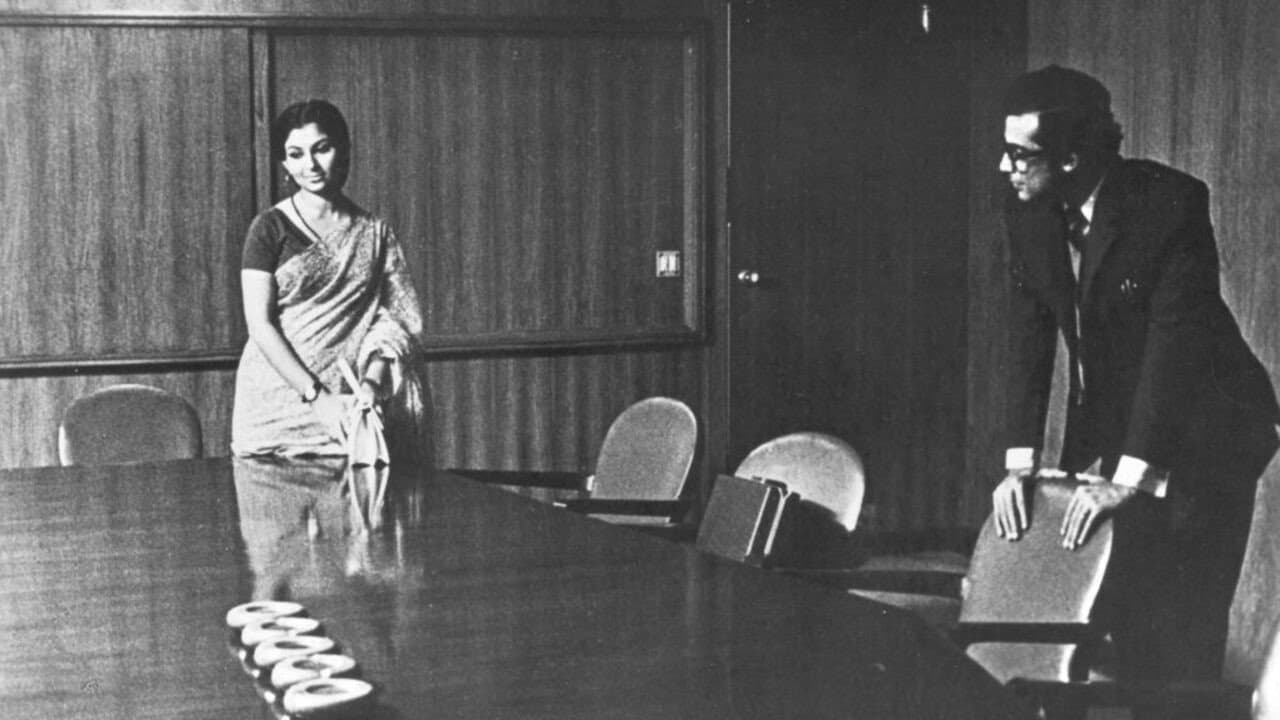
What's striking about Company Limited is how it refuses to let Shyamalendu off the hook—but also refuses to caricature him. He's not a villain. He's a man caught in a system that rewards ambition and penalizes conscience, and he's chosen the former. Ray shows us the moments where Shyamalendu glimpses the emptiness, where he feels Tutul's judgment, where he might have taken a different path. Those moments are unbearable precisely because they're brief. The film's visual language—the cramped framing of boardrooms, the cold modernist geometry of Shyamalendu's apartment, the way Ray photographs Calcutta's streets as both vibrant and alienating—mirrors the psychological state of a man who's won everything and lost what matters.
I keep coming back to one scene where Shyamalendu tries to impress Tutul with his business acumen, and she simply looks away. No dialogue. No confrontation. Just that look—and suddenly you understand the entire film's argument about the bankruptcy of materialist values. The performances don't rely on histrionics; they're built on what's unsaid, what's withheld. That restraint is Ray's signature, and it's never been more effective than here. Sharmila Tagore's presence is particularly crucial—she's the outsider who sees clearly, the voice of values that Shyamalendu's world has discarded. Without her, the film might collapse into mere social critique. With her, it becomes a tragedy.
Where to stream Company Limited online
Company Limited is available on major OTT services, making Ray's 1971 masterpiece accessible to a new generation of viewers. Movie OTT tracks current streaming availability across platforms, so you can find exactly where the film is playing right now in your region. The film's 110-minute runtime makes it an easy evening commitment, though its emotional weight lingers long after the credits roll. Whether you're a Ray devotee or discovering the Calcutta Trilogy for the first time, the streaming widget at the top of this page will show you all your options to watch Company Limited today.
Frequently asked questions
Q: Who directed Company Limited?
Satyajit Ray directed Company Limited in 1971. It's the second film in his Calcutta Trilogy, following Pratidwandi and preceding Jana Aranya, all of which explore the social and spiritual costs of modernization in urban India.
Q: Is Company Limited based on a true story?
No, it's based on the novel Seemabaddha by Mani Shankar Mukherjee. While it's not autobiographical, Ray drew on his observations of Calcutta's rapidly changing corporate culture and the moral compromises that often accompany material success.
Q: What awards did Company Limited win?
The film won the FIPRESCI Award at the 33rd Venice International Film Festival and the National Film Award for Best Feature Film in 1971, cementing its status as one of the year's most important films.
Q: How long is Company Limited?
The film runs 110 minutes, giving Ray ample time to develop his characters and themes without rushing the emotional impact of the narrative.
Q: What's the Calcutta Trilogy?
It's a series of three films by Satyajit Ray examining modern urban life in Calcutta: Pratidwandi (1970), Company Limited (1971), and Jana Aranya (1976). Each film approaches the theme of ambition and greed from a different angle.
Final thoughts on Company Limited
Company Limited isn't easy viewing—it won't make you feel good about yourself or the world, and that's precisely why it matters. Ray made a film about a man who has everything and possesses nothing, and he did it without sentimentality or preaching. Fifty years on, the film's critique of corporate culture, the hollowness of status-seeking, and the erosion of values in pursuit of wealth feels unnervingly current. If you're looking for cinema that challenges rather than comforts, that observes rather than judges, Company Limited remains essential. It's a masterwork of restraint and moral clarity.