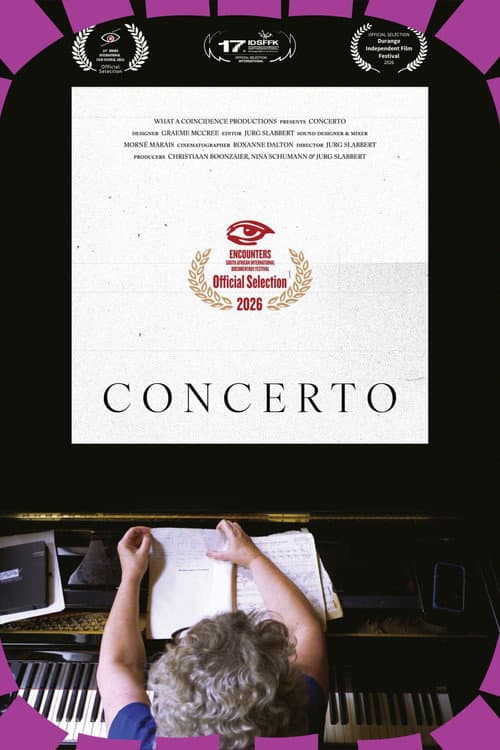
What Concerto is about: Nina Schumann and a familiar piece made new
Concerto is a 2026 short documentary that follows South African pianist Nina Schumann as she prepares to perform Rachmaninoff's Piano Concerto No. 2 — one of the most technically demanding and emotionally charged works in the classical piano repertoire. She's played it before. Many times, in fact. But something about this particular performance is different, and the film's entire dramatic tension hangs on that quiet, almost private distinction. What does it mean to return to a piece you already know by heart? The film doesn't rush to answer that. It sits with Schumann in rehearsal rooms, in the stillness before a concert, in the particular kind of focus that professional musicians carry like a second skin — and it lets the question breathe.
How Concerto came together: production and the pedigree behind the film
As of this writing, confirmed production details for Concerto — director, production company, runtime, and distributor — haven't been widely reported across major film databases or trade outlets. Hard to say if that's a matter of timing (the film is, after all, a 2026 release) or simply the nature of short documentary work, which tends to travel through festival circuits and specialist platforms before landing in broader coverage. What we do know is that the film centers on Nina Schumann, a pianist with a substantial international performance career and a long relationship with the Rachmaninoff Second — a concerto that, as any classical music follower will tell you, is not a piece you perform casually. It demands everything.
The Rachmaninoff Piano Concerto No. 2 in C minor, first performed in 1901, has become one of those works that carries almost mythological weight in the concert world. Its three-movement structure — following the classical concerto form that solidified in the early 18th century, with a slow movement framed by two faster outer movements — gives it a shape audiences instinctively recognize even on first hearing. For a performer like Schumann, returning to it isn't repetition. It's excavation.
No box office figures apply here, given the documentary's short-form nature, and no MPAA rating or Metascore has been logged at the time of publication. Movie OTT will update this page as festival results and critical aggregation data become available — the site tracks awards and ratings across platforms in real time, so check back if you're researching the film's recognition trajectory.
What makes Concerto stand out: craft, performance, and the pressure of repetition
The thing nobody mentions often enough about performance documentaries is how rarely they manage to capture actual stakes. Most of them settle for biography — here's the artist's childhood, here's their breakthrough, here's what critics said. Concerto appears to take a narrower, more nerve-wracking approach: one piece, one performance, one question about whether familiarity is a gift or a kind of trap.
What's striking is the specificity of the subject. Nina Schumann isn't a newcomer proving herself. She's a seasoned performer returning to something she already owns — and that's a psychologically richer premise than most music documentaries attempt. The Rachmaninoff Second is famous partly because of its difficulty and partly because of the emotional exposure it demands from the soloist. There's a moment, somewhere in the first movement's long opening build, where the pianist is essentially alone on stage before the orchestra fully joins — and the film reportedly leans into exactly that kind of solitude.
Documentaries about classical musicians can sometimes feel reverential to the point of being airless (you know the type — hushed voiceover, slow pans across concert halls). The early signals from Concerto suggest something more interior and less ceremonial. That's a genuinely difficult balance to strike in a short-form format, and whether the film fully achieves it is something viewers will have to judge for themselves. Movieott.com's editorial team will be revisiting this assessment once broader critical responses come in from festival screenings.
Where to stream Concerto online in 2026
Concerto is currently available on major OTT services — and the quickest way to find out exactly which platform has it in your region is to check the Where to Watch widget at the top of this page, which updates in real time as licensing deals shift. Streaming rights for short documentaries can move around more than people expect, with titles rotating between services or landing on niche platforms that specialize in arts and music programming.
Movie OTT aggregates availability across major streaming services so you don't have to tab through half a dozen apps to track down a title. If Concerto moves platforms or becomes available in additional territories, this page will reflect that. Worth bookmarking if you're planning to watch.
Frequently asked questions
Q: Where can I watch Concerto (2026)?
Concerto is currently streaming on major OTT platforms. The Where to Watch widget at the top of this Movie OTT page shows real-time availability by region, so that's your most reliable first stop.
Q: Who is Nina Schumann, and why does she matter to Concerto?
Nina Schumann is a South African concert pianist with an extensive international performance career, and she is the documentary's sole subject. The entire film is built around her preparation for a specific performance of Rachmaninoff's Piano Concerto No. 2 — a work she has performed before, which makes the film's central tension about repetition, memory, and renewed meaning rather than debut nerves.
Q: Is Concerto based on a true story or real events?
Yes — it's a documentary, so the events depicted are real. The film follows Nina Schumann during an actual preparation process for a live performance of the Rachmaninoff Second Concerto, not a dramatized or fictional account.
Q: How long is Concerto (2026)?
Concerto is described as a short documentary, though an exact runtime hasn't been confirmed in major databases at the time of publication. Short documentaries in the festival circuit typically run between 20 and 45 minutes.
Q: Is Concerto suitable for viewers who don't know classical music?
Almost certainly yes — documentaries in this vein tend to use the music as emotional architecture rather than assuming prior knowledge. The film's core question, what it means to return to something familiar and find it changed, is universal enough to work for any viewer.
Final thoughts on Concerto: who should watch this film
Concerto is the kind of film that rewards patience. Not a sprawling biography, not a concert film in the traditional sense — something quieter and more focused. Viewers who respond to intimate documentary work, or who've ever wondered what goes on inside a performer's head in the days before a high-stakes concert, will find real substance here. Classical music fans will have an obvious entry point, but honestly, the film's premise reaches further than genre. If you're curious, Movie OTT has the streaming details ready for you above.