What Faithless is about — and why it starts in the wreckage
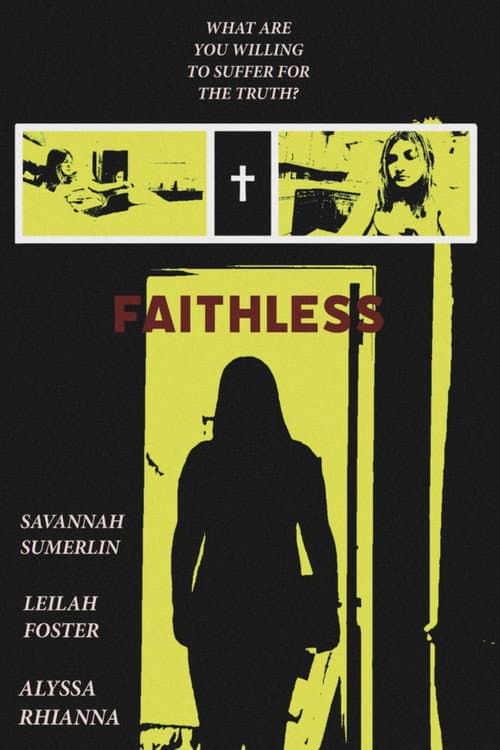
Faithless, the 2026 psychological thriller, drops you into the aftermath of loss without preamble. There's no establishing act where you get to know Savannah before things fall apart — she's already broken when the film begins. What follows is a 60-minute portrait of how grief doesn't just hurt; it warps what the mind is willing to accept as real. The official tagline, "Grief changes what the mind accepts as truth," isn't marketing shorthand. It's the film's entire operating system. Savannah's relationship to faith — religious, personal, and perceptual — becomes the lens through which her psychological unraveling is filtered, and the film refuses to tell you whether what she's experiencing is spiritually genuine or catastrophically self-generated.
How Faithless came together as a streaming-native production
Faithless was built from the ground up as a streaming-native production — no theatrical run, no wide release strategy, no awards-season rollout. That choice shapes everything about how it's constructed. At 60 minutes, it sits in an awkward commercial category (too long for a short film, too brief for a standard feature), but streaming platforms have increasingly made room for this kind of mid-length work, and Faithless commits to the format rather than padding itself out to hit an arbitrary runtime.
The film sits across three genre classifications — thriller, mystery, and drama — which tells you something about the tonal balancing act it's attempting. Pure thriller would demand momentum and payoff. Pure drama would invite you to sit with Savannah's grief at a slower pace. The mystery element is what holds the tension: you're never entirely sure whether you're watching a woman in spiritual crisis or a woman experiencing a psychological break, and the film isn't interested in resolving that cleanly.
Production details are still filtering through. Formal MPAA ratings are pending confirmation in some territories, and with an IMDb rating currently in early accumulation — listed at 0/10, which reflects the absence of sufficient votes rather than any critical consensus — it's genuinely hard to cite aggregate scores with confidence. What Movie OTT editorial tracked early on was the film's positioning within a growing wave of short-form psychological thrillers designed specifically for single-sitting streaming consumption, a format that rewards tight scripting over spectacle.
Why Faithless works — the craft behind Savannah's controlled collapse
Honestly, what's striking about Faithless is how much psychological texture it packs into an hour without ever feeling rushed or, conversely, like it's stalling. The restraint is the craft. No sprawling set pieces, no third-act action pivot, no moment where Savannah suddenly gets competent and fights back. Just a woman and the increasingly unreliable architecture of her own mind.
The religious dimension isn't window-dressing — it's structural. Faith becomes the specific filter through which Savannah's breakdown runs, and that matters because it opens questions about truth and perception that a purely secular psychological thriller can't access the same way. I keep coming back to one particular sequence where Savannah confronts something that might be a memory or might be a hallucination of an event she never actually witnessed. It lands hard precisely because the film hasn't spent 40 minutes making you comfortable with her perspective. You don't fully trust your read on her yet. The film knows that and uses it.
The tension in any psychological thriller lives or dies on whether you trust the protagonist as a point-of-view character — too stable and there's no dread, too fractured from the start and you stop caring what happens to her. Faithless threads that needle by keeping Savannah's grief legible even as her perception warps. You understand why she's reaching for meaning in the chaos (and that's what makes the distortion frightening rather than just disorienting). Hard to say if it lands perfectly for every viewer, but the ambiguity reads as intentional rather than a script problem that got left unfixed.
Movie OTT flagged this title early as one that rewards attentive, single-sitting viewing rather than background-on-the-couch streaming — the kind of film where half-attention means you'll miss the moment the ground shifts.
Where to stream Faithless online right now
Faithless is currently available on major OTT streaming services — check the Where-to-Watch widget at the top of this page for a live, up-to-date list of every platform currently carrying it. Streaming rights shift more frequently than most viewers realize, and a title that's on one service this month may move or expire without much notice.
If you're juggling multiple subscriptions and can't keep track of what's where, movieott.com tracks availability across services and updates listings when titles move. The practical upside of Faithless being 60 minutes is real: this is a genuine weeknight watch. You don't need to carve out a two-hour block or save it for the weekend. Start it after dinner. It'll be done before you've talked yourself out of it.
Frequently asked questions
Q: Where can I watch Faithless (2026)?
Faithless is available on major streaming platforms — the Where-to-Watch widget at the top of this page shows every service currently carrying it. Movie OTT updates availability listings regularly, so it's worth checking there if you're not sure which of your current subscriptions has it.
Q: How long is Faithless — is the 60-minute runtime accurate?
Yes, 60 minutes is the confirmed runtime. The brevity is deliberate — the film was designed as a compact, single-sitting experience, and the tight runtime is part of how it maintains psychological pressure without releasing the tension through subplots or pacing breaks.
Q: Is Faithless (2026) based on a true story?
No. Faithless is an original psychological thriller. The central character, Savannah, and her experience of grief-induced perceptual distortion are fictional, though the film draws on recognizable psychological and religious themes to ground the story in something that feels emotionally true.
Q: What are the main themes in Faithless?
The film works across three thematic registers: religious faith, psychological breakdown, and the unreliability of grief-altered memory. The tagline — "Grief changes what the mind accepts as truth" — captures all three. None of these themes is treated as background; they're load-bearing elements of the plot.
Q: Is Faithless suitable for all audiences?
Faithless is a psychological thriller with sustained themes of grief, religious doubt, and mental distortion. Formal content ratings are still being confirmed in some territories. Check your streaming platform's listed rating before watching, particularly if you're considering it for younger viewers.
Who should watch Faithless — and who probably shouldn't
Faithless isn't built for viewers who want clean resolution. It's a film for people who find ambiguity satisfying — who don't mind sitting with a question after the credits roll rather than having it answered for them. If you're drawn to psychological thrillers that treat faith as a genuine narrative force rather than set dressing, and you can commit to 60 minutes of focused attention, this is worth your time. If you're looking for a thriller with a propulsive plot and a satisfying twist, it may test your patience. Grief doesn't announce itself with a three-act structure. Sometimes it just arrives.