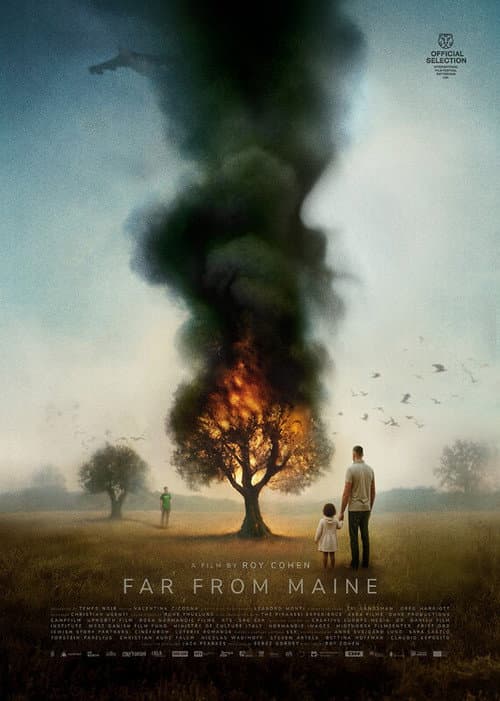
Far from Maine
A 95-minute documentary built as a letter to a dead friend — and a reckoning with what Israel has become.
Roy Cohen didn't set out to make a film about genocide. He set out to write a letter to someone who'd been dead for 26 years.
In October 2000, Cohen and Aseel Asleh were both seventeen. They'd met at Seeds of Peace, a conflict-resolution camp in Maine, where Israeli and Palestinian teenagers spent a summer learning to see each other as human. Asleh was a Palestinian peace activist. Cohen was a queer Arab-Jewish Israeli filmmaker in the making. They became friends. Then Israeli police shot Asleh during the early days of the Second Intifada, and that friendship ended the way too many do in that part of the world — with a body, and no conversation to follow.
Twenty-six years later, Cohen made Far from Maine (2026), a documentary that speaks directly to Asleh across the gap. It's not a traditional film about the conflict. It's something stranger and more intimate — an essay in grief, a dialogue with someone who can't respond, an attempt to recover moral clarity from a friend whose teenage letters still exist.
The film premiered at International Film Festival Rotterdam in 2026 and screened at Atlanta Film Festival 2026. It's produced by Temps Noir with support from France, Italy, Switzerland, Hungary, Denmark, and Norway — a funding geography that tells you something about where filmmakers can still make work this uncompromising. The runtime is 95 minutes. There's no narrator. Just Cohen, Asleh's letters read aloud, archival footage, and the shape of a friendship interrupted by history.
What Actually Happens in the Film
Here's what I kept thinking about while watching: Cohen doesn't explain the conflict to you. He doesn't position himself as a guide. He positions himself as someone lost inside it — someone reaching backward to ask a dead friend how he stayed so clear.
The film weaves three threads together. First, Asleh's own letters, written as a teenager at Seeds of Peace. You see the handwriting on screen. The voice-over reads them. There's something unbearable about watching a seventeen-year-old's earnest words about peace while knowing what's coming. Second, archival material — footage from the Seeds of Peace camp, news clips from 2000, images of the landscape both of them grew up in. Third, Cohen in the present day, navigating what he describes as a "growingly genocidal society" — confronting memory, friendship, and the question of what it means to live inside a country you can't leave and can't accept.
The tagline sums up the film's temporal reach: "Nothing started on October 7th, but everything has changed." Cohen isn't making a film about one catastrophe. He's making a film about the long, slow accumulation of ruptures that precede one.
Modern Times Review praised the film's emotional rawness — its refusal to offer easy political comfort. InSession Film called it a love letter to a friendship. Eye for Film noted that Cohen's inward-turning approach can test patience. That's fair. There are stretches where the film circles rather than arrives. But the restraint feels intentional, not limited. Cohen doesn't aestheticize violence. He stays close. Ninety-five minutes. No wasted motion.
Where to Watch — and When
Far from Maine is still rolling out beyond the festival circuit, which means availability varies by territory and platform. The film had its world premiere at Rotterdam, one of Europe's leading festivals for documentary and art-house work — the kind of placement that signals prestige but doesn't guarantee immediate streaming access.
Check the where-to-watch widget at the top of this page for current listings across major OTT services in your region. Movie OTT aggregates streaming availability across platforms and updates listings weekly as distribution deals get confirmed — it's the fastest way to catch the moment the film lands on your preferred service. European co-production structures like this one often mean staggered rollouts across territories, so if it's not live where you are yet, checking back through Movie OTT is worth doing.
MUBI had the film highlighted ahead of its festival run, though general streaming availability there remained pending as of the Rotterdam premiere. Hard to say if a wide VOD release is weeks or months away. Festival documentaries with this profile can move quickly once a distributor commits — or they can disappear into limited availability for years. Worth tracking.
Why This Matters (and Who Should Watch)
Look — this film isn't for everyone. It's too interior. Too slow. Too unwilling to give you the distance that most political documentaries quietly offer. If you want answers about the Israeli-Palestinian conflict, you won't find them here. If you want someone to explain what went wrong and when, this isn't that film.
But if you're interested in how a filmmaker processes grief and complicity in real time? If you care about what happens to conscience inside a system you can't escape? If you've ever wondered what a film looks like when someone stops pretending to be objective and just mourns instead? Then this is worth seeking out.
The closest comparison might be something like The Walrus and the Carpenter (Sophia Tabak, 2023) — a personal documentary that refuses to separate the filmmaker's interior world from the political landscape they're documenting. Or Avi Mograbi's work, which sits at the same intersection of intimate and urgent. But honestly, there's not much like Far from Maine right now.
One specific moment: Cohen reads from Asleh's teenage letters while the camera holds on the handwritten pages. You hear both voices — the seventeen-year-old and the adult reading him. The effect is close to unbearable. Not performed grief. The real thing.
Key Details
- Released: 2026
- Genre: Documentary
- Runtime: 95 minutes (some festival cuts list 1 hour 39 minutes)
- Director/Writer: Roy Cohen
- Production: Temps Noir (France, Italy, Switzerland, Hungary, Denmark, Norway co-production)
- World Premiere: International Film Festival Rotterdam, 2026
- Other Festival Screenings: Atlanta Film Festival 2026
- Where to Stream: Check Movie OTT's where-to-watch tracker for current platform listings and availability in your region
Frequently Asked Questions
Q: Who is Roy Cohen?
Cohen is an Israeli filmmaker who identifies as queer and Arab-Jewish. He's the writer, director, and central subject of Far from Maine — the film's entire perspective flows through his voice and his editorial choices.
Q: Is this based on a true story?
Yes. Cohen and Aseel Asleh met as teenagers at Seeds of Peace in Maine. Asleh was killed by Israeli police in October 2000 during the Second Intifada. The film incorporates Asleh's actual teenage letters.
Q: Do I need to know about the Israeli-Palestinian conflict to understand this?
Not in the way you might think. The film isn't an explainer. It's personal testimony. If you understand that two friends were separated by violence, you understand enough to watch it.
Q: How is this different from other documentaries about Israel/Palestine?
Most documentaries on this conflict try to be objective. They position the filmmaker as a guide. Cohen does the opposite — he's a participant in the history he's excavating, and he's not pretending otherwise. It's more essay than journalism.
Q: Will this be on Netflix or other major platforms?
Not yet. It's still in its festival-to-streaming window. Movie OTT tracks these transitions in real time, so that's the best place to watch for a release announcement.
What to Do Next
If Far from Maine sounds like something you want to see, don't wait for it to land on your usual platform. Add it to your watchlist now. Festival documentaries like this one can vanish into limited availability if you're not paying attention — or they can pop up suddenly on a service you already have. The only way to know is to check.
Movie OTT's where-to-watch tool will alert you the moment it becomes available. Set a reminder. This is the kind of film that stays with you — not because it answers questions, but because it asks the ones that matter.