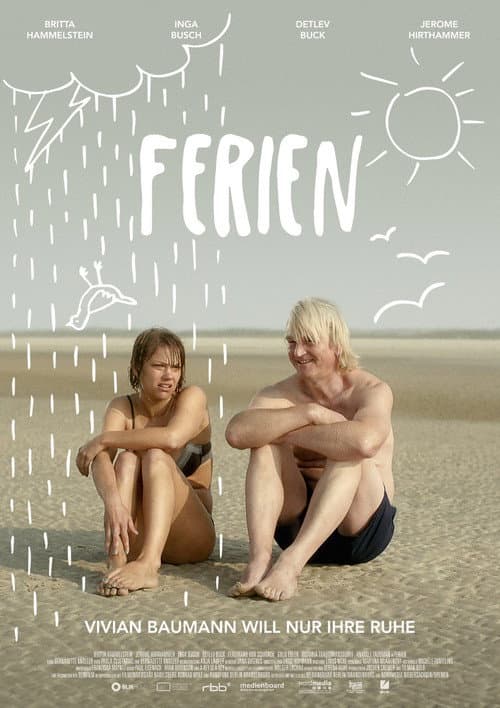
The story of Ferien: Stuck between ambition and exhaustion
Ferien follows Vivi, a woman teetering on the edge of what's supposed to be her adult life. She's about to become an attorney. She's moving in with her boyfriend Adam. Everything looks right from the outside—the kind of life you're supposed to want. And yet she's paralyzed. Not by fear exactly, but by a kind of creeping dissatisfaction that she can't quite name. When she tries to retreat to her mother's place for a breather, she discovers there's no room for her there either. Literally. Her father, sensing that his daughter needs more than a couch and some sympathy, makes a decision: Vivi's going to an island. A proper vacation. A real break from the life that's suffocating her even as it promises everything she thought she wanted.
What starts as a reluctant getaway becomes something else entirely. The island isn't a fairy-tale escape—it's a space where Vivi has to sit with herself, away from the scripts she's been following and the people whose expectations have shaped her choices. This is where the film's real story begins, and it's far messier and more honest than a typical "finding yourself" narrative.
Behind the making of Ferien: German indie cinema and emerging talent
Ferien is a product of serious filmmaking infrastructure. The film was produced by Blikfilm in collaboration with Filmuniversität Babelsberg KONRAD WOLF, Germany's most prestigious film school, and RBB, a major German public broadcaster. This combination of independent production, educational partnership, and public broadcasting support is typical of how European cinema nurtures new voices—and it shows in the film's sensibility.
The 89-minute runtime is deliberately lean. There's no fat here, no scenes that exist just to pad the story. That's a choice that reflects both budget constraints and artistic intention. Released in 2016, Ferien arrived during a period when German cinema was experiencing a quiet renaissance of character-driven, psychologically nuanced films that didn't rely on spectacle or formula. The film holds a 5.8 rating on IMDb, which tells you something important: it's not trying to please everyone, and it doesn't. It's a film that works for people who want something real, something that sits with discomfort rather than resolving it neatly.
The collaboration between industry professionals and film students at Babelsberg speaks to a filmmaking philosophy that values mentorship and experimentation. This wasn't a film designed by committee or focus-grouped into blandness. It's the kind of project that emerges when you give filmmakers room to explore what actually interests them about human behavior and choice.
What makes Ferien stand out: Performance and the unresolved life
Here's what's striking about Ferien: it refuses to pretend that taking a vacation solves anything. Most films in this genre—the "woman finds herself" story—end with a revelation, a decision, a neat emotional arc. Vivi's journey doesn't work that way. She arrives on the island exhausted and stuck. She leaves... well, that's the question, isn't it? The film won't tell you whether she's "fixed" herself or found clarity or any of the other things we expect from this narrative.
What the film does offer is a portrait of someone genuinely trying to understand why the life she built doesn't fit. That's harder to pull off than it sounds. It requires a performance that doesn't lean on likability or charm—and the cast delivers exactly that. There's no moment where Vivi suddenly becomes the person everyone wants her to be. Instead, she sits with her own contradictions: ambitious but burned out, committed but resentful, adult but still searching for permission to be something other than what's expected.
The comedy in Ferien isn't built on jokes—it's built on the absurdity of being human, on the gap between what we're supposed to want and what we actually want, on the uncomfortable moments when that gap becomes impossible to ignore. I keep coming back to how the film treats her boyfriend Adam. He's not a villain. He's not even particularly wrong about anything. He's just... not the answer. And that's messier and more true to life than any dramatic betrayal could be. The film trusts you to sit with that ambiguity.
Where to stream Ferien online
Ferien is available on major OTT streaming services, and Movie OTT tracks current availability across platforms in real time. Depending on your region and subscription services, you'll find it listed in our "Where to Watch" widget at the top of this page. The film works best on a platform where you can give it your full attention—it's not background viewing. The dialogue is naturalistic, sometimes quiet, and the emotional weight builds in small moments rather than explosive scenes. If you're browsing through your streaming options on Movie OTT and you see Ferien pop up, it's worth stopping to watch rather than scrolling past.
Frequently asked questions
Q: Is Ferien based on a true story?
Not directly, but it feels true to life in the way that good fiction often does. The film captures something real about the experience of burnout and the pressure to follow a predetermined path, even when that path is falling apart.
Q: Who directed Ferien?
The film emerged from Filmuniversität Babelsberg KONRAD WOLF, Germany's leading film school, as a collaboration between independent producers and emerging filmmakers. It represents the kind of auteur-driven work that comes from that institution.
Q: What's the runtime of Ferien?
The film runs 89 minutes—a tight, focused runtime that serves the story without unnecessary padding.
Q: Is Ferien a comedy or a drama?
It's both, though not in the way that phrase usually means. There are genuinely funny moments, but they come from character and situation rather than from jokes. The drama is grounded and psychological rather than melodramatic.
Q: Will Ferien give me the ending I want?
Probably not. The film ends with ambiguity, with Vivi still figuring things out. That's the point. Life doesn't resolve neatly, and neither does this film.
Final thoughts on Ferien
Ferien isn't a feel-good movie, and it doesn't pretend to be. What it is: honest, funny in an uncomfortable way, and genuinely interested in how we get stuck and what it takes to unstick ourselves. It won't give you answers. It might give you something better—a mirror held up to your own unresolved contradictions. If you're looking for escapism, look elsewhere. If you want a film that trusts you to sit with complexity and doesn't tie everything up with a bow, Ferien's waiting for you.