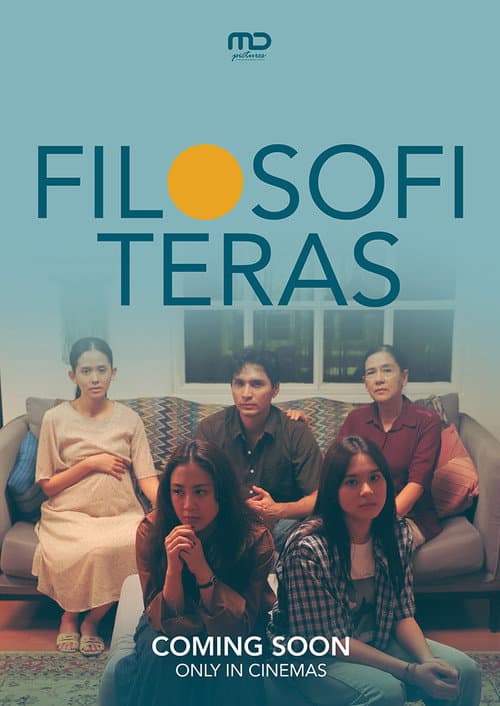
Filosofi Teras
The Setup: A Woman Carrying Everyone Else's Debt
Since her father died, Nea's become the person holding her entire family together. She pays the household bills. She covers her mother Ratih's medical needs. She's funding her younger sister Runi's college tuition and allowance. Meanwhile, her older brother Abi—the one with a wife and a job—stays financially dependent on his spouse, Ayu. Nea's planning to move forward. She's ready to commit to her boyfriend Dio, to build something that's actually hers.
Then the house gets pulled out from under her.
Her late father pawned their home to pay for Abi and Ayu's wedding. Nea finds out too late. The dreams she was finally allowing herself to have—marriage, a life with Dio, forward momentum—get buried. She chooses to endure. For her family. Because that's what she's always done.
Filosofi Teras (2026) translates that Stoic philosophy book into domestic drama. The source material became a phenomenon in Indonesia by teaching people who don't read philosophy how to survive burnout, family obligation, and financial pressure. The film takes that intellectual framework and turns it into something much more brutal: a woman watching her own future get sacrificed for a brother who doesn't even realize the cost.
Why the Book's Fanbase Matters More Than You'd Think
Henry Manampiring's Filosofi Teras wasn't positioned as heavy reading. It was accessible. Personal. Indonesian readers who'd never touched a philosophy book before—people working two jobs, people sending money home, people exhausted by family expectations—they connected with it. Hard to overstate how rare that is for non-fiction philosophy in a mass market.
The film's got a built-in audience that most Indonesian productions don't get to start with. These aren't cinephiles waiting for the next prestige drama. These are people who've read the book and know exactly what it meant to them. That's worth tracking if you're curious about what Indonesian cinema's audience actually wants right now (spoiler: stories about people who sacrifice too much, told without judgment).
Movie OTT will have release updates the moment they land, but the real momentum here is coming from readers who've already bought in.
What Makes This Story Work (When It Easily Wouldn't)
The premise could collapse into melodrama so fast. A villain-driven story about Abi being selfish, about Ayu being ungrateful, about the father being irresponsible—that's easy. Sentimental. Safe.
Instead, what's striking is how nobody's actually the bad guy here. Abi's not evil. He's just... passive. The kind of person who inherited privilege and never questioned it. Ayu made a reasonable choice marrying someone with family money. The father made a decision under pressure that outlived him. Nea's the only one paying interest on a debt she didn't create—that's the actual anatomy of the story. Circumstance plus quiet neglect equals catastrophe.
That moral ambiguity, where the real antagonist is how families fail to see each other clearly, tends to land harder than anything more theatrical.
Production Details: MD Pictures, 2026, No Exact Date Yet
Release year: 2026 (theatrical, Indonesia only)
Specific release date: Not confirmed
Production company: MD Pictures
Source material: Henry Manampiring's non-fiction book Filosofi Teras
Where to watch: Not yet announced
MD Pictures has a track record with emotionally driven Indonesian dramas—they know how to build tension in quiet moments, which is exactly what this story needs. The cast has been visually revealed on their official channels, though individual actor names haven't circulated widely in English-language sources yet. Marketing seems deliberately slow-burn, which makes sense for a film this character-dependent.
Streaming rights haven't been announced. When they are, Movie OTT's where-to-watch tracker will have the breakdown—which platforms, which regions, whether it'll hit cinemas first or day-and-date release.
The Terrace as Philosophy
The title's not just borrowed from the book. In the teaser materials, the "teras" (terrace) works as an actual physical space—a threshold where you set down what the outside world has piled on you before stepping back inside. It's a small, specific image doing a lot of philosophical work. Stoicism isn't about happiness. It's about how you carry what can't be changed. The terrace is where that happens.
I keep thinking about how rarely films actually visualize philosophy instead of just quoting it. This one seems to be trying.
When You'll Actually Be Able to Watch
Filosofi Teras doesn't have a confirmed release date yet—just a 2026 window. Promotional materials from MD Pictures and theater exhibitors point to sometime that year, but nothing more specific has been locked in. The film's not streaming anywhere. It's not available for purchase. If you're waiting for this one, bookmark this page and check back—or use Movie OTT to get notified the moment a date drops and platforms are announced.
Streaming availability will be announced separately once theatrical distribution is finalized. No platform has claimed it yet.
FAQ
When does Filosofi Teras come out?
2026, but no specific month or day yet. Indonesian cinemas only.
Is it out now?
No. As of now it hasn't released.
Where can I watch it?
Nowhere yet. Cinema-only is the current plan. Streaming information will be posted here as soon as it's confirmed.
Is it based on something?
Yes—Henry Manampiring's bestselling book about Stoic philosophy. If you've read it, you know what this story means. If you haven't, the film will work fine on its own.
Who made it?
MD Pictures produced it. Cast confirmations are coming.
What to Watch For
A story about a woman who keeps choosing her family even after they've already cost her everything. That's the film. Whether it earns its Stoic title or simply borrows the philosophy is what'll matter when it lands—but the premise is strong enough to make the wait worthwhile.
Bookmark this page. Check back in 2025 for a confirmed release date and cast details. When it hits Indonesian cinemas next year, that's the watch.