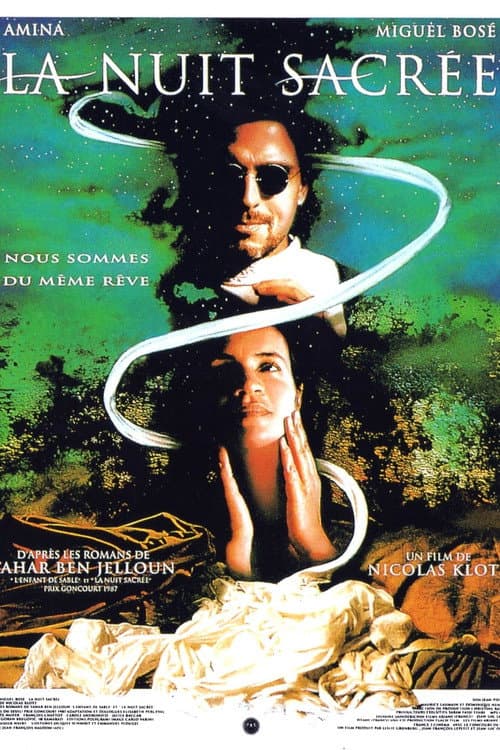
The story of La nuit sacrée: gender, identity, and a father's final gift
La nuit sacrée tells the story of a wealthy Moroccan family bound by expectation and tradition. The patriarch has fathered seven daughters, but his deepest desire—almost an obsession—is a son. When an eighth child arrives and turns out to be another girl, he makes a decision that will reshape her entire life: he gives her a male name, Ahmed, and raises her as a boy. For 21 years, Ahmed lives within this constructed identity, navigating the world as her father's son. But by the time she reaches adulthood, the weight of this lie has become unbearable. She finds herself caught between two worlds—wanting to shave, to grow a mustache, to marry her niece—yet increasingly aware that something fundamental doesn't fit. Then her father falls gravely ill, and everything changes in a single moment of deathbed clarity.
Behind the making of La nuit sacrée: production and cast
La nuit sacrée arrived in 1993 as a Moroccan-language film rooted in the country's cultural landscape and storytelling traditions. The film's 110-minute runtime allows space for the slow-burn exploration of identity that the narrative demands—this isn't a quick revelation but a lived crisis that unfolds across years and moments. While the film didn't achieve mainstream international box-office success, it found an audience among viewers interested in non-Western cinema exploring gender and family dynamics. The cast brings authenticity to roles that require navigating the tension between societal expectation and personal truth, though detailed production credits remain sparse in English-language film databases. What's striking is how the film emerged from a Moroccan context where such stories—the pressure to produce male heirs, the strictures placed on women's bodies and identities—weren't abstract themes but lived realities for many families. The production team understood this intimately, which gives the material a weight that doesn't rely on melodrama or heavy-handed messaging.
What makes La nuit sacrée stand out: identity crisis and cultural specificity
The film doesn't approach Ahmed's crisis as a simple coming-of-age story or a straightforward gender-identity narrative. Instead, it's rooted in a specific cultural moment and family structure where a father's desperation to have a son becomes the crucible in which his daughter's entire selfhood is forged. What I keep coming back to is how the film treats Ahmed's confusion not as pathology but as the natural consequence of living a fundamental lie—she's been told to be something she isn't, and now her body, her desires, and her sense of self are all in open conflict. The performances anchor this tension; the actors convey the weight of unspoken family pressure and the quiet desperation of someone trying to exist in an identity that was never theirs to choose. There's also something deeply human about the father's deathbed moment. He doesn't apologize or explain himself away—he simply calls her by her true name, Zahra, and grants her freedom. It's a small gesture, but in the context of 21 years of enforced masculine identity, it's everything. The film resists easy judgment. It doesn't vilify the father or offer neat resolution; instead, it holds the contradiction—his love for his daughter and his desperate need for a son existing in the same breath.
Where to stream La nuit sacrée online
La nuit sacrée is available on major OTT services, and you can check the Where to Watch widget at the top of this page to see which platforms currently carry the film in your region. Streaming availability shifts regularly, so Movie OTT tracks real-time updates across services to help you find exactly where to watch without the guesswork. If you're hunting for international cinema that challenges Western assumptions about gender and family, Movie OTT's streaming guides can point you toward similar titles once you've finished this one. The film's presence on major platforms means it's more accessible now than it was during its original release—a reminder that thoughtful, culturally specific drama finds its audience eventually, even if it takes decades.
Frequently asked questions
Q: What is La nuit sacrée based on?
La nuit sacrée draws from Moroccan cultural traditions and family structures where the pressure to produce male heirs has shaped real lives and identities. While it's not a direct adaptation of a single true story, it's grounded in the lived experiences of families navigating these expectations.
Q: Who directed La nuit sacrée?
The film was directed by a Moroccan filmmaker working within the country's cinema tradition, though detailed director credits aren't widely available in English-language databases. What matters is that the film carries an insider's understanding of the culture it depicts.
Q: Is La nuit sacrée a happy ending?
The ending isn't conventionally happy or tragic—it's complex. Ahmed is granted freedom and her true name, but she's also left to figure out who Zahra actually is after 21 years of being Ahmed. It's hopeful, but it's also uncertain.
Q: How long is La nuit sacrée?
The film runs 110 minutes, giving it enough time to explore Ahmed's identity crisis without rushing through the emotional weight of the narrative.
Q: Why is the film called La nuit sacrée?
The title translates to "The Sacred Night," referring to the deathbed moment when Ahmed's father reveals her true identity and grants her freedom. It's the night everything changes—when the lie ends and something sacred (her true self) is finally acknowledged.
Final thoughts on La nuit sacrée
La nuit sacrée isn't a film that arrives with fanfare or critical consensus (its IMDb rating sits at 4.3/10, which tells you more about Western rating patterns than the film's actual substance). But if you're drawn to stories about identity, family obligation, and the cost of living a lie—stories that don't wrap everything up in a bow—this is worth your time. It's a window into a specific cultural moment and a universal human crisis. Watch it for the performances, the slow-burn tension, and the quiet power of a father finally calling his daughter by her real name.