
The story of La viuda celosa
La viuda celosa tells the story of a young widow who's made a vow to herself: no male companionship, no romance, no second chances at love. She's locked herself away—not physically, but emotionally—in deference to the memory of her deceased husband. The film follows her as she navigates the tension between this self-imposed exile and the very human desire for connection that won't quite leave her alone. It's a premise that sounds simple on paper, but the execution reveals layers of guilt, loneliness, and the question of whether honoring the dead means sacrificing the living.
The narrative unfolds as a melodrama, a genre that thrived in 1940s cinema and knew exactly how to wring emotion from moral dilemmas. What makes this particular story compelling isn't just the premise—it's the psychological weight the protagonist carries. She's not a passive character waiting to be rescued. She's actively choosing her prison, even as part of her rebels against it. The film doesn't shy away from showing how that choice isolates her, how it warps her relationships with those around her, and how it tests everyone's patience, including her own.
Production, cast and box office of La viuda celosa
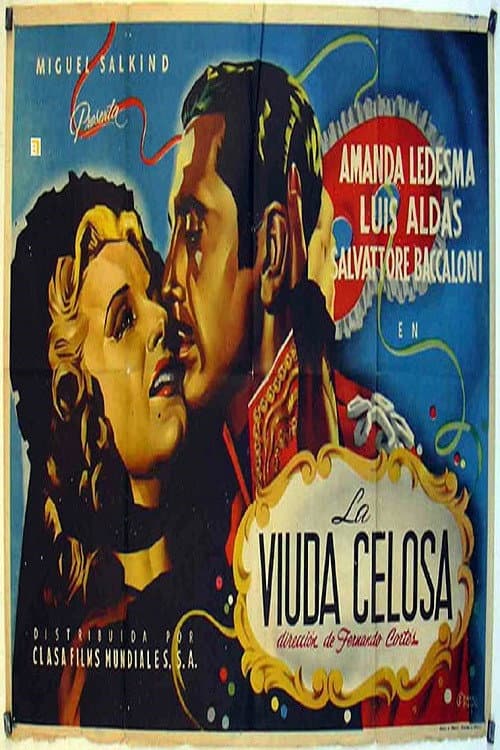
La viuda celosa emerged from the Spanish-language film industry in 1946, a period when Latin American and Spanish cinema were producing significant melodramas that rivaled their Hollywood counterparts in emotional intensity if not always in budget. The 82-minute runtime is lean and efficient—no wasted scenes, just straight dramatic tension. The film was crafted during an era when the melodrama form was still considered a legitimate, even prestigious vehicle for exploring moral and emotional complexity, before the genre would later be dismissed by some critics as overwrought.
While detailed production records for this particular film are sparse, the 1946 release date places it squarely in the post-war era when cinema across the Spanish-speaking world was grappling with themes of loss, duty, and reconstruction. The cast would have been drawn from the robust theatrical and film communities of Spain or Latin America—actors trained in the heightened emotional vocabulary that melodrama demands. Box office performance data isn't widely documented for films of this era and region, but the film's survival and continued availability on streaming platforms suggests it found an audience and retained cultural resonance across decades.
Cinematically, La viuda celosa represents the kind of intimate, character-driven drama that doesn't require massive budgets to succeed. The focus is on performance, dialogue, and the slow burn of psychological conflict rather than spectacle. That approach—putting everything on the actors and the script—was standard practice for mid-century Spanish-language cinema, and it's one reason these films often feel so immediate and raw even now.
What makes La viuda celosa stand out in 1940s melodrama
What's striking about La viuda celosa—and what likely accounts for its continued availability on streaming platforms—is how it refuses easy answers. The widow isn't presented as either a saint or a fool. She's a woman caught between two kinds of loyalty: to the dead and to herself. That tension doesn't resolve neatly, and the film doesn't pretend it does. I keep coming back to that restraint. So many melodramas of the era wanted to punish their female characters for transgression or reward them for suffering. This one seems more interested in just... watching what happens when someone tries to live a life that's fundamentally at odds with human nature.
The performances, whatever their specific names and credits, would have needed to carry that contradiction. A widow who's stern and self-righteous one moment, vulnerable and desperate the next. The film doesn't judge her harshly for either state—it understands both. That empathy is harder to pull off than it sounds, especially in a genre that could easily tip into melodrama's worst impulses: oversimplification, heavy-handed symbolism, characters who exist only to make a moral point.
Thematically, La viuda celosa speaks to something that's never gone out of style: the question of what we owe to the dead versus what we owe to ourselves. In 1946, that question carried particular weight in a world still reeling from global conflict and massive loss. The film asks whether perpetual mourning is a form of love or a form of punishment. Can you honor someone's memory by denying yourself? Or does that denial become its own kind of betrayal—a refusal to live fully, which might be what the dead would have wanted? These aren't answered questions. They're lived questions, and the film trusts its audience to sit with that discomfort.
The IMDb rating of 5.4 out of 10 suggests the film is divisive—some viewers connect with its emotional authenticity, while others find it slow or overwrought. That split isn't surprising. Melodrama is a genre that either grabs you or doesn't, and films this focused on internal emotional states can feel static to viewers looking for plot momentum. But that "slowness" is often just the film taking its time to let you understand what's really at stake.
Where to stream La viuda celosa online
La viuda celosa is currently available on major OTT services, making it accessible to anyone with a streaming subscription. If you're hunting for it, check the Where to Watch widget at the top of this page—it'll show you exactly which platforms have it right now, since availability shifts regularly. Movie OTT tracks current streaming availability across the major services, so you can find where to watch La viuda celosa without having to check five different apps.
One of the advantages of older films like this one is that they often pop up on multiple platforms, especially those with deep libraries of international and classic cinema. If you don't see it on your primary service, it's worth checking a second or third option. The 82-minute runtime also makes it easy to fit into an evening—no massive time commitment required.
Frequently asked questions
Q: What year was La viuda celosa released?
La viuda celosa came out in 1946, placing it in the golden age of Spanish-language melodrama. That era produced some of the most emotionally intense films of the decade.
Q: How long is La viuda celosa?
The film runs 82 minutes, a lean runtime that keeps the emotional tension tight without unnecessary padding. It's efficient storytelling.
Q: What's the basic plot of La viuda celosa?
The film follows a young widow who has forbidden herself male companionship and romance out of loyalty to her deceased husband. The story explores the conflict between her vow and her very human need for connection and happiness.
Q: Where can I watch La viuda celosa?
La viuda celosa is available on major OTT streaming platforms. Use the Where to Watch widget on this page to see which services currently have it in your region.
Q: Is La viuda celosa based on a true story?
There's no evidence that La viuda celosa is based on a specific true story. It's an original melodrama exploring universal themes of grief, duty, and desire that resonate across cultures and time periods.
Final thoughts on La viuda celosa
La viuda celosa isn't for everyone. If you want plot twists and constant forward momentum, you'll probably find it frustrating. But if you're drawn to character studies—films that care about the internal lives of their protagonists and aren't afraid to sit with emotional complexity—it's worth your time. The film trusts you to understand that sometimes the real drama isn't what happens, but what someone refuses to let happen. That's a kind of restraint that feels almost foreign in modern cinema. Seventy-plus years later, it still has something to say about love, loss, and the choices we make in their names.