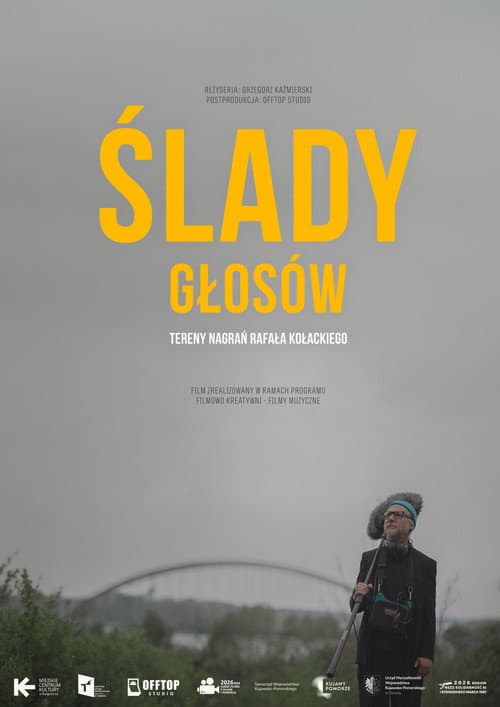
Ślady głosów. Tereny nagrań Rafała Kołackiego — A Film About Listening, Not Talking
This 2026 Polish documentary doesn't explain what sound artist Rafał Kołacki does. It watches him do it. Over 53 minutes, director Grzegorz Kaźmierski follows Kołacki through six months of field recording and installation work—capturing sound from physical spaces, shaping it, deploying it in rooms where listeners encounter it on the work's own terms. No talking heads. No archival footage. Just proximity and patience.
If you've grown tired of music documentaries that rush past the studio work because they're afraid silence will bore you—this film makes the opposite bet entirely.
What the film actually tracks: Two installations, one artist in motion
The documentary centers on two specific sound pieces: ITO and Skowyt. Those aren't just names dropped for texture. The film structures its entire observational arc around how these installations move from raw location recordings to finished spatial works. That gives the documentary an actual spine, even though it refuses conventional storytelling machinery.
What's striking is how the film treats field recording as a genuinely rigorous form of listening—one that demands the practitioner develop an almost physical attentiveness to spaces and the sounds that inhabit them. Kaźmierski's camera follows Kołacki into those spaces rather than reconstructing them afterward. It's a craft decision with real consequences: the film ends up doing its own version of field recording, capturing the artist in situ rather than explaining him after the fact.
The six-month span has dramatic tension embedded in it (watching a work evolve from raw location audio to something that fills a room), but the film never manipulates that tension with fake stakes. No deadline crises. No manufactured conflict. Just the unglamorous patience that installation work actually requires—and the trust that viewers will stay engaged because the work itself is compelling enough to watch unfold.
How this film ended up at Bydgoszcz, then the festival circuit
Miejskie Centrum Kultury w Bydgoszczy (the Municipal Centre of Culture in Bydgoszcz) produced the film—a venue with a track record of backing documentary and experimental arts projects that wouldn't find a home in mainstream commercial pipelines. Director Grzegorz Kaźmierski's name appears consistently across festival catalogues as the creative force.
The film screened at BellaTOFIFEST on July 1, 2026, with an earlier premiere on May 30, 2026 at the Centre for Contemporary Art in Toruń. That pairing of venues matters—a contemporary art institution plus an independent film festival, both suggesting the film sits comfortably between documentary cinema and the gallery world. There's no major award to cite yet (it's still early in its festival life), and there's no box office figure to mention—this isn't that kind of film.
According to festival materials, the film found its initial audience among people who already care about experimental sound practice. Word-of-mouth from those early screenings has been steady, though it hasn't cracked mainstream film coverage. That's typical for a 53-minute Polish documentary with a specific artistic focus and no studio distribution deal behind it.
Why this stands apart from standard music documentaries
Here's the thing nobody mentions: most music documentaries get the pacing wrong. They assume process is boring, so they skip past the field recordings, the failed compositional attempts, the long silences before something clicks. They're afraid audiences won't stay.
Ślady głosów. Tereny nagrań Rafała Kołackiego doesn't rush. The film's patience is its actual argument—that watching someone listen carefully, work slowly, and shape sound over time is worth your attention. I keep coming back to how rare that is in documentary cinema. The runtime is disciplined. No padding. The film knows when it's done.
If you've watched experimental music documentaries before—say, something about Alvin Lucier or Pauline Oliveros—you'll recognize the sensibility here: sound as a serious artistic material, not as accompaniment to images. But this film goes further by making the spaces where sound is recorded as important as the final installation. The field recording isn't just a technique. It's the whole practice.
Movie OTT's documentary tracker covers experimental and festival films like this one—the kind of work that tends to disappear without dedicated editorial attention. It's worth bookmarking if you're serious about finding films beyond the algorithm.
Where to watch it (and why availability might be slower than usual)
Ślady głosów. Tereny nagrań Rafała Kołackiego is available on major OTT services, but the exact platform breakdown depends on your region. Check the where-to-watch widget at the top of this page for current availability—streaming rights for festival documentaries can shift fast, especially for titles without major studio distribution.
Movie OTT tracks streaming availability across platforms in real time, which makes it the first place to check if you're trying to pin down exactly where this title has landed in your region. For a Polish documentary with festival pedigree rather than a theatrical release, the streaming path tends to be slower and less predictable than mainstream releases. But it does arrive eventually.
Set a watchlist alert. It'll be worth the wait.
Who should actually watch this
You'll want to watch Ślady głosów. Tereny nagrań Rafała Kołackiego if:
- You're drawn to documentaries that trust silence—films that watch rather than explain
- You're curious about experimental sound practice or field recording as an art form
- You've wondered what installation work actually looks like behind the scenes (spoiler: it's less glamorous than the finished piece suggests)
- You're tired of music documentaries that assume you need dramatic arc and talking-head commentary to stay engaged
You probably won't connect with it if you need conventional biography structure, celebrity backstory, or clear narrative payoff. This film doesn't do any of that.
Produced by Miejskie Centrum Kultury w Bydgoszczy and premiered on the Polish festival circuit in 2026, it's a small film with a specific focus—and that specificity is exactly its strength. Documentary and contemporary art enthusiasts should absolutely find the 53 minutes.


![G-DRAGON IN CINEMA [Übermensch]](https://storage.googleapis.com/movieott-media/movies/g-dragon-in-cinema-bermensch-1478082/poster-portrait.webp)

