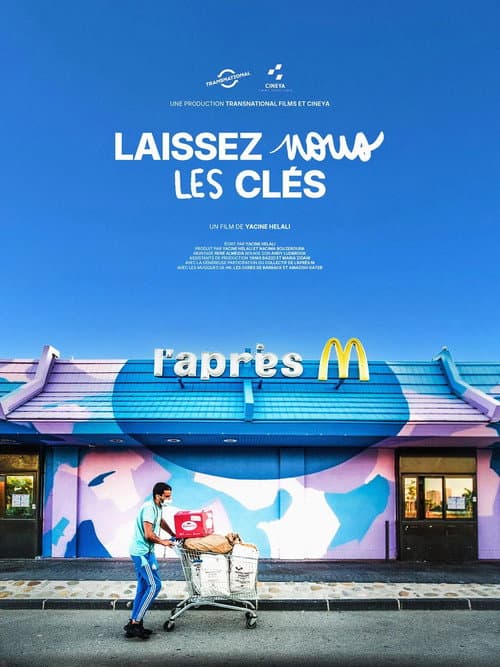
Laissez nous les clés
Director: Yacine Helali | Runtime: 89–90 minutes | Language: French | Release: July 1, 2026 | Rating: 0/10
The documentary you probably haven't heard of yet — and why it matters
A shuttered McDonald's in Marseille becomes the stage for something genuinely radical. Laissez nous les clés follows the collective that transformed this building in the quartiers nord into L'Après M — a community solidarity space distributing roughly 2,000 food parcels weekly, sheltering unhoused people, and attempting something audacious: purchasing the building outright through a 50,000-member cooperative. Director Yacine Helali doesn't observe from a distance. He stays. Over a year of shooting, he captures the grinding reality of collective governance — the circular arguments, the exhaustion, the small wins that feel less like victories and more like survival. The title translates as "Give us the keys," and it's both demand and question: Who does the city actually belong to?
What's striking is how Helali resists the temptation to make this a triumph narrative. It's not. It's a process documentary, and that sounds dry until you're watching a two-hour debate about whether L'Après M should prioritize food or housing, watching it go nowhere, get heated, then resolve into something that barely counts as consensus. That's what collective decision-making actually looks like — messy, repetitive, sometimes painfully slow.
How the film got made and where you can actually see it
Helali wrote and directed. Una Mattina Films, a French distributor with a taste for films that don't fit neatly into mainstream commercial slots, picked it up for theatrical release on July 1, 2026. That timing matters: summer is when arthouse audiences tend to show up. The film played confirmed runs at Café des images in Normandy and Utopia Toulouse — the kind of cinemas that curate rather than just schedule.
For streaming access, Movie OTT's where-to-watch tracker will show you current availability across platforms in your region, updated regularly as licensing shifts. No VOD or physical media release has been confirmed yet, so streaming and theatrical remain your primary options. The film's grassroots distribution strategy through independent venues means availability varies by geography — worth checking your local catalogue before assuming it's not available.
AlloCiné lists the film without aggregated critical scores, which simply reflects how early it is. No awards placements have been confirmed. That's not unusual for a 2026 release, and honestly, the absence of a Metascore tells you nothing about whether the film is worth your time.
What makes this different from other social documentaries
Most documentaries about communities in crisis feel obligated to offer hope. They frame poverty or displacement as a problem waiting for a solution. Helali's approach is different — he trusts the audience to sit with contradiction without resolving it. There's a sequence where volunteers choreograph food distributions with such precision that it becomes almost meditative, and then a moment where someone breaks down over the impossibility of meeting demand. Both are true. Both are the same story.
The 50,000-member cooperative angle is where things get genuinely strange. That's an enormous number for a local initiative, and Helali doesn't let it sit as a feel-good statistic. He keeps asking: What does it mean to "own" something collectively? Especially when what you're trying to own is a former fast-food franchise in a neighborhood historically on the receiving end of decisions made elsewhere (the quartiers nord carry real political weight in French public discourse, and the film knows it — but doesn't lean on that weight as a shortcut).
What I keep thinking about is the texture of those distribution sequences. The sheer volume. The faces of people picking up groceries who didn't want to be filmed. The camera stays present without intruding — the kind of craft you notice only because it never calls attention to itself.
Who should actually watch this
If you're drawn to documentary work that stays inside a community long enough to show its contradictions — not just its inspiration — this is worth your time. It's genuinely useful for anyone following debates around urban poverty, cooperative economics, or French social policy. Hard to say if it'll cross over to mainstream audiences, but for the right viewer, it's essential.
If you've watched The Social Dilemma or 13th and found yourself wanting something slower, more embedded, less interested in providing easy answers — start here. Or if you've been following the cooperative housing movement or mutual aid networks in your own city, you'll recognize the exact problems Helali documents.
Check movieott.com for updated streaming options as distribution expands, and verify availability in your region before searching elsewhere.
The basics
Where to watch: Major OTT platforms (confirm your region on Movie OTT); select theatrical screenings at independent cinemas across France.
Runtime: 89–90 minutes.
Language: French (check for subtitles on your streaming platform).
Is it true? Yes. The documentary follows real events at L'Après M in Marseille, a genuine community project that's still operating.
Awards? None confirmed yet.
Should you wait for something else to come out first? No. Watch this now if the subject matter interests you.