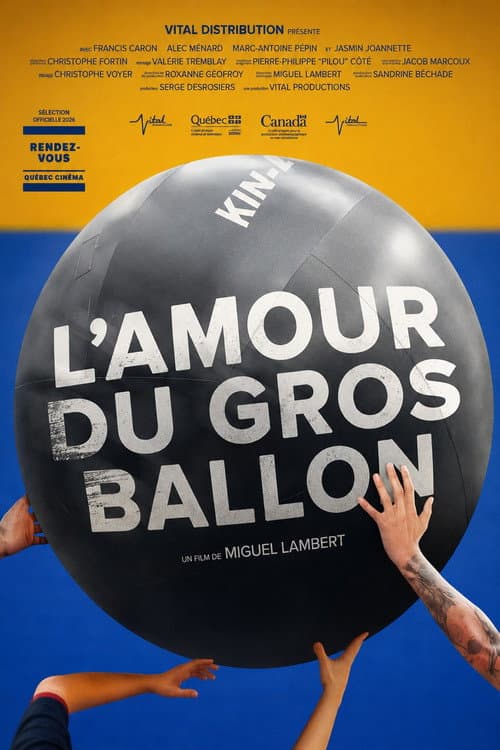
L'amour du gros ballon
Director: Miguel Lambert | Year: 2026 | Runtime: 75 minutes | Genre: Documentary | Where to watch: Quebec theatrical (June 18–19, 2026); streaming availability via Movie OTT
The film nobody expected to care about — and why they should
Here's the thing about sports documentaries: they usually get it backwards. They think the sport matters. Miguel Lambert's L'amour du gros ballon — a 2026 Quebec documentary following Canada's national kin-ball team to South Korea in November 2024 — knows better. The tournament is just the container. What's actually happening on screen is four men, far from home, watching something they love maybe slip away.
Kin-ball, for anyone unfamiliar, is a Canadian-invented sport played with an enormous 1.2-metre inflatable ball. The whole game is built around cooperation — you can't win by dominating. You win by trusting the people beside you. That's the metaphor Lambert doesn't have to explain because he's smart enough to just film it. The four central players — Alec Ménard, Jasmin Joannette, Marc-Antoine Pépin, and Francis Caron — aren't performing for the camera. They're just living inside a moment that might be ending, and somehow that's infinitely more compelling than any dramatic arc a screenwriter could manufacture.
At 75 minutes, the film doesn't overstay its welcome. It's tight. Focused. And it does something that sounds simple but rarely happens: it trusts its subjects enough to let them breathe.
How a Quebec filmmaker made a documentary about friendship that actually works
Miguel Lambert directed and wrote the film through Vital Productions, a Quebec company that's quietly built something real in French-language documentary — not the prestige kind, but the kind that matters to actual people. His approach here is observational without being passive. He's embedded with these athletes in a way that feels earned, not invasive.
What strikes me about the film is its refusal to narrate. There's no voice-over explaining what you're seeing or why it matters. Instead, Lambert holds on moments that most documentarians would cut: two players sitting in what looks like a hotel corridor, saying almost nothing, just existing together. That stillness does more work than any talking-head interview could manage.
The film premiered at Les Rendez-vous Québec Cinéma — the festival that's traditionally been where Quebec's best documentary voices get launched. From there it moved into theaters across the province. Cinémathèque québécoise screened it on April 26, 2026; Cinéma Cartier picked it up; so did Cinéma Beaubien and Cinéma Moderne. The kind of houses where a film like this finds exactly the audience it deserves. A wider Quebec theatrical release is scheduled for June 18–19, 2026, distributed by Vital Distribution.
No major awards have surfaced yet. The Rotten Tomatoes scores and Metacritic aggregates haven't materialized in verifiable places — hard to say if they will once the June release lands — but the festival reception suggests this one has staying power.
What makes this different from every other sports documentary you've seen
Most sports docs treat the sport as the subject. Lambert treats it as setting. And kin-ball, it turns out, is a perfect setting for what he actually wants to film: vulnerability between men, the particular kind of friendship that surfaces when you're far from home facing something that might be ending.
I keep coming back to the South Korea location. It's not just backdrop. There's quiet work happening throughout — the unfamiliarity, the distance from home, the sense that you're operating outside your usual frame of reference. It deepens everything. When these players interact, there's an honesty to it that doesn't feel performative. Ménard, Joannette, Pépin, and Caron aren't performing emotional openness for the camera. They're just being themselves, and Lambert is smart enough to stay out of the way.
The result? A documentary that earns its emotional moments rather than manufacturing them. This is what positive masculinity looks like when you're not trying to prove anything — just watching men care about each other without explanation or apology.
If you liked documentaries that trust their subjects — Hoop Dreams, The Dawn Wall — this belongs on that shelf. Movie OTT's documentary tracker lists it among 2026's most interesting releases, and it's worth tracking down.
Where and when to watch
Theatrical (Quebec): June 18–19, 2026 and beyond at participating venues including Cinéma Cartier, Cinéma Beaubien, and Cinéma Moderne. Check individual theater websites for showtimes.
Streaming: The film will migrate to OTT platforms after its theatrical window closes. Use the where-to-watch widget above for current platform availability — it updates in real time across services. Honestly, though? This is a film that benefits from a theater. The communal experience matters for something about collective identity and shared purpose.
Film festivals: Already screened at Les Rendez-vous Québec Cinéma; additional festival dates may be announced.
Frequently asked questions
Q: Who's in it?
The four central players are Alec Ménard, Jasmin Joannette, Marc-Antoine Pépin, and Francis Caron. They're members of Canada's national kin-ball team. All appear as themselves.
Q: How long is it?
75 minutes. No padding. Every minute counts.
Q: Is this really a documentary?
Yes. It documents the actual 2024 Canadian national team's trip to South Korea for the world championship. Everything on screen is real.
Q: What if I don't care about kin-ball?
You don't need to. The sport is the vehicle, not the destination. This is a film about friendship, aging, and what it means to compete when you suspect time is running out. That lands whether you know the rules or not.
Q: Where can I stream it?
Check Movie OTT for current streaming availability. Theatrical is the primary option through June 2026.
Should you watch it?
If you've ever been part of a team — any team, not necessarily sports — this will land somewhere specific. It's not a kin-ball film the way Senna is a Formula 1 film. The sport is the backdrop. The foreground is four men navigating something that might be ending.
Watch it if you want documentary filmmaking that doesn't explain itself to death. Watch it if you care about Quebec cinema. Watch it if you want to see what happens when a director trusts his subjects enough to simply watch them live.
Don't wait for streaming if you're in Quebec. Catch it theatrically.