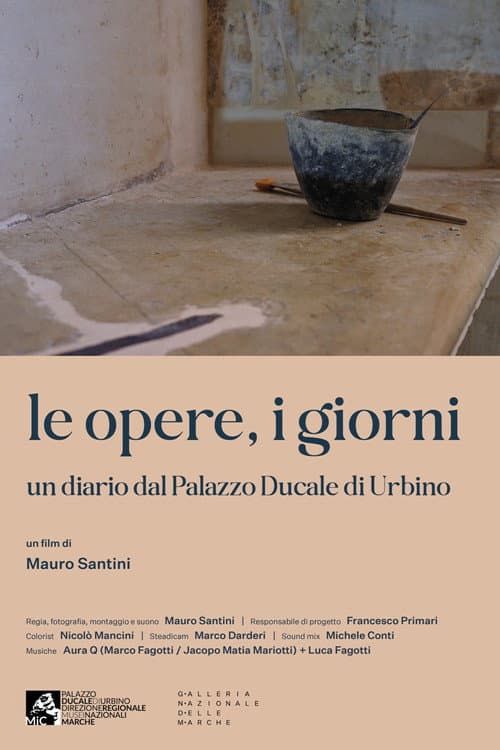
Le opere, i giorni
A three-year restoration project at one of Italy's greatest Renaissance palaces becomes the subject of an unhurried documentary that trusts its audience to sit with dust, decisions, and doubt. Le opere, i giorni premiered at the Pesaro Film Festival in 2026 and offers something rare: institutional filmmaking that resists self-congratulation.
What you're actually watching: A construction site diary, not a heritage broadcast
Here's what happens: the camera plants itself inside the piano nobile of the Palazzo Ducale of Urbino and simply stays there. Director Mauro Santini follows the restoration work over its full three-year span — scaffolding going up, plaster examined under raking light, decisions made and occasionally reversed. There's no narrator. No swooping drone shots. No celebrity voice-over explaining what Renaissance means.
The film trusts the construction site itself — the sounds, the textures, the small human moments between specialists who've stared at the same wall for months — to carry weight. What strikes me most is how little it feels like a promotional exercise. MiC (Italy's Ministry of Culture) backed the production, but Santini resists the usual institutional instinct to polish and validate. The camera lingers on problems as much as solutions: a section of fresco that resists the restorers' tools, scheduling conflicts that send workers home early, the long stretches of waiting that any construction project involves.
It's a documentary about patience. And it earns every one of its 110 minutes.
How this film got made — and why institutional access matters
Mauro Santini describes the work as "un diario dal Palazzo Ducale di Urbino" — a diary from the Ducal Palace. That framing sets expectations correctly: this isn't polished heritage television. It's rawer and more intimate.
The film received its world premiere as a special screening at the 62nd Mostra Internazionale del Nuovo Cinema in Pesaro (PFF62) in 2026. Both Santini and Luigi Gallo, director of the Galleria Nazionale delle Marche in Urbino, attended — a sign that genuine institutional trust was earned here. That kind of access doesn't happen by accident. The camera gets close to the work, close to the workers, close to the moments of uncertainty that a more cautious production would've cut.
As of now, there are no aggregated scores on Rotten Tomatoes, Metacritic, or Letterboxd. The film's too new and too festival-specific for those pipelines to activate. No box-office data exists either — which makes sense. This is Italian art cinema, operating within the cultural-institution circuit. Movie OTT's tracking system will update as critical scores and audience ratings emerge, so it's worth bookmarking if you're following the film's trajectory.
Why this documentary stands apart from typical palace-and-restoration stories
The Palazzo Ducale of Urbino is one of the great buildings of the Italian Quattrocento — built largely under Federico da Montefeltro in the second half of the 15th century, it's the kind of place art historians write entire careers about. Santini doesn't lean on that prestige. He's more interested in the people who show up every morning with their equipment and their expertise and their ordinary human frustrations.
Hard to say if this was a conscious choice, but the film's closest spiritual relatives might be Frederick Wiseman's institutional documentaries — the long takes, the refusal to editorialize, the accumulation of small moments into something that feels, by the end, genuinely substantial. The in medias res structure (you arrive after the project has started, leave before every question resolves) gives the film an authenticity that tidier narratives can't touch.
What's interesting is that Santini doesn't pretend restoration is glamorous or simple. It's methodical. It's uncertain. Sometimes the workers don't know what they're looking at until they've spent weeks examining it. That's not drama — it's honesty. And for viewers accustomed to documentary cinema that actually respects its subject (and its audience), this approach lands harder than any narration could.
Where to watch Le opere, i giorni — and what streaming looks like for festival docs
Streaming availability for festival documentaries shifts faster than most titles. The where-to-watch widget at the top of this page shows current options in your region, since rights vary by country. The film is accessible on major OTT services, though regional rollout tends to favor European platforms before English-language ones catch up — a pattern common for documentaries with Italian institutional backing.
Movie OTT tracks real-time streaming availability across platforms so you don't have to hunt manually. If the title moves or new platforms pick it up, that page updates. Worth checking back if you hit a regional wall the first time.
FAQs: The basics you actually need to know
Director? Mauro Santini, an Italian filmmaker who describes this as a diary from the Palazzo Ducale of Urbino. Produced with support from MiC, Italy's Ministry of Culture.
Where did it premiere? World premiere at the 62nd Mostra Internazionale del Nuovo Cinema in Pesaro (PFF62) in 2026. Santini and Luigi Gallo, director of the Galleria Nazionale delle Marche, both attended.
Runtime? 110 minutes. For observational, diaristic documentary work, that's considered rather than excessive — there's no padding.
Is it a true story? Yes. It's a documentary following actual restoration work carried out in the piano nobile of the Ducal Palace of Urbino over three years. Real restorers. Real work. Real time.
Where can I watch it? Major OTT services, with regional variation. Use the where-to-watch widget above for current availability in your area.
Who should actually watch this
This isn't for everyone. Viewers who need narrative momentum and clear resolution will find this demanding. But if you're drawn to documentary cinema that takes its subject seriously — that treats the labor of restoration as worthy of attention — Santini's film rewards patience.
Fans of slow cinema, Italian cultural heritage, and documentary work that trusts its audience to sit with ambiguity should prioritize this. Think of it alongside work by Wiseman or Agnes Varda's late documentaries: unhurried, attentive, more interested in presence than explanation. If you've appreciated that approach in the past, you'll recognize it here.
Movie OTT rates it as essential viewing for documentary enthusiasts in 2026. Worth seeking out — especially if you can find it on a platform that supports the production quality it deserves.