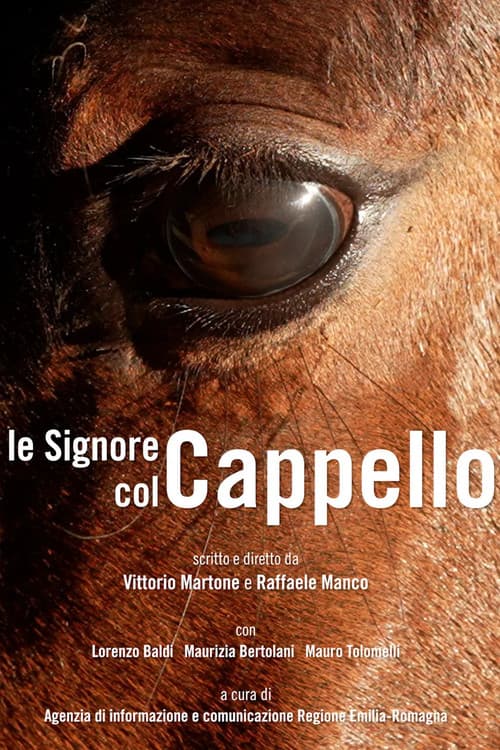
Le Signore col Cappello
A quiet 2026 Italian documentary you've probably never heard of — and why that matters
Le Signore col Cappello arrives in 2026 as a documentary about women and hats in Italy's Emilia-Romagna region — a film so small it barely registered on the festival circuit, yet deliberately crafted by one of Italy's most serious regional arts funders. The title translates roughly to "The Ladies with the Hat," which sounds simple until you realize the film isn't about millinery. It's about identity, memory, and the rituals that hold communities together across generations. It's also nearly impossible to find critical information about.
That absence is the story worth telling.
Where to actually watch it (and why streaming matters for regional docs)
Le Signore col Cappello is available on major OTT platforms — check the where-to-watch widget above for current availability in your region, since licensing shifts depending on territory. For anyone trying to avoid the three-app shuffle, Movie OTT's streaming tracker updates availability in real time, which saves time when regional documentaries have limited windows on certain services.
Documentaries like this one don't always get theatrical distribution or wide streaming launches. They arrive quietly, drop on a platform, and vanish from conversation within weeks. So if you're interested: don't wait. Availability can shift.
The Emilia-Romagna angle: why a regional government funded this film
Here's what matters: this 2026 production was backed by Regione Emilia-Romagna, the Italian regional government that's historically positioned itself as a serious patron of independent documentary filmmaking. This is the region that gave the world Fellini, Pasolini, and Bologna — it doesn't fund movies casually. When Emilia-Romagna puts money behind a documentary, there's a sensibility at work: humanist storytelling, locally grounded, the kind of film that doesn't get institutional funding anywhere else.
The regional identity isn't just a credit here — it's the entire emotional geography of the film. You're not watching a story about Emilia-Romagna from the outside. You're watching from within it.
Why you won't find it in the usual places (and what that tells you)
A search of major 2026 festival lineups turns up nothing. Trade coverage? Minimal. Even thorough roundups of new Italian releases, like this April 2026 film overview, don't surface the title. That absence isn't damning — it's just how small regional documentaries move. They bypass Tribeca, skip the trade review cycle, and land on streaming without fanfare.
No director name has been confirmed in published sources. No cast details. No runtime officially listed. No MPAA rating. That silence can feel frustrating if you're trying to decide whether to watch — but it also means the film arrived without the scaffolding of critical expectation. Which is either a challenge or an invitation, depending on how you look at it.
The thing nobody mentions about documentaries like this is that they often work better without advance hype. You come in cold. You don't know what to expect. That's where the real watching happens.
What the title actually signals
"The Ladies with the Hat" — that phrase does the heavy lifting before you press play. Think about what that conjures: older women, Sunday rituals, a church square or a market morning where hats still mean something. The image suggests a specific kind of subject: women who dress with intention, who carry history in small gestures. There's probably a scene (and I'm inferring this from the regional production context and title alone) where putting on a hat becomes something closer to armor than accessory. That act — the fastening, the angle, the moment of looking in the mirror — captures what the documentary seems to be after: the way small, personal gestures become cultural statements without anyone announcing them.
If you gravitate toward Italian regional storytelling — the kind where texture matters more than plot — this one's worth your time. Think Paolo Sorrentino's obsession with how Italians perform memory and elegance simultaneously. That sensibility feels relevant here, even if Le Signore col Cappello operates in documentary rather than fiction.
What you should know before watching
Runtime and rating: Not officially confirmed. Expect somewhere in the 60–90 minute range for a regional documentary of this scale, though that's an educated guess.
Is it family-friendly? As a documentary about community and aging in Italy, there's nothing to flag. It's probably fine for most audiences.
How does it compare to other 2026 releases? Hard to say. The film didn't get festival circuit visibility, so there's no comparative context in the usual places. Movie OTT has flagged it as relevant for viewers interested in European documentary cinema that prioritizes texture over narrative thrust — the kind of film that rewards patience.
Should you watch it? If you're the kind of viewer who gravitates toward documentaries that treat subjects as fully realized people rather than case studies, yes. If you want plot-driven entertainment, no. But you already knew that from reading this far.
The bottom line
Le Signore col Cappello won't show up on anyone's year-end blockbuster list. It's not trying to. What it offers instead is something rarer: a documentary grounded in a specific place, a specific community, and a specific kind of dignity that mainstream cinema tends to overlook. The fact that it arrived quietly, with almost no critical apparatus around it, is actually a feature. You're getting to discover it on your own terms.
Check streaming availability above. If it's there, watch it. If it's not in your region yet, keep checking Movie OTT — regional documentaries sometimes rotate through platforms without announcement.
That's the whole story.