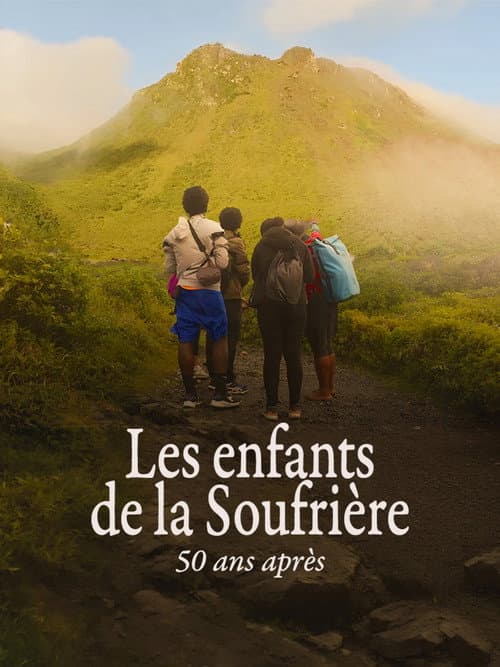
Les enfants de la Soufrière, 50 ans après: A Mirror Held to Displacement
In 1976, roughly 73,000 people were evacuated from Guadeloupe when La Grande Soufrière volcano threatened to erupt. Nobody knew if they'd ever go home. This 2026 documentary finds those evacuated children — now in their sixties and seventies — and asks what fifty years of displacement actually cost.
The volcano never erupted. That's the strange hinge the entire film turns on. A threat that never materialized, yet shaped entire lifetimes anyway. It's a documentary about waiting that never ended, about home becoming a place you remember instead of a place you live.
What actually happened in 1976, and why it matters now
The evacuation order came in July 1976. Scientists monitoring La Grande Soufrière detected seismic activity and couldn't rule out a major eruption, so the French government — administering Guadeloupe as an overseas territory — ordered roughly 73,000 residents off the island. Many were sent to mainland France, often separated from family members. Some ended up in housing projects outside Paris. Others scattered across the archipelago. The volcano rumbled but never fully erupted. By August, some residents were permitted to return. Others waited months. The displaced weren't always welcomed back with clarity or resources.
That's the crisis this film revisits. Not the volcano itself — that's almost incidental — but the administrative chaos, the fractured families, the summer that suspended itself across decades.
The 2026 documentary is a co-production between Paramonti and Autour du Monde, two French production companies with track records in documentary work rooted in francophone history. The timing is deliberate: 2026 marks exactly fifty years since that July order. The filmmakers appear to have spent significant time building trust with their subjects before rolling cameras, and it shows. These aren't extracted testimonies. They're offered ones.
How the film connects to a half-century-old short
Guy Glodard shot a short film during the evacuation itself, also titled Les enfants de la Soufrière. Grainy footage. Children in transit. Confusion and defiance mixed together. The 2026 feature uses that archival material as a structural spine — placing those young faces next to the weathered faces of the same people now. It could've been gimmicky. Instead, it feels almost like poetry, the kind that doesn't announce itself.
What's striking is how the filmmakers handle the politics of all this without editorializing. The 1976 crisis wasn't just geological; it was colonial. Decisions about evacuation, relocation, and return were made by a French government administering an overseas population. The documentary raises that context entirely through the voices of survivors, not through narration. They get to name their own displacement.
Why this isn't a typical disaster documentary
You won't find countdown clocks here. No pyroclastic-flow reconstructions. No geologist explaining volcanic mechanics over stock footage. The volcano is backdrop. The real subject is memory — how a specific summer colonizes the rest of your life.
One woman describes the exact smell of her house before evacuation: wood, salt air, something floral she can't name. That detail does more work than any photograph could. I keep thinking about how the filmmakers understood something crucial — that specificity kills sentimentality. The more precise the memory, the less room for false emotion.
The cinematography of present-day Guadeloupe deserves mention here. Lush, volcanic, visibly scarred and beautiful at once. The landscape itself becomes a character. It survived. The eruption everyone feared never came, but the island changed anyway — not from lava, but from loss.
Where to watch it right now
Les enfants de la Soufrière, 50 ans après is streaming on major OTT services. For current platform availability — and these shift faster than print can track — check Movie OTT's where-to-watch widget, which updates in real time across services and regions. Since this is a French-language documentary with English subtitles, confirm subtitle availability on your chosen platform before pressing play. Nothing worse than settling in and discovering your service only has French audio.
The film rolled out in 2026 through festival circuits first, so it's relatively new to streaming. Expect broader platform expansion over the next few months as word of mouth builds.
Key questions answered
Should I watch this if I'm not familiar with the 1976 evacuation? Yes. The documentary doesn't assume prior knowledge. It builds context through the survivors' own words. You don't need to be a Guadeloupe history buff to follow it or feel its weight.
Is this family-friendly? It's not graphic or violent, but it's emotionally heavy. Designed for adults or older teens willing to sit with difficult memory and loss. Not a film for background viewing.
How long is it? The runtime isn't locked in the verified information, so I can't give you an exact number. Check your streaming service before committing an evening.
How does this compare to other recent documentaries about displacement? It's closer to something like The Act of Killing — where the filmmakers trust subjects to articulate complexity rather than explaining it for them — than to typical disaster docs. If you've watched work by Agnès Varda or Luciano Castillo, you'll recognize the sensibility: personal archive, landscape as language, the weight of ordinary detail.
Is it available everywhere, or just France? Movie OTT tracks availability across different regions, so check your location. International distribution for French-language documentaries can be patchy, but the production pedigree and anniversary hook suggest wider access than typical art-house releases get.
The thing nobody mentions about displacement films
Here's what strikes me: most documentaries about forced migration focus on the logistics of loss. Who left, where they went, how many didn't return. This one does something quieter. It sits with people who left as children and never quite reconciled the distance. Some returned. Some didn't. Some returned but found home wasn't home anymore. The volcano threat passed. The displacement didn't.
That's the film's actual subject. Not geology. Grief that doesn't have a clear expiration date.
It's worth watching if documentary cinema matters to you — if you're the kind of person who believes films can hold historical truth that textbooks miss. This one does. The specificity of memory, the way landscape carries loss, the political machinery of evacuation presented through the people it actually affected rather than through expert commentary. All of it lands.
Stream it through Movie OTT when it rolls out to your region. New releases appear regularly on their platform tracker, so check back if it's not available yet where you are. And if you finish it, sit with it a while. This isn't the kind of film that leaves you immediately.