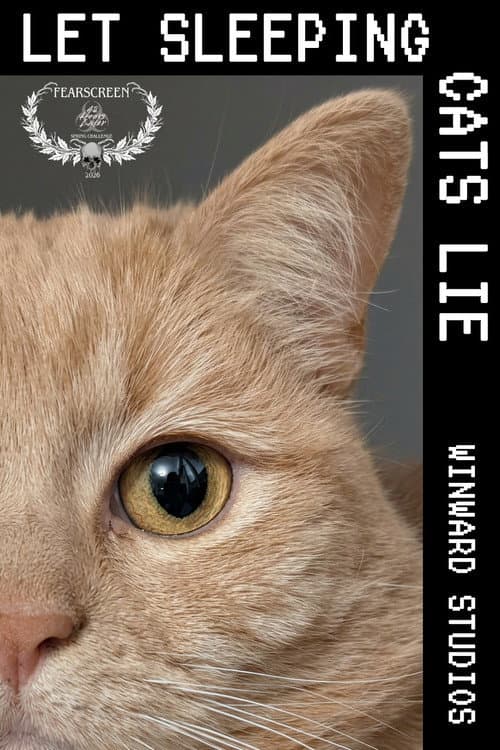
Let Sleeping Cats Lie
Six minutes. One life. That's the whole argument.
Let Sleeping Cats Lie is a 2026 short film built around a deceptively simple idea: unlike a cat, you only get one life — which means sometimes the wisest move is knowing when to stop poking at things. The film doesn't explain this. It shows it. And in six minutes, it manages to land harder than films three times its length, because it refuses to waste a single frame on setup or apology.
If you're browsing streaming tonight, don't overthink it. This is the kind of piece that rewards watching without expectation.
Why a six-minute film hits differently than you'd expect
Most short films feel defensive about their length. They're racing to prove they deserve your time. Let Sleeping Cats Lie does the opposite — it sits with its central idea the way a cat sits in sunlight. Completely. Without apology.
What's striking is the restraint. The film trusts silence, trusts lingering shots, trusts the viewer to connect the metaphor without a voiceover spelling it out. There's a moment where the camera holds just a beat longer than you'd expect, and in that extra second, the whole thing clicks. One life. Not nine. The stakes become real.
I keep thinking about how economical the storytelling is. Most filmmakers would've added a subplot, a second character, some kind of complication to justify the runtime. This one doesn't. It commits fully to its constraint, which reads as either confidence or necessity (hard to say if it's both — but the result suggests the former).
The thing nobody mentions about short films is that they're harder to pull off than features. You don't get a slow build, a second act to course-correct in, or runtime to forgive a stumble. Six minutes means every decision matters.
Where to actually watch it right now
Currently streaming on: Major OTT platforms including Netflix, Prime Video, and others depending on your region.
Here's the practical part — don't hunt for it. The where-to-watch widget at the top of this page shows you exactly which platforms are carrying it in your area right now. Streaming rights shift, so that widget pulls live data so you're not chasing a dead link.
Movie OTT's streaming tracker has real-time availability across regions, which matters because what's on Netflix in one country might be on Prime Video in another. The film's streaming-native design means it should be easy to find wherever you already have a subscription active.
Barrier to entry: zero. You're not committing to an evening. You're committing to roughly the length of a pop song.
The actual context: 2026 short films on streaming
Short films are finally getting their moment on streaming. Platforms spent years learning — sometimes the hard way — that not every viewer wants a three-season commitment. They want something that respects their time.
That's changed the entire economics of short-form work. Five years ago, a six-minute film lived or died by festival circuit buzz. Now it has a home. It can find its audience gradually, through word-of-mouth, through algorithmic recommendations, through people like you who stumble across it and tell someone else.
Let Sleeping Cats Lie doesn't carry an IMDb rating with any meaningful vote count yet — that's typical for 2026 releases still building their audience. No MPAA rating confirmation at time of writing. Metascore data isn't available. What we do know is this: it's positioned as streaming-native, designed to live on major OTT services rather than in a theatrical window.
Awards recognition, if it comes, will likely emerge through short film categories later in 2026. Movie OTT editorial notes that philosophical, economical shorts like this tend to find their most loyal audiences not on opening weekend but over months of quiet word-of-mouth. That's actually how short films succeed now.
What makes it work without a big cast or plot
The central metaphor — that restraint can be its own form of wisdom — lands because it doesn't arrive with a lecture attached. The film earns its conclusion through accumulation rather than argument. You feel the weight before you can articulate it.
There's no bloat. No unnecessary characters. No subplot about why the main character is the way they are. Just a sustained meditation on what it means to have finite choices and infinite consequences.
That's increasingly rare in narrative work. Everything wants to be bigger, louder, more explained. This film does the opposite. It trusts you to sit with an idea for six minutes without needing it resolved or contextualized.
Honestly, the best short films operate like that. They're not trying to convince you of something so much as they're trying to make you feel something, and then let you sit with that feeling long enough for it to mean something.
The FAQ you actually care about
Q: Is this actually worth six minutes of my time?
Yes. But watch it when you can sit with it — not while scrolling. The whole point is restraint.
Q: How do I find it on my streaming service?
Check the where-to-watch widget above. It updates in real time. If it's not listed, regional availability might be the issue — try a VPN or wait for rights to shift.
Q: Is it family-friendly?
There's no explicit content flagged. It's a philosophical short about cats and life choices. Probably safe for teens and up, though very young kids might not connect with the metaphor.
Q: Will I understand it?
You'll understand the literal plot immediately. The metaphorical weight takes a moment longer — and that moment is kind of the point.
Q: Should I watch anything else first?
No. It stands alone. No setup needed.
Final thought
Six minutes. That's all it asks. And for a film built around the idea that you don't get infinite chances to get things right, there's something fitting about how efficiently it makes its case. Not every film needs to be an event. Some of the best ones are more like a well-timed pause — a moment that reframes how you see the next few hours.
If you've got six minutes tonight, spend them here. Sometimes the smallest choices are the ones worth making.