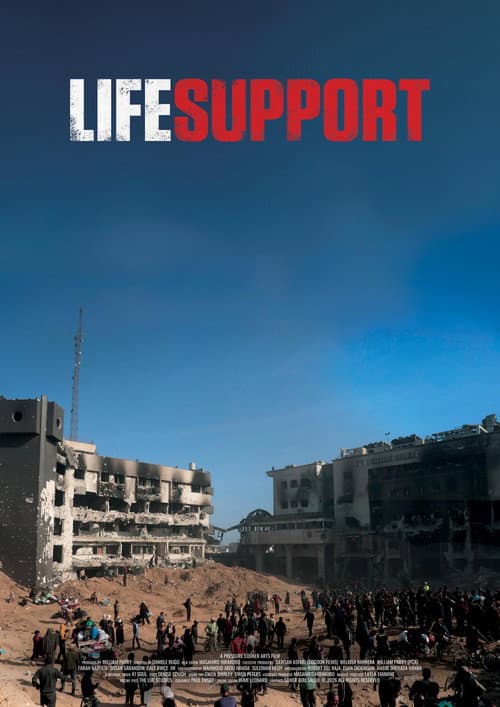
Life Support
2026 documentary | 90 minutes | Pressure Cooker Arts | Streaming availability varies by region
The film: What you're actually watching
Since October 2023, Gaza has been sealed from the outside world. One group keeps slipping through: international doctors working under the Doctors Without Borders banner. Life Support follows what they find — and what their cameras capture.
It's not just a shortage of medicine or food. The filmmakers characterize what they document as deliberate — a structured erasure of the conditions that allow ordinary life to exist. Hospitals without power. Surgeries without anesthesia. The film doesn't editorialise much. It doesn't need to.
Running 90 minutes tight, the documentary draws on news footage shot inside Gaza, woven alongside testimony from the medical personnel who were actually there. That combination of firsthand witness and archival material gives the film texture — it's not a talking-heads piece or an advocacy film leaning on rhetoric. It's observation.
Hard to say if the production team anticipated how politically charged the reception would be when they started. What's clear from the finished film is that the editorial choices are careful — almost forensically so. Every sequence anchors large-scale horror in individual faces, individual procedures, individual moments where a doctor makes a decision under conditions that shouldn't exist in the twenty-first century.
There's one sequence — I won't describe it in full — where a surgeon operates using a phone flashlight during a power outage, and the camera holds on that light for just a beat longer than you'd expect. That extra second does more work than any voiceover could.
Why this film matters right now
The thing nobody mentions when they talk about conflict documentaries is how easy it becomes to numb you — pile atrocity on atrocity until your emotional circuitry trips a breaker. Life Support works against that risk deliberately.
The film's engagement with the concept of "life support" itself is layered. Yes, the literal medical meaning is everywhere — the treatments, the improvised equipment, the desperate attempts to keep vital organs functioning when infrastructure has collapsed. But the documentary keeps returning to something broader: what does it mean to support life in a place where life itself has been placed under siege? That's the question that stays with you after the credits roll.
If you've been trying to understand what conditions in Gaza actually look like since October 2023 — not through headlines or policy debates, but through the eyes of people trying to keep humans alive — this is the film that goes where journalism sometimes can't reach.
Where to watch and what to expect
Movie OTT tracks streaming availability in real time across platforms, and their where-to-watch widget will show you exactly which services carry the film right now. Streaming rights for documentaries shift fast, so that's your best bet for current information.
A heads-up: the film contains footage from active medical situations inside Gaza, including surgeries performed under severely compromised conditions. If you're sensitive to medical imagery or depictions of human rights violations, know what you're walking into.
This isn't comfortable viewing. It's not designed to be. But it's the kind of documentary that earns its difficulty — every hard image serves a genuine attempt to make visible what has been kept invisible.
Who made this and when
Life Support is produced by Pressure Cooker Arts, released in 2026. The production company has built a reputation for working in difficult terrain — politically, geographically, ethically — and this represents perhaps their most ambitious project to date.
The 90-minute runtime is disciplined. There's no fat, no padding, no detours into geopolitical history that might dilute the immediate human stakes. As a documentary entering the streaming ecosystem, it doesn't carry an MPAA rating or Metascore — that's standard for this format — though awards consideration is likely as the festival circuit evaluates major documentaries in the coming cycle. Movie OTT will track any awards developments as they're announced.
Context: What happened in October 2023
The film is grounded in real events. On October 7, 2023, conflict escalated sharply in Gaza. By October, the territory was effectively sealed — no journalists, no aid workers, no international observers. Except the doctors. The film documents what happened inside that sealed space, filtered through the experience of medical personnel attempting to provide care under blockade.
The documentary engages directly with questions of human rights violations and what the filmmakers describe as a calculated dismantling of civilian life. It's a narrow lens — medical workers, not policy experts — but that's precisely what makes it powerful. You're not watching an argument. You're watching a surgeon make impossible choices.
Should you watch it?
Yes, if you follow human rights issues. Yes, if you've been trying to understand what life in Gaza actually looks like. Yes, if you believe documentary film has a responsibility to go where journalism can't always reach.
Don't come expecting resolution. Come expecting truth — which, in this case, is harder and far more valuable.