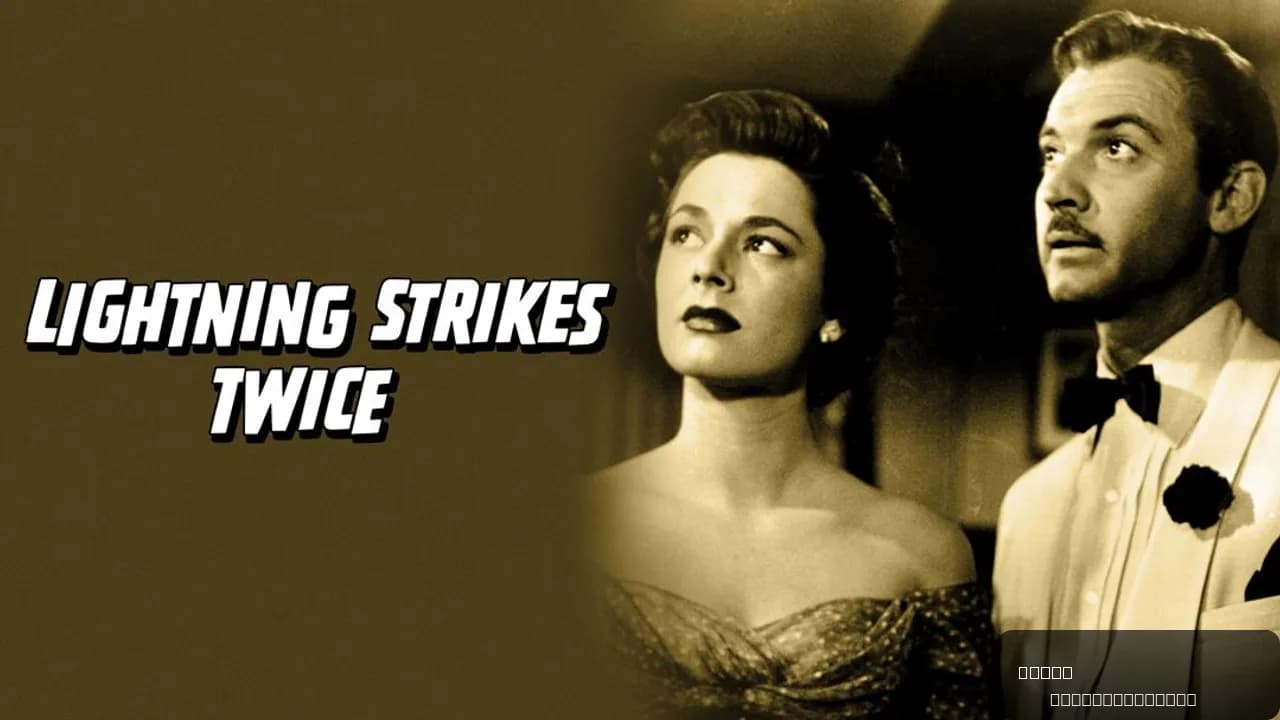
The story of Lightning Strikes Twice
Lightning Strikes Twice opens on a premise that sounds deceptively straightforward: an actress becomes convinced that a man has been falsely accused of murdering his wife, and she decides to champion his cause. It's the kind of setup that could generate real tension—a woman putting her reputation and safety on the line for someone she believes in—but director King Vidor's 1951 film approaches the material with a certain weariness, as if everyone involved already knows where this is heading. The narrative unfolds against the backdrop of a dude ranch, a setting that feels incongruous with the dark subject matter, creating an odd tonal friction that never quite resolves itself. What could've been a gripping courtroom drama or psychological thriller instead settles into something more diffuse, more caught between genres than committed to any single one.
Behind the making of Lightning Strikes Twice
King Vidor, the legendary director behind Stella Dallas and The Big Parade, helmed this picture during a period when his career was in transition—he'd been one of Hollywood's most celebrated figures in the silent era and early sound period, but by 1951, the industry was shifting beneath his feet. The film brings together a capable ensemble: Ruth Roman, who'd recently made waves in Strangers on a Train, carries much of the emotional weight, while Richard Todd (fresh off his role in The Hasty Heart) provides the male lead. Mercedes McCambridge, Zachary Scott, Frank Conroy, Kathryn Givney, and Rhys Williams round out a cast that suggests MGM invested some resources here, even if the final product doesn't always justify that confidence.
Box office returns were modest at best—this was a B-movie dressed up in A-picture clothing, and audiences didn't quite bite. The film doesn't appear to have garnered major award recognition, and it's largely been forgotten by mainstream cinema history. At 90 minutes, it moves briskly enough, though that brevity sometimes works against it; there's not enough room to develop the psychological complexity the premise demands. Movie OTT tracks where titles like this one—mid-century noirs with interesting pedigrees but uneven execution—end up in the streaming landscape, and Lightning Strikes Twice is no exception to that pattern of quiet availability.
What makes Lightning Strikes Twice a period piece worth revisiting
What's striking about Lightning Strikes Twice, honestly, is how it embodies all the contradictions of early-1950s Hollywood melodrama: it wants to be serious about justice and wrongful conviction, yet it can't resist indulging in the kind of catfight dramatics and ridiculous plot twists that undercut that seriousness. Ruth Roman does what she can with the material—she's committed, vulnerable, and you believe her investment in proving the man's innocence—but the script keeps pulling her back into clichéd territory. There's a scene where the tension between Roman's character and McCambridge's (the suspected wife, alive and scheming) becomes almost farcical in its intensity, the kind of moment that would feel at home in a screwball comedy but sits uneasily in a film trying to grapple with systemic injustice.
The dreary atmosphere Vidor creates—all shadows and suspicious glances, the dude ranch somehow feeling more claustrophobic than any city setting could—works in the film's favor more often than not. There's a genuine unease to watching these characters circle each other, even if the plot mechanics feel creaky by modern standards. The IMDb rating of 6.2/10 feels about right: enough craft and performance to make it interesting to film historians and noir enthusiasts, but not enough coherence or originality to make it essential. I keep coming back to the central tension—an actress risking everything for someone she barely knows—because that's genuinely compelling. The film just doesn't trust that premise enough to let it breathe.
Where to stream Lightning Strikes Twice online
If you're keen to track down Lightning Strikes Twice, you'll find it available on HBO Max's Amazon Channel as well as on Max itself—meaning you've got at least two direct routes to watch it, depending on your existing subscriptions. The Where-to-Watch widget at the top of this page will show you exactly where it's streaming in real time, since availability shifts constantly. Movie OTT keeps tabs on these changes across all major platforms, so you won't waste time hunting for a title that's disappeared into licensing limbo. Both services carry the film in decent picture quality, though given the age of the original print, don't expect restoration-level clarity.
Frequently asked questions
Q: Who directed Lightning Strikes Twice?
King Vidor, one of Hollywood's most celebrated directors, helmed the film. By 1951, Vidor was in the later stages of his career, having made silent classics and early sound masterpieces decades earlier.
Q: What year was Lightning Strikes Twice released?
The film came out in 1951. It's a product of post-war Hollywood melodrama, when the noir aesthetic was beginning to fade but still influenced the industry.
Q: Is Lightning Strikes Twice based on a true story?
There's no indication that the film is based on a real case. It's an original screenplay that uses the wrongful conviction premise as its narrative engine.
Q: How long is Lightning Strikes Twice?
The film runs 90 minutes, a brisk runtime that was typical for mid-tier Hollywood productions of that era.
Q: What's the plot of Lightning Strikes Twice about?
An actress becomes convinced that a man has been falsely accused of murdering his wife and takes it upon herself to prove his innocence, a mission that puts her in danger and tests her commitment to justice.
Final thoughts on Lightning Strikes Twice
Lightning Strikes Twice won't change your life, and it probably won't become your favorite noir either. But it's worth a watch if you're interested in how mid-century Hollywood handled themes of justice, female agency, and moral conviction—even when the execution falters. Ruth Roman's performance alone justifies the 90 minutes, and there's something to be said for a film that doesn't quite work but tries hard anyway. It's the kind of title Movie OTT exists to help you find: not a masterpiece, not a disaster, just an interesting artifact of its time, waiting for the right viewer to appreciate what it was attempting.