The story of Maddalena: Faith tested in a small Italian village
Maddalena unfolds in a tiny Italian village during its most sacred annual ritual — the Good Friday pageant. The community's spiritual centerpiece, this reenactment of the Passion is woven into the fabric of local identity, passed down through generations. But when the girl selected to play the Virgin Mary arrives at rehearsals visibly pregnant, the carefully ordered world of Don Vincenzo, the village priest, begins to crack. What starts as a logistical crisis — who will fill the role? — quickly becomes something far more profound: a test of faith, judgment, and whether a priest can truly live by the forgiveness he preaches. The film doesn't shy away from the uncomfortable tension between religious ideals and the messy reality of human bodies, desire, and consequence.
Behind the making of Maddalena: Cannes recognition and Technicolor ambition
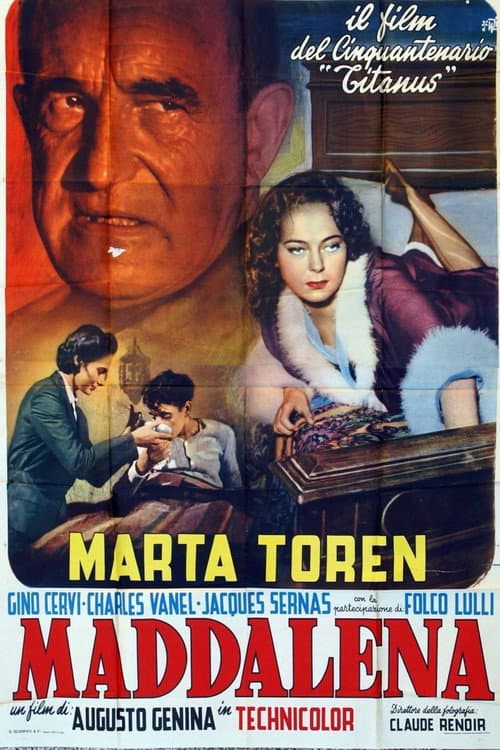
Maddalena arrived in 1954 as a co-production between French and Italian studios, directed by Augusto Genina, a veteran filmmaker with a sharp eye for emotional drama. The film was selected for the 1954 Cannes Film Festival, a recognition that signaled its artistic seriousness within the postwar European cinema landscape. What's striking is the production's commitment to visual richness — the film was shot in Technicolor, a choice that wasn't cheap or casual in 1954. That decision bathes the Italian village in warm, almost sacred hues, making the pageant sequences feel genuinely ceremonial. The art director Ottavio Scotti designed sets that feel lived-in and authentic rather than theatrical, grounding the melodrama in a real place. The cast brought genuine pedigree: Märta Torén, a Swedish actress known for her cool elegance; Gino Cervi, the Italian character actor; and Charles Vanel, a French stage and screen veteran. Genina assembled a team that understood how to balance intimate character moments with the larger spiritual questions the story demanded.
What makes Maddalena stand out: Performance and the weight of expectation
What's interesting about Maddalena is how it refuses to make anyone entirely wrong. The priest isn't a villain for his crisis of conscience. The pregnant girl isn't a moral failure — she's a person caught in a system that demands perfection from those who play its sacred roles. The pageant itself becomes a character, almost — this annual ritual that's supposed to bring the village together but instead exposes every crack in its moral foundation. The performances anchor the film in genuine emotion rather than melodramatic excess. When Torén's character faces the priest, there's a real vulnerability there, a sense of someone caught between shame and defiance. Cervi brings a weathered humanity to Don Vincenzo, a man who's preached mercy his whole life and suddenly has to practice it in a way that costs him something. The film doesn't resolve its central tension neatly — it sits with the discomfort, which is braver than most melodramas of its era managed. The Technicolor cinematography, rather than softening the drama, actually intensifies it. Bright colors make the emotional stakes feel more vivid, more immediate. You can't hide in shadows when everything's lit in those rich reds and golds.
Where to stream Maddalena online
Maddalena is currently available on major OTT services, and Movie OTT tracks its exact streaming home across all platforms so you don't have to hunt. The "Where to Watch" widget at the top of this page shows you which services are carrying it right now — availability shifts between platforms, so it's worth checking before you settle in. If you're exploring European cinema from the 1950s, Movie OTT's streaming aggregator makes it easy to find where these kinds of films live. The Technicolor print holds up beautifully on modern screens, so you'll want to watch on a platform that respects the image quality.
Frequently asked questions
Q: Who directed Maddalena?
August Genina, an experienced Italian filmmaker, directed this 1954 melodrama. He brought a careful hand to the balance between intimate character drama and larger spiritual themes, making sure the film never tipped into pure soap opera.
Q: Was Maddalena shown at any major film festivals?
Yes. The film was selected for the 1954 Cannes Film Festival, which was a significant recognition for a European co-production at that time. It signaled the film's artistic credibility within postwar cinema circles.
Q: Is Maddalena based on a true story?
The film isn't based on a documented historical event, but its premise — a pregnant girl cast in a sacred role — taps into real tensions between religious tradition and human reality that have existed in small communities for centuries.
Q: What's the runtime of Maddalena?
The film runs 102 minutes, giving Genina enough time to develop both the emotional stakes and the community context without feeling rushed or padded.
Q: Was Maddalena shot in color?
Yes, it was shot in Technicolor, which was a significant technical choice in 1954 and gives the film its distinctive warm, almost sacred visual palette.
Final thoughts on Maddalena
Maddalena won't appeal to everyone — it's a 1950s melodrama, which means it moves at its own pace and trusts you to sit with ambiguity. But if you're interested in how European cinema of that era tackled faith, shame, and community judgment, it's worth your time. The Technicolor alone makes it a visual experience. There's something refreshing about a film that refuses easy answers, that shows a priest struggling genuinely with his own principles. It's not a masterpiece — the IMDb rating of 5.3/10 reflects that it's uneven — but it's a sincere, well-crafted exploration of a genuinely difficult moral situation. Watch it for the performances, the color, and the willingness to let its central conflict remain unresolved.