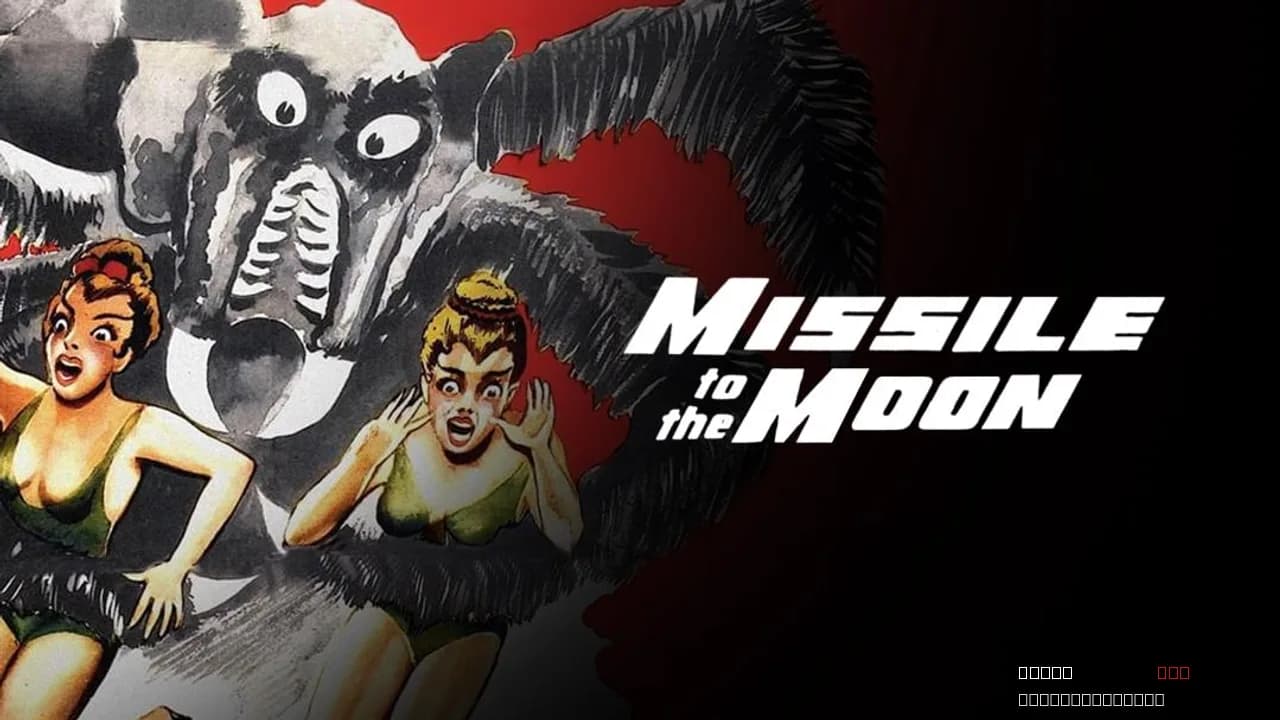
The story of Missile to the Moon
Missile to the Moon tells the story of two escaped convicts who manage to sneak aboard a rocket bound for the lunar surface. What starts as a daring bid to flee Earth quickly spirals into something far stranger when the ship's crew discovers the stowaways mid-flight — but it's too late to turn back. Once they land on the moon, the entire party encounters a civilization unlike anything they could have imagined: a race of alien women, each more elaborate and otherworldly than the last, all ruled by a fierce and sadistic queen who tolerates no defiance. The film doesn't pretend to be serious science fiction in the Kubrick sense. Instead, it embraces the pulp adventure spirit of 1950s B-movies, where the rules of physics are more like suggestions and the stakes feel genuinely unpredictable.
Behind the making of Missile to the Moon
Missile to the Moon emerged in 1958 as an independently produced black-and-white science fiction film distributed by Astor Pictures. Director Richard E. Cunha helmed the project, which was produced by Marc Frederic and released theatrically on December 15, 1958, paired as a double feature alongside Cunha's Frankenstein's Daughter. What's particularly interesting about the film's origins is that it wasn't entirely original — Missile to the Moon functions as a remake of Cat-Women of the Moon, an earlier Astor Pictures production from 1953. The cast included Richard Travis, Cathy Downs, and K.T. Stevens in the leads, alongside Gary Clarke, Tommy Cook, and Michael Whalen. For a low-budget independent production, the film managed to assemble a working ensemble, though none of the performers went on to major Hollywood stardom. The 77-minute runtime suggests Cunha and his team kept the pacing brisk, refusing to linger on exposition or romantic subplots — a choice that, whether intentional or budgetary, actually works in the film's favor. Movie OTT tracks where films like this one have landed in the streaming ecosystem, and discovering these kinds of forgotten genre entries remains one of the platform's core functions.
What makes Missile to the Moon stand out
Here's the thing about Missile to the Moon that critics and audiences have grappled with since its release: it doesn't work as serious science fiction, and it doesn't quite work as straightforward comedy either. What it does work as is pure, unapologetic pulp entertainment. The performances carry an earnestness that borders on camp — nobody's winking at the camera, but the sheer absurdity of the premise creates an unintentional comedy that's oddly charming. The alien women, dressed in elaborate costumes and masks, move through scenes with the kind of B-movie gravitas usually reserved for rubber monsters, and that commitment to the bit is exactly what makes them memorable. The production design, constrained by budget but not by imagination, leans hard into colorful papier-mâché creatures and lumbering rock men that shamble across the lunar surface with a kind of clumsy menace. What's striking is how the film treats these elements with complete sincerity — there's no ironic distance, no self-aware humor. That straightforward approach is what separates Missile to the Moon from later camp films that deliberately play for laughs. The IMDb rating of 3.9/10 reflects the film's status as a cult curiosity rather than a critical success, but that low score misses what makes it worth watching: it's a genuine artifact of 1950s B-movie ambition, the kind of film that emerged from a studio system where a director with limited resources and unlimited imagination could still get a picture made and distributed theatrically.
Where to stream Missile to the Moon online
If you're looking to watch Missile to the Moon, the film is currently available on Prime Video. You can check the Where to Watch widget at the top of this page for the most up-to-date streaming availability across platforms. Since Missile to the Moon is a 1958 independent production, its streaming home has shifted over the years as rights holders and distribution agreements change. Movie OTT keeps tabs on these shifts, so if you're hunting for older genre films and B-movies, it's worth bookmarking the site for real-time platform tracking. The 77-minute runtime makes it a manageable commitment — you won't need to block out an entire evening to experience what Cunha's vision offers.
Frequently asked questions
Q: Who directed Missile to the Moon?
Richard E. Cunha directed Missile to the Moon in 1958. Cunha also directed Frankenstein's Daughter, which played as a double feature with Missile to the Moon upon its theatrical release.
Q: Is Missile to the Moon based on another film?
Yes — Missile to the Moon is a remake of Cat-Women of the Moon (1953), another Astor Pictures production. Both films share similar premise elements but take different approaches to the alien-women-on-the-moon concept.
Q: What's the runtime of Missile to the Moon?
The film runs 77 minutes, making it a relatively brisk B-movie adventure that doesn't overstay its welcome.
Q: Who stars in Missile to the Moon?
The cast includes Richard Travis, Cathy Downs, K.T. Stevens, Gary Clarke, Tommy Cook, and Michael Whalen. None of the performers were major stars, but they bring a working-actor professionalism to the pulpy material.
Q: What's the critical consensus on Missile to the Moon?
The film holds a 3.9/10 rating on IMDb, reflecting its status as a low-budget B-movie oddity. However, it's developed a cult following among fans of 1950s science fiction and camp cinema who appreciate its earnest approach to absurd material.
Final thoughts on Missile to the Moon
Missile to the Moon won't appeal to everyone. If you're looking for hard science fiction or sophisticated storytelling, you'll want to look elsewhere. But if you're in the mood for something genuinely strange — a film that commits fully to its lunar adventure premise without a trace of self-awareness — it's absolutely worth the 77 minutes. The kind of independent filmmaking that produced this movie doesn't really exist anymore, and that alone makes it a historical curiosity worth experiencing. It's a window into a different era of cinema, when a director could make something this weird and get it into theaters.