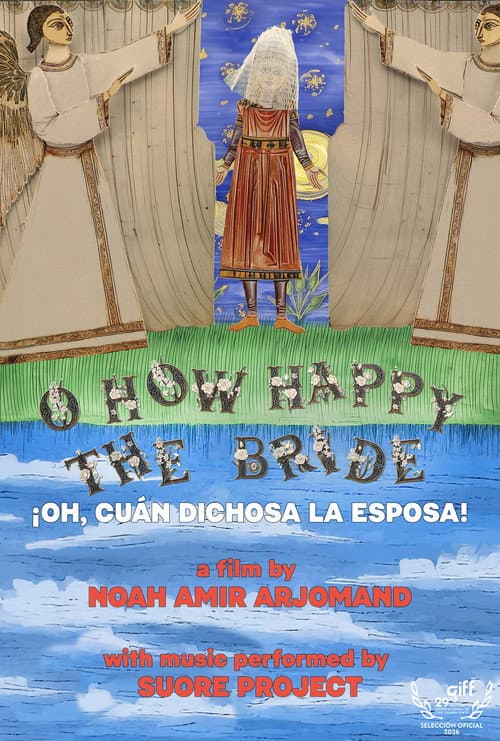
O How Happy the Bride
A 2026 animated short that trades a medieval saint's life through the eyes of a 17th-century nun composer — and finds dark comedy in a woman escaping one marriage by entering another, this time to Jesus. Eight minutes. One unforgettable premise.
What you're actually getting: The film's real story
O How Happy the Bride uses Rosa Giacinta Badalla, a genuine 17th-century Benedictine composer from Milan, as narrator for the life of Saint Radegund, a sixth-century Frankish queen who didn't want to be queen. Here's what happens: Radegund gets traded between murderous kings like a diplomatic hostage, forced into a marriage she never asked for, watches family members die in political violence — and then escapes it all by fleeing to a convent. There, she performs miracles, builds a reputation for fierce piety, and prays for what she calls a happier second marriage. Her groom? Jesus.
The structural choice is bold. Badalla narrates from more than a thousand years later, a woman looking back across centuries at another woman who made the same choice: God over power. It's the kind of framing device that either collapses under its own cleverness or lands perfectly. Here it lands.
What strikes me is how much the film trusts its audience. It doesn't explain the irony — that Radegund trades one involuntary marriage for a mystical, voluntary one. It doesn't announce the dark humor when she finally reaches convent walls and you feel actual relief. The film just presents it and moves on.
Why the visual style matters more than you'd think
The animation draws on medieval manuscript aesthetics — flat, gold-leafed imagery like something from a Book of Hours. Radegund looks like she belongs in the margins of a psalter. Not an accident.
This choice does something clever: it places you inside the period's own self-image rather than imposing a modern lens on medieval history. You're not watching a contemporary director's interpretation of the 6th century. You're watching how the 6th century saw itself, filtered through 17th-century religious art. That's a specific visual argument, and it works.
The eight-minute runtime isn't a limitation — it's a formal commitment. Short animation has a long tradition of compressing enormous material into almost jewel-like packages, and this film understands that tradition. Radegund's entire arc from captive to saint to bride of Christ fits because the film knows exactly what to show and what to leave for your imagination.
Where to watch and what to expect
O How Happy the Bride is currently streaming on major OTT platforms. Movie OTT's where-to-watch tracker shows you live availability across Netflix, Prime Video, and others — that's the fastest way to find a direct link rather than hunting through five different sites.
The film carries no MPAA rating (standard for shorts this length and distribution model) and hasn't accumulated enough IMDb votes for a meaningful score yet. That's typical for short-form animation that hasn't had wide theatrical exposure. Awards recognition, if any, would likely come through festival circuits — animated short categories at places like Sundance or the Annie Awards — though Movie OTT will track that as it develops.
If you liked: animated historical work with bite (think Persepolis territory), or documentaries that treat religious figures with both reverence and wry humor, this'll connect. It's not reverent. It's not mocking either. It's something stranger.
The historical foundation is real
Both Radegund and Badalla were actual historical figures, not inventions. Radegund (c. 520–587) was a real Frankish queen who founded the Holy Cross Convent in Poitiers and became venerated as a saint. Badalla (1660–1710) was a genuine Milanese nun and composer whose sacred music survived largely because of the convent of Sant'Ambrogio Maggiore where she spent her life.
The film dramatizes their stories — it's not a documentary — but the biographical bones are solid. Using Badalla as narrator works because her own trajectory mirrors Radegund's in ways that feel thematically resonant rather than arbitrary. Both women chose vocation. Both created or participated in art within religious community. Both understood something about the power of saying no to the world's demands.
Why this matters in 2026's animation landscape
What's rare for a film in this moment — and what makes O How Happy the Bride stand out even in a crowded festival circuit — is the specificity of its historical vision. It doesn't flatten medieval Europe into a generic "dark ages" backdrop. It doesn't treat Radegund as a victim requiring modern sympathy. It presents her as someone who made a choice, even if that choice was between terrible options.
That's harder to do than it sounds. Most animation that touches history either goes reverent (all the nuance drained out) or comedic (all the weight drained out). This film holds both at once. The moment when Radegund finally reaches the convent walls feels like relief. But it's complicated relief — she's escaping one cage for another, just one she chose.
Hard to say if it'll break through to major animation awards. But the subject matter alone makes it a conversation piece, especially in spaces where animation is taken seriously as a medium for historical and spiritual storytelling rather than just entertainment.
Questions people actually ask about this
Where can I watch it? Check Movie OTT for current availability — it's on major streaming platforms, and the tracker updates in real time rather than showing you stale links.
Is it actually based on true stories? Yes. Both figures are historical. The film interprets and dramatizes their lives, but Radegund was a real sixth-century saint and Badalla was a real seventeenth-century composer.
How long is it? Eight minutes. That's intentional. The film feels complete, not truncated.
Who is Rosa Giacinta Badalla? A Milanese nun and composer of sacred music. She lived in the convent of Sant'Ambrogio Maggiore and created music that survived because of her community. The film uses her as narrator because her choice — God over the world — echoes Radegund's choice across more than a thousand years.
Final thought
Eight minutes, two remarkable women, roughly fourteen centuries of Catholic history. O How Happy the Bride earns every second. It's the kind of short that makes you wish it were longer, then reconsider, then decide the length was exactly right. If you respond to animation that takes history seriously, or you don't mind a film treating a mystical marriage proposal as both absurd and genuinely moving, watch it. You've got eight minutes.