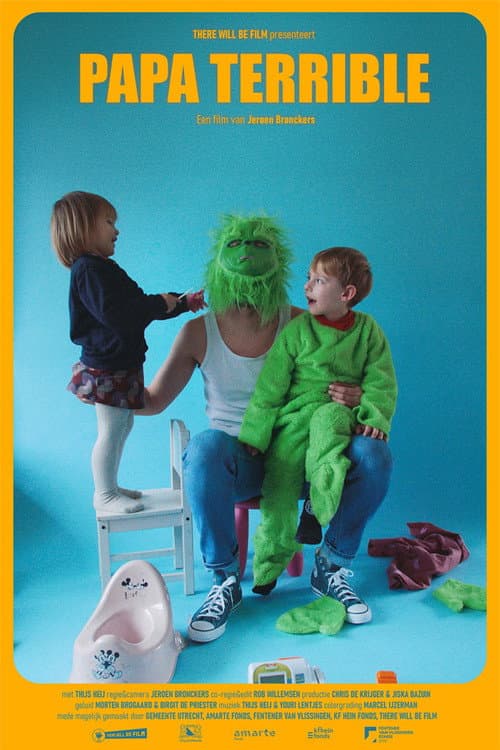
Papa Terrible
The Film: A Filmmaker Watching Himself Fall Apart
Papa Terrible is a 2026 Dutch documentary where director Jeroen Bocken follows musician Thijs into fatherhood—and ends up interrogating his own. Bocken's the one behind the camera, but he's also the subject, a burnt-out father who's lost something he can't quite name. Freedom, maybe. Courage. The kind of love that doesn't come with conditions. When Thijs announces he's going to be a father, Bocken decides to film him over several years as he prepares. What starts as a portrait of someone else becomes a mirror. And mirrors can be uncomfortable.
The structure's clever: Thijs moving toward something (parenthood, responsibility, a new identity he actually seems to want), while Bocken moves through something else—a quiet crisis that doesn't announce itself loudly but accumulates in glances, voiceover, the exhaustion of a man who loves his kids but can't find himself in the rubble of fatherhood. There's a scene where Thijs plays music, completely absorbed, and the camera just lingers. No narration needed. You see the contrast immediately—presence versus absence, rendered visually.
The film posed one question at the Nederlands Film Festival: Are you living the life you would like to live? It's the kind of question that sounds deceptively simple until you sit with it.
Why This Matters (If You've Ever Felt That Vertigo)
Look—documentaries like this live or die on the relationship between filmmaker and subject. Bocken didn't pick Thijs randomly. He picked him because Thijs represents a version of life that feels more alive, more free. That's not neutral observation. That's envy, maybe, or longing, or both. And the film doesn't pretend otherwise.
What's striking is how the film holds two timelines in tension without ever spelling it out. Thijs is becoming someone new. Bocken's becoming... less sure of who he is. The film doesn't rush—it was shot over several years, which matters because you can't fake time passing. The emotional weight earns itself.
I keep thinking about that central question. It's not really about parenting, even though parenting's the subject. It's about identity, about the stories we tell ourselves regarding freedom, about whether becoming a father is something that happens to you or something you choose, over and over again. For parents especially—though honestly, for anyone who's ever wondered if they're living the life they imagined—this hits.
Where to Find It (And Why Streaming Info Gets Messy)
Papa Terrible is available on major OTT platforms, though which ones depends on where you live. Streaming rights for international documentaries shift constantly by territory. Movie OTT aggregates current availability in real time—worth checking there first rather than hunting through five different apps.
If it's not live in your region yet, add it to your watchlist. Distribution for Dutch documentaries is still rolling out in English-speaking markets, so it's worth keeping tabs on.
The Basics You Need
Director: Jeroen Bocken (also appears as a subject in the film)
Production: There Will Be Film
Release: 2026
Format: Documentary feature
Where it screened: Nederlands Film Festival
Runtime: Not yet widely confirmed in English sources
Streaming: Check Movie OTT for your region's current availability
Common Questions
Q: Is this actually a documentary?
Yes. Bocken followed Thijs over several years as Thijs prepared for fatherhood. The events and people are real. But it's also deeply personal—Bocken's processing his own experience as an exhausted father throughout.
Q: So it's just a parenting film?
Not quite. It uses fatherhood as the lens, but the actual subject is identity, freedom, and whether the life you're living matches the one you imagined. It's as much about the filmmaker as about his subject.
Q: Where should I start with documentaries like this?
Start with Papa Terrible if you're drawn to introspective character studies. It doesn't answer its own questions—it just asks them unflinchingly. If you want something slower and more meditative than conventional documentaries, this is the entry point.
Q: What if I haven't seen much Dutch cinema?
You don't need background. Bocken's not making a film for insiders. He's making a film for anyone who's ever felt the particular anxiety of watching someone else live more freely and wondering what that says about their own choices.
Q: Is it heavy?
Yes. It's introspective, it moves at its own pace, and it doesn't resolve things neatly. But it's not depressing—it's honest. There's a difference.
Who Should Actually Watch This
Not everyone. It's slow. It asks questions without answering them. It won't give you the catharsis of a typical narrative arc.
But if you've ever felt that specific vertigo—watching someone else live more freely and wondering what that means for you—or if you're a parent trying to figure out who you are outside of your kids, this film sees you. It doesn't have solutions. But it has recognition. And sometimes that's what you actually need.
Movie OTT's where-to-watch tracker has it listed with current availability in your region. Worth your time.