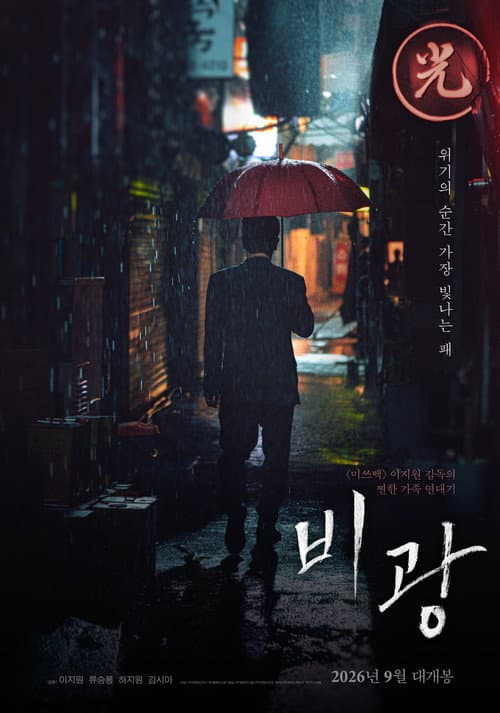
Portrait of a Family (2026)
A baseball star and a movie actress have everything — careers, fame, a marriage that looks perfect from the outside. Then a girl named Dong-ju shows up, and their entire world collapses. Seven years later, when Dong-ju becomes entangled in a middle-school girl's death, Jung-gu and Nam-mi decide to fight a battle they know they'll lose. That's the premise of Portrait of a Family, and honestly, it's the kind of setup that sticks with you before you've even seen a frame.
What happens in Portrait of a Family
The film doesn't ease into anything. Dong-ju's arrival is described as an instant rupture — not a slow-building threat, not a mystery to untangle, but a complete and immediate destruction of the life Jung-gu and Nam-mi have built together. Then the story jumps forward seven years. That gap is crucial. The film makes you sit with consequences before anyone fights back.
When Dong-ju becomes involved in a death — a middle-school girl's death, which carries its own weight in Korean crime narratives — Jung-gu and Nam-mi choose to act. Not because they think they'll win. The premise is explicit: this is a battle they have no chance of winning. What that raises is a harder question: Why do people fight when the odds are impossible? What does it cost them?
The film's setup and why it matters
What strikes me about the structural choice here is the seven-year time jump. Korean crime dramas have gotten particularly good at this kind of long-burn moral reckoning — the question of what you owe a stranger, of how celebrity insulates you from accountability until one day it doesn't. Portrait of a Family looks like it's working in that same vein.
The Busan setting matters too (a port city that carries its own weight in Korean cinema — grit, working-class realism, a certain kind of institutional corruption). It's not just backdrop. It's the kind of place where a celebrity couple's fall from grace plays differently than it would in Seoul.
The involvement of a child's death signals this won't be a comfortable watch. The film isn't positioning Jung-gu and Nam-mi as heroes, necessarily. They're just people who waited too long, and now they're moving.
Key details about the film
Here's what you need to know:
- Release year: 2026 (specific date not yet announced)
- Runtime: 113 minutes
- Genres: Crime, Drama
- Location: Busan, South Korea
- Production: Ace Factory, 지오필름, Green Tree Pictures
- Rating: 0/10 (likely placeholder; the film hasn't released yet)
Casting announcements and director confirmation haven't hit English-language coverage yet. That's not unusual for Korean films at this stage — sometimes productions stay quiet until they're closer to release. Movie OTT typically updates casting and crew info as announcements roll out, so checking back there as we get closer to 2026 is worth doing.
Where to watch Portrait of a Family
The film hasn't released yet. No theatrical or streaming distribution has been confirmed. Once it drops — whether that's a Korean theatrical run first, a platform like Netflix, or something else — Movie OTT's where-to-watch tracker will log the availability. If you're in South Korea, you'll likely get it first. International audiences will have to wait for festival play or platform acquisition.
For now, add it to your watchlist. When release announcements come, you'll want to know.
If you liked... you'll probably want to see this
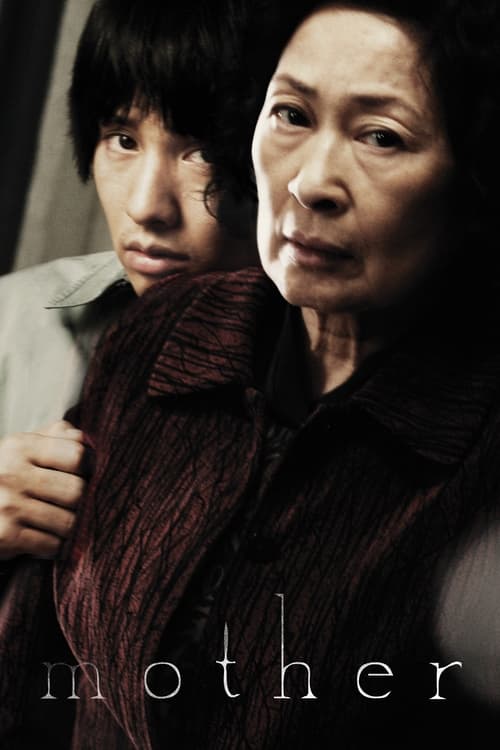
If you've watched Burning (2018) or Mother (2009) — films that use genre mechanics to ask unsettling questions about guilt and complicity — Portrait of a Family is tracking in that same territory. The celebrity angle is different, but the moral ambiguity at the center is the same.
You're also looking at something adjacent to the crime-family dynamics of Badland Hunters or The Outlaws series, but grounded in something more intimate and psychologically fractured.
What to watch for when it releases
A marriage stripped of everything. A girl whose arrival breaks a life in two. A decision to fight anyway, knowing it won't work. What's rare here is that the film doesn't promise catharsis or justice — just the question of what you do when both are impossible. That's the kind of Korean crime drama that stays with you after the credits roll, the kind that uses genre mechanics to ask questions about love and guilt that don't have clean answers.
Keep this one on your watchlist. When 2026 rolls around and the release date solidifies, you'll want to be ready.