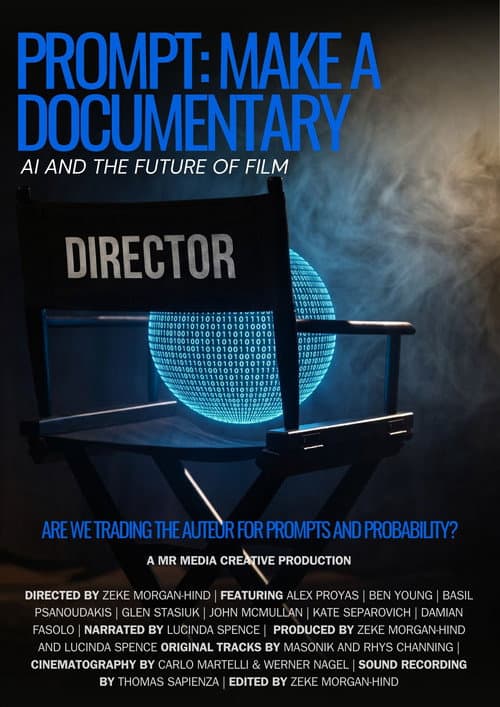
Prompt: Make a Documentary (2026)
What This Film Actually Asks
Prompt: Make a Documentary arrives in 2026 asking something the film industry's been nervously skirting for years: are we trading the auteur for prompts and probability? That's not rhetorical hand-wringing — it's the official tagline, and it sets the real stakes for 90 minutes of genuine, sometimes uncomfortable inquiry into AI's expanding footprint across cinema.
The documentary doesn't treat AI as either savior or apocalypse. Instead, it plants the technology inside cinema's long history of upheaval — synchronized sound in the late 1920s, the shift to color, the digital effects revolution of the 1990s — and asks whether what's happening now is more of the same or something fundamentally different. It's the kind of question that doesn't have a clean answer, which is exactly why the film works.
The Structure That Makes It Work
Here's what's smart about the production: Mr Media Creative built this at 90 minutes, long enough to develop a real argument but short enough that it doesn't pad. More importantly, they brought together directors, academics, and people actually using these tools on sets and in editing bays. You get theory from scholars, ground-level texture from practitioners, and artistic perspective from filmmakers who've spent careers thinking about what makes a film human-made.
I keep circling back to the historical scaffolding. The film doesn't rush into contemporary panic. It spends real time revisiting landmark moments in cinema history — which takes archival work, research, careful assembly — before pivoting to what's happening now. That kind of slow setup earns the questions it asks later. No shortcuts. No doomscrolling rhetoric.
Where the Argument Lands Hardest
What strikes me most is how the film resists the binary that dominates every other AI conversation — either techno-optimism or full dread. Prompt: Make a Documentary stays genuinely curious. The tension it keeps returning to: if AI democratizes filmmaking, who actually benefits? And what gets lost when decades of human craft knowledge compress into algorithmic weights?
The section on the sound transition is particularly effective. Talkies wiped out careers, reshaped performance entirely, forced the whole industry to rebuild — and yet we don't mourn that disruption now. The film uses that history not to reassure but to complicate. Because the counterpoint is right there too: some people displaced in that transition never got work again. They didn't live long enough to enjoy the "long view."
One exchange stuck with me — a practitioner describing the moment they realized a tool had made a creative decision they never authorized. It's ordinary. Specific. Which is exactly why it lands. The ethics of automation in the arts aren't abstract when you're staring at a screen wondering who made that call.
Where to Actually Watch It
Prompt: Make a Documentary is streaming now on major platforms. Check the where-to-watch widget on Movie OTT at the top of this page for current availability across services — the tracker updates in real time, so if the film moves between platforms, that widget reflects it before most aggregators catch on.
There's something fitting about watching a documentary on AI's impact on cinema through the same digital infrastructure that's already reshaped how films get made, distributed, and discovered. The film knows that irony. It's the kind of self-aware framing that rewards paying attention.
The Key Details You Need
Release Year: 2026
Runtime: 90 minutes
Producer: Mr Media Creative
Genres: Documentary
Official Tagline: "Are we trading the auteur for prompts and probability?"
The film features interviews with directors, academics, and industry practitioners — specific names haven't all been publicly released ahead of distribution, but that's fairly standard for docs hitting streaming and festival circuits simultaneously. No MPAA rating has been widely publicized, which is typical for documentaries targeting the streaming-first strategy.
Who Should Actually Watch This
Anyone who watches movies and has wondered what it means for a film to feel human-made. Not just filmmakers or technologists — people who care about where cinema is headed. The documentary doesn't hand you a conclusion. It hands you better questions, which is honestly what the best nonfiction filmmaking does.
Movie OTT's editorial team notes that documentaries tackling technology tend to age unpredictably — either becoming essential historical records or cautionary tales about their moment's blind spots. This one feels built to last.
FAQ
Q: Where can I stream Prompt: Make a Documentary?
It's available on major OTT platforms as of 2026. The where-to-watch widget on movieott.com has the full, updated platform list.
Q: How long is it?
90 minutes. Substantial without overstaying its welcome.
Q: Does it cover only AI, or film history too?
Both. The film frames the AI moment within cinema's longer history of technological disruption — sound, color, digital effects — to ask whether AI is a different kind of shift or a familiar one.
Q: Is there a specific audience for this?
Anyone interested in cinema's future, creative ethics, or how technology reshapes artistic practice. You don't need to be a filmmaker or tech person to care about what the film's asking.
Start watching now. The conversation it's part of is still live.