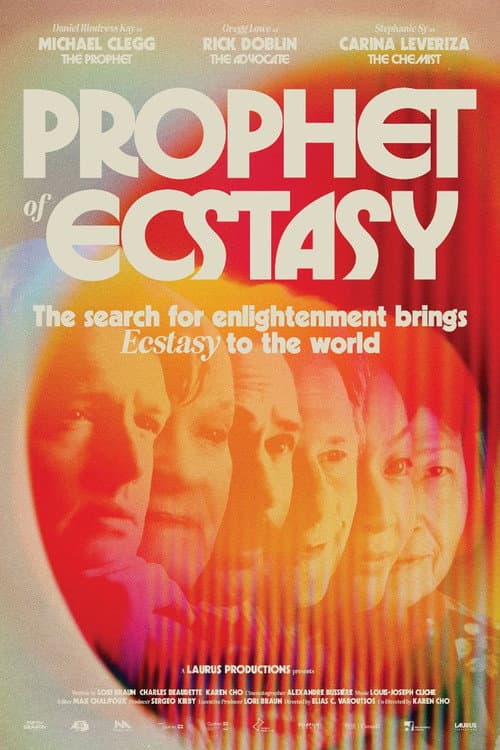



Prophet of Ecstasy
Prophet of Ecstasy is a 2026 documentary that follows one of the strangest arcs in modern drug history: Michael Clegg, a former Catholic priest who didn't just distribute MDMA—he built an empire around it, coined the name "Ecstasy," and somehow lived long enough to reinvent himself as a spiritual teacher. The film refuses to pick a lane. It won't let you decide whether Clegg is a villain, a visionary, or both at once.
The documentary runs 105 minutes and weaves together the lives of three figures whose paths became inseparable from MDMA's own chaotic journey: chemist Carina Leveriza, who gets far more screen time than the male-dominated drug-history mythology typically allows; Rick Doblin, founder of the Multidisciplinary Association for Psychedelic Studies (MAPS), whose decades-long campaign to legitimize MDMA as a therapeutic tool gives the film its forward momentum; and Clegg himself, somehow willing to speak candidly about running what was essentially a pharmaceutical black market.
Why This Documentary Doesn't Play by Genre Rules
Look—the drug documentary space is crowded. Netflix crime sagas, earnest public-health explainers, true-crime procedurals. Most pick a lane and stay in it. Prophet of Ecstasy doesn't do that. What strikes me most is how it holds the contradictions open without resolution. Clegg was a kingpin and possibly a genuine spiritual seeker. That's uncomfortable. The film trusts you to sit with it.
The reenactment sequences deserve their own paragraph. Rather than the flat, low-budget recreations you see in true-crime TV, these feel integrated into the documentary's visual language—almost meditative at points, which actually tracks given the subject matter. There's an early sequence reconstructing Clegg's underground distribution network, shot with an eerie calm that makes the whole operation feel both mundane and surreal. It shouldn't work. It does.
What makes the timeline genuinely weird—and why the film doesn't need to over-explain—is that MDMA's arc is already strange enough on its own. Therapeutic tool in the 1970s. Illegal rave drug in the 1980s. Potential PTSD treatment in the 2020s. That's one of the stranger trajectories in pharmacology, and the documentary captures it without editorializing.
Carina Leveriza emerges as the figure who deserved her own film years ago. Her story cuts against the grain of the Clegg-centric mythology in ways that feel genuinely corrective—like the documentary is correcting the record rather than just telling it.
The Question the Film Leaves Unanswered
Here's what I keep coming back to: how much of Clegg's spiritual transformation is real, and how much is performance? Hard to say if the filmmakers know either. That ambiguity isn't a weakness. It's the whole point.
If you're drawn to character studies more than drug history, this works just as well. It's a story about reinvention, about how a single substance can reshape law, medicine, and consciousness all at once. Not for viewers who want easy moral conclusions—but if you appreciate documentaries that take their subjects seriously without sanitizing them, this is essential viewing.
Where to Watch Prophet of Ecstasy Right Now
Prophet of Ecstasy is available on major streaming platforms, and the best way to find it in your region is checking Movie OTT's streaming tracker, which updates as licensing windows open and close. Streaming rights for documentaries shift constantly—what's on Hulu today might move to Apple TV+ in six weeks. Checking before you sit down saves frustration.
If it's not on your preferred service yet, it will be soon. Documentary licensing tends to expand rather than contract over time. Movie OTT tracks availability globally, which is particularly useful for a title like this one that lands differently depending on where you're located.
What You Should Know Before Watching
Is it based on a true story? Entirely. Michael Clegg is a real person—former priest, actual MDMA distributor, credited with popularizing the name "Ecstasy." So are Carina Leveriza and Rick Doblin. Their lives actually intersected with MDMA's history in the ways the film portrays.
Who's in it? The three central figures are Michael Clegg (the ex-priest turned drug kingpin turned yogi); Carina Leveriza (the chemist whose work is fundamental to MDMA's story); and Rick Doblin (the psychedelics advocate who's spent decades pushing for therapeutic legitimacy). They're treated as parallel threads rather than a simple protagonist-and-supporting-cast structure.
How long is it? 105 minutes—long enough to give the material room to breathe, but tight enough that it doesn't overstay its welcome. For a story this sprawling, that's an achievement.
Does it use reenactments? Yes, and they're handled better than you'd expect. The film uses historical reconstruction to show events that couldn't be captured on camera, particularly around Clegg's years running his operation. They're woven in intentionally rather than as a compensatory Band-Aid.
Is it heavy? It's not a party film. It's contemplative and doesn't shy away from the moral messiness of its subject. If you're looking for something that respects your intelligence and doesn't offer easy answers, that's exactly what you're getting.
Who Should Actually Watch This
Not just for psychedelics enthusiasts or drug-history scholars—though if you're in either camp, it's a must. Anyone interested in character transformation, institutional change, or how a single chemical can reshape a culture will find something here. The film works as a portrait of reinvention, a legal history, and a meditation on authenticity all at once.
Start here if you're new to MDMA's history. It gives you the context without feeling like a textbook. Then, if you want deeper dives, Movie OTT has related documentaries that explore psychedelics from different angles—journalistic, scientific, cultural.
Watch it without preconceptions about where it's going. The best part of Prophet of Ecstasy is sitting with the uncertainty of whether you're watching a redemption story or a con.