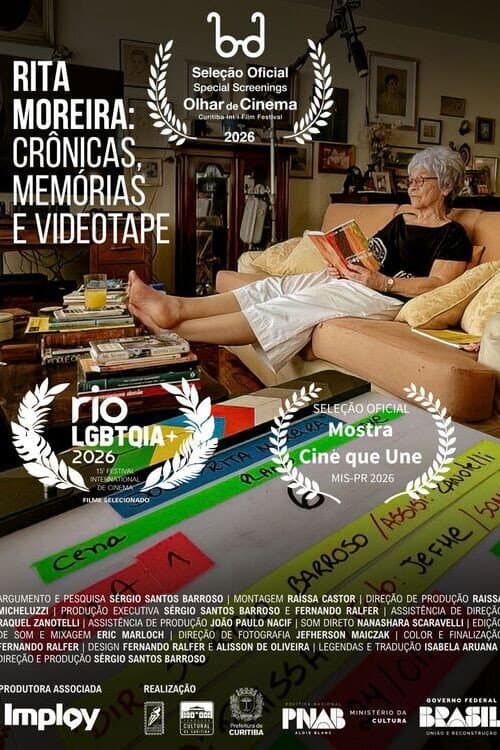
Rita Moreira: Crônicas, Memórias e Videotape — A Brazilian Filmmaker's Archive as Autobiography
Streaming on major OTT platforms | 70 minutes | 2026 documentary | Directed by Sérgio Santos Barroso
Here's the central idea: memory works like an editing room. You pull one clip, lay it against another, and meaning emerges from the cut. Rita Moreira: Crônicas, Memórias e Videotape builds its entire structure around that premise—using the veteran Brazilian lesbian filmmaker's own archive to reconstruct not just her life, but the political moment that shaped it. The film doesn't feel like a conventional biography. It feels like a conversation between two versions of the same woman, separated by four decades.
Why This Documentary Matters Now
Rita Moreira fled to New York in the 1970s during Brazil's military dictatorship. She wasn't a refugee in the formal sense—she was a self-exile, choosing distance because the alternative was artistic and personal erasure. That period produced a specific kind of filmmaking: urgent, made on whatever stock was available, shot through the pressure of not knowing if you'd ever be able to show it at home.
What's striking is how the film refuses the standard documentary grammar. No talking heads. No "and then Rita was born" chronology. Instead, Moreira's presence moves through the footage itself—in the narration, in the gaps between images, in the way a Super 8 frame from 1975 suddenly sits next to digital video from 2018. The edit doesn't smooth the transition. It lets you feel the decades colliding.
The political dimension never stays abstract. That dictatorship wasn't historical backdrop—it was the mechanism that determined which films she could make, which stories she could tell, which version of herself was permitted in public. And you feel that pressure in the early footage. It's visceral, not academic.
The Film's Structure: Why 70 Minutes Works
Most Brazilian documentary features run long out of a sense that their subjects deserve the space. Sometimes they do. But Crônicas, Memórias e Videotape understands something different: compression is its own form of respect. You don't need two hours to make someone's life feel significant.
The essay-film format—think somewhere between Agnès Varda's late-career self-portraits and the Brazilian experimental documentary tradition—gives director Sérgio Santos Barroso room to let structure become meaning. There's no artificial narrative arc here. Images from different decades bleed into each other the way actual memory works: messily, without respecting chronology, sometimes looping back.
I kept thinking about how rare that is in contemporary documentary. Most filmmakers are afraid of ambiguity. This one trusts it.
Where to Watch & What You Need to Know
Stream it on: Major OTT services currently carry the title. Movie OTT's streaming tracker shows the full, up-to-date list of platforms—worth checking because licensing windows shift, and you don't want to hunt for dead links.
Festival history: The film premiered in the 2026 RioLGBTQIA+ festival program, which positions it squarely within Brazil's LGBTQ+ cinema conversation (though the film is doing something more formally ambitious than that label alone suggests). Beyond that festival screening, theatrical release data hasn't materialized—which is typical for a documentary of this scale still making its way through distribution channels.
Runtime: 70 minutes. On the shorter end for a feature documentary, but intentional. The compact form suits the meditative, non-linear approach.
Year: 2026 production.
Hard to say if wider distribution deals are in play, but the teaser materials that have surfaced suggest a film confident enough in its own rhythm to skip the usual promotional machinery.
What Makes This Different From Standard Filmmaker Retrospectives
This isn't a career survey. It's not "here are the films Rita Moreira made, in order." The film's engagement with lesbian identity and feminist filmmaking history positions it as something with uses beyond cinema appreciation. It's an artifact of a specific moment in Brazilian cultural politics—made at a time when LGBTQ+ visibility in the country carries stakes that aren't academic.
Barroso's editorial challenge was enormous. He had access to Moreira's personal archive spanning roughly five decades (Super 8, 16mm, digital), and the job wasn't just selecting footage. It was finding the emotional logic that makes 1970s film stock sit comfortably next to video from 2018 without the whole thing collapsing into a highlight reel. That's genuinely difficult work, and it shows in the precision of every cut.
The film treats memory as unstable, non-linear, politically charged—which is exactly what memory actually is. Especially memory shaped by exile, by artistic suppression, by living through a country's worst years from an ocean away.
Who Should Watch This
If you're interested in Brazilian cinema history—particularly the experimental documentary tradition or LGBTQ+ filmmaking—this documentary earns its 70 minutes. Even if you haven't seen Moreira's original films, the archive clips work. They don't need context to move you.
Patient viewers. People who don't need a three-act structure to feel like their time was well spent. Readers interested in the question of how memory and art hold each other up.
The film isn't for everyone. It won't appeal to viewers looking for conventional narrative momentum or clear character arcs. But for the right audience, it's rare.
How to Access It Right Now
Movie OTT aggregates live availability across multiple streaming platforms—no excuses to hunt through dead links or check five services separately. The where-to-watch widget shows current options, and they update daily as licensing windows shift.
For a documentary with limited theatrical footprint, streaming is the right home. It's where audiences most likely to care about Moreira's work are already spending their time. And honestly? That's where archival cinema belongs now. Accessible. Discoverable. Not locked behind festival credentials or regional film societies.
Watch it this week if it's available in your region. If it's not, add it to your watchlist—these things rotate through platforms steadily.