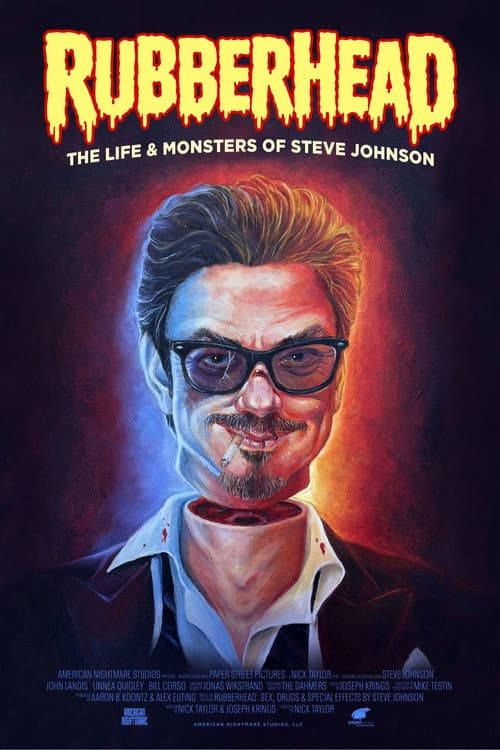







Rubberhead: The Life & Monsters of Steve Johnson
A 2026 documentary about the practical effects artist who built monsters for cinema's greatest directors — and quietly destroyed himself in the process.
Why Steve Johnson matters (and why most people don't know his name)
Steve Johnson's hands built creatures that millions of people grew up terrified of. You've seen his work in films directed by John Carpenter, David Cronenberg, Sam Raimi, James Cameron, Steven Spielberg, and Guillermo del Toro. You probably don't know his name.
That's the central unfairness that Rubberhead circles around. Directors get the marquee. Effects artists get the craft. Johnson spent decades moving between some of cinema's most ambitious creative minds—adapting his approach each time, pushing the boundaries of what foam latex and mechanical rigs could do—while his name stayed in the fine print. The documentary doesn't pretend that's fair. It just shows what happened when you gave everything to the work anyway.
Running 105 minutes, Rubberhead resists the typical effects-artist hagiography. It's not a victory lap. It's an anatomy of obsession: how the same intensity that produced genuinely groundbreaking creature design also drove Johnson toward divorce and a serious drug addiction that cost him years he couldn't recover. The film treats both threads with equal weight. His self-sabotage isn't a tragedy footnote—it runs parallel to the career highlights, which makes those highlights feel earned rather than celebratory.
What the documentary actually shows you
Here's the thing nobody mentions about practical effects documentaries: they're visual in ways that matter. Watching foam latex get poured. Tracking a creature's eyes as they get rigged for movement. That's genuinely cinematic when the archive material is rich, and Rubberhead apparently leans into it hard.
Johnson worked across radically different creative universes—Cronenberg's body horror, Raimi's slapstick terror, del Toro's gothic precision. Each director pulled something different out of him. The film uses that range to show not just what Johnson could do, but how he thought. A creature design isn't just a technical problem. It's a conversation between an artist's obsession and a director's vision, and Johnson was fluent in all of them.
Early descriptions suggest the documentary includes sequences where Johnson reflects on projects he lost—or walked away from, and that distinction matters more than it sounds. There's genuine grief in those moments, specific enough to feel real rather than performed for the camera. The film doesn't soften that. It doesn't repackage failure as redemption. It just sits with the contradiction: brilliant work and personal wreckage existing in the same life, at the same time.
Where to watch it right now
Rubberhead: The Life & Monsters of Steve Johnson is streaming on major OTT platforms as of 2026. Rather than hunting across five different apps, Movie OTT's where-to-watch tracker pulls real-time availability across services—Tubi, Netflix, Amazon Prime, the whole lineup—and updates as licensing shifts. Streaming rights move fast for documentaries (a platform that has it today might not in three months), so checking that widget before you settle in saves the frustration.
Is this actually worth your time?
Yes, if you care about any of this:
- Practical effects and how they're made. The documentary is visual enough that it works as pure craftsmanship porn.
- Genre filmmaking history. Johnson's collaborators span horror, sci-fi, and action across four decades. The film gives you a cross-section most single documentaries couldn't claim.
- The psychology of creative obsession. This isn't a recovery narrative or a "where are they now?" It's about what happens when someone's ambition outpaces their ability to sustain themselves—and how that plays out in work you can't unsee once you know the cost.
- Character studies about gifted people burning out. If you've watched someone talented self-sabotage and wondered how that happens, Rubberhead doesn't answer the question so much as refuse to look away from it.
Not for younger viewers. The film addresses Johnson's drug addiction and personal collapse directly. Parents should consider that before watching with kids.
What critics are saying (so far)
Movie OTT's review aggregator is still collecting responses as the film circulates through its 2026 release window, but early takes emphasize the same thing: this is a documentary with spine. It doesn't flinch. It doesn't flatten Johnson into either a victim or a villain. It just shows you a complicated person doing complicated work while his life came apart—and suggests that maybe those things aren't separate.
The current IMDb rating is still accumulating votes (normal for a doc this fresh), but awards eligibility for the 2026 cycle is in play. Given the caliber of directors who appear as interview subjects, a documentary shortlist appearance wouldn't surprise anyone paying attention.
Who should watch this, and in what order
Start with Rubberhead if you want to understand the invisible architecture of films you already love. Then go back and rewatch one of the movies Johnson worked on—pick any Carpenter or del Toro film—and notice what his hands built. You'll see the movie differently. That's the real value here: not just the documentary itself, but what it teaches you to see in everything that came before.
If you haven't revisited those films recently, they hold up. The creatures don't feel dated—they feel like the work of someone who understood that a monster on screen needs to move like it's alive, needs to feel like a weight in space, needs to matter physically in a way that pure CGI struggles to match (which is probably why there's been a genuine critical rehabilitation of practical effects in the last few years). Rubberhead arrives at exactly the right moment to capitalize on that shift.
Check Movie OTT for the full streaming breakdown and queue it up before the conversation moves on.