




Running Man Việt Nam Mùa 3: Con Rối Tự Do
The film that cost Vietnam's biggest entertainment company approximately 38 billion VND to produce hit theaters on January 22, 2026 — and it's asking a question most TV spinoffs don't bother with: what does it actually cost to be watched?
What the film is really about (and why the premise matters more than the games)
Running Man Việt Nam Mùa 3: Con Rối Tự Do isn't just a feature-length finale to a fifteen-episode season. It's the philosophical capstone. Society turns all of us into marionettes, the film argues — pulled by four invisible strings: wealth, talent, desire, and fame (rendered in Vietnamese as Tiền – Tài – Sắc – Danh). The season spent those fifteen hours building that idea. The movie makes you sit with it.
The setup: clown-costumed "puppet" characters hunt Running Balls across elaborate warehouse sets in a high-stakes name-tag ripping race. Sounds familiar if you've ever watched the show. But here's where it gets strange — the costume choice isn't just decoration. Watching the cast perform inside full clown makeup, chasing elimination after elimination, starts to feel less like a game and more like allegory. Each tag ripped is a small death of persona. Whether that reading was intentional or something audiences are projecting onto it, I'm genuinely not sure. But the film invites it, and it doesn't flinch away.
The real hook: even if the strings can't be cut, you still get to choose how you move.
At 161 minutes, Con Rối Tự Do doesn't rush. The documentary-thriller-comedy hybrid structure — unusual for Vietnamese theatrical releases — gives it room to breathe in ways a standard episode never could. Most TV movie spinoffs aren't built for that kind of tonal whiplash. One moment you're watching grown adults sprint through a warehouse. The next, editing slows, and someone's quietly confronting what it means to perform joy for a living. The contrast works. It doesn't feel cheap.
Ninh Dương Lan Ngọc carries several of the quieter emotional beats with a restraint that feels earned after a full season of escalating stakes. The ensemble chemistry — built across those fifteen episodes — pays dividends here in ways a standalone film simply couldn't manufacture.
How the film came together: Korean production, Vietnamese sensibility
Forest Studio partnered with Seoul Broadcasting System and CJ CGV (the Korean multiplex giant whose Vietnamese footprint made theatrical release possible) to produce this. Three Korean directors share credit: Dongwook Kim, Jaeyun Hwang, and Jaeun Park. They've overseen the franchise's visual grammar since local adaptation began, which shapes everything — the film feels Korean in production design and pacing, Vietnamese in humor and emotional register.
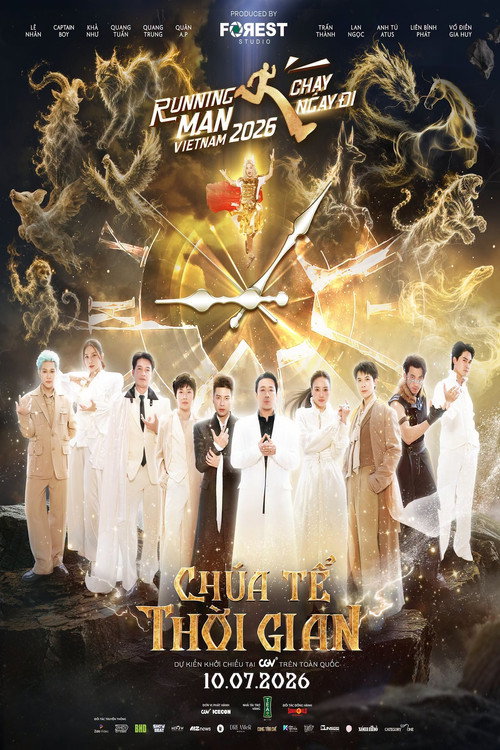
The cast reassembles the full Season 3 lineup: Trấn Thành, Quang Tuấn, Ninh Dương Lan Ngọc, Anh Tú Atus, Quang Trung, Quân A.P, Liên Bỉnh Phát, and Lê Nhân. Trấn Thành, Vietnam's most commercially bankable entertainer, anchors the ensemble — the kind of performer who makes you forget he's performing, which is, of course, exactly what the film is playing with.
The film premiered in Ho Chi Minh City on January 22, 2026, then rolled out to CGV cinemas nationwide two days later. That cross-cultural production pipeline is worth noting because it's rare to see a Vietnamese entertainment property built this way — usually it's either fully domestic or fully imported. This sits in the middle, which gives it a sensibility that doesn't quite fit into either category cleanly.
The box office numbers, and what they mean for Vietnamese TV spinoffs
The film pulled in approximately 38 to 38.1 billion VND across its theatrical run, with preview screenings and the first two days alone generating between 6.7 and 18.1 billion VND on roughly 700 daily showings. According to local coverage, that makes it the highest-grossing Vietnamese theatrical spinoff from a TV show — surpassing even Anh trai "say hi": Kẻ phản diện tạo nên người hùng.
That's a specific niche rather than the wider box-office landscape. It's not Avatar money. But for a comedy-game-show hybrid built for an existing fanbase, those numbers tell you the audience showed up — and they showed up in volume.
Movie OTT tracks titles like this precisely because serialized context matters when recommending what to watch and in what order. A TV spinoff's box office can't be divorced from its season-one viewership. The audience was already there. The film just gave them permission to leave their couch.
Where to watch it right now
Running Man Việt Nam Mùa 3: Con Rối Tự Do premiered exclusively in CGV cinemas, but that window has closed. The film is now available on major OTT services — no exclusive streaming deal has been publicly announced, which means it's rolled out to the standard post-theatrical pipeline most Vietnamese productions follow.
For the most current platform availability in your region, check the where-to-watch widget at the top of this page — Movie OTT updates streaming data continuously across major services so you don't have to check each one manually. Particularly useful for a title like this, where the OTT rollout is still settling.
Do you actually need to watch Season 3 first?
Short answer: yes, ideally.
The film functions as a feature-length finale to a fifteen-episode arc. Familiarity with the cast dynamics and the season's Tiền – Tài – Sắc – Danh theme will enrich the experience considerably. You'll understand why certain eliminations land harder. You'll catch the callbacks. The psychological texture will hit different.
That said, the game-show format is accessible enough that newcomers can follow the action. They'll just miss the accumulated emotional context — which is maybe 40% of what the film is doing. If you haven't followed Running Man Vietnam before, start with Season 3. Watch it in order. Each episode builds on the last. Then sit down for the film. It'll make more sense. It'll hit harder.
The thing nobody mentions about TV-to-film adaptations is that context isn't a luxury — it's a structural requirement for this particular story to work.
Who should actually watch this
If you've followed the Running Man Vietnam cast across any stretch of the franchise, Con Rối Tự Do is the payoff — 161 minutes of a team at peak chemistry working inside a concept that's smarter than it looks. For newcomers to Vietnamese variety entertainment, it's a solid entry point that rewards patience. Hard to say if it'll convert skeptics of the format entirely, but if you've ever enjoyed Korean-influenced game-show productions, you'll find plenty here.
The film doesn't expire. It doesn't feel dated. Even if you've already seen the Season 3 episodes, rewatching the cast perform inside this new frame — with the clown costumes and the tighter narrative structure — shifts what you thought you understood about the season itself.
Watch it with the knowledge that it's designed for people who already care about these performers. That's not a limitation. That's the point.
FREQUENTLY ASKED QUESTIONS
Q: How long is Running Man Việt Nam Mùa 3: Con Rối Tự Do?
161 minutes. It's not a short sit, but the structure — documentary-thriller-comedy hybrid — gives it room to breathe between game segments.
Q: Who directed it?
Dongwook Kim, Jaeyun Hwang, and Jaeun Park, all Korean directors working under Forest Studio in collaboration with Seoul Broadcasting System.
Q: Where can I watch it?
It's available on major OTT services following its theatrical window at CGV cinemas. Check Movie OTT's where-to-watch tracker for the most current platform availability in your region.
Q: Do I need to watch Season 3 first?
Yes. The film is a feature-length finale to the season, and context matters significantly here.
Q: How much money did it make?
Approximately 38–38.1 billion VND during its theatrical run — the highest-grossing Vietnamese TV-show spinoff to date.
Q: Who's in it?
Trấn Thành, Quang Tuấn, Ninh Dương Lan Ngọc, Anh Tú Atus, Quang Trung, Quân A.P, Liên Bỉnh Phát, and Lê Nhân.
Q: Is it based on a true story?
No. It's a scripted and produced reality-competition hybrid with philosophical themes about fame and freedom, but the events are staged entertainment.