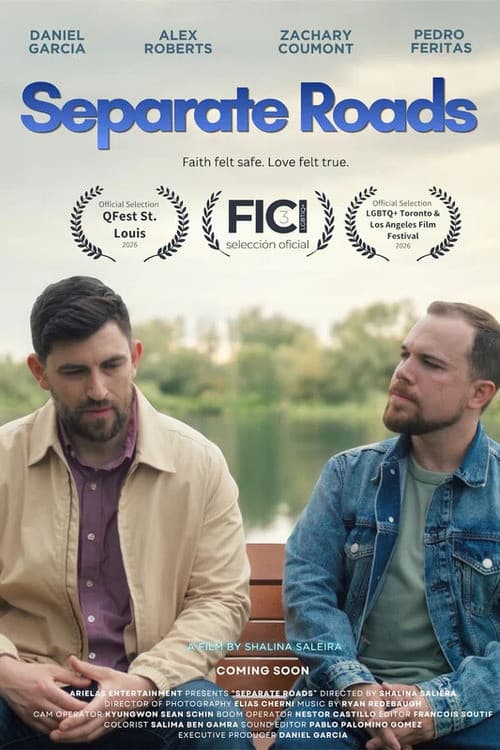
Separate Roads
2026 Canadian short film | 14 minutes | Shalina Saleira, director | Not yet rated
What happens when two exes can't actually talk it through
Separate Roads opens on the moment nobody wants: Daniel and Tyler, high school sweethearts, in the same room years after everything fell apart. The breakup itself wasn't clean — Tyler went through conversion therapy, trying to cure something that didn't need curing, and that wound never closed. What makes this film work is that it doesn't dramatize the therapy itself. Instead it lives in the aftermath — the loaded silences, the half-finished sentences, the way two people can sit across from each other and still be miles apart. Fourteen minutes. That's genuinely all director Shalina Saleira needs to lay out the wreckage and ask whether closure is even possible when old wounds run this deep.
How the film actually landed on the festival circuit
Saleira wrote and directed this herself — no wasted scenes, no expository detours. The production is tight and Canadian through and through, and you can feel it in the craft: a team that knew exactly what story it wanted to tell and refused to let budget constraints dilute that vision.
Rather than chasing theatrical release, Separate Roads took the festival route, which is the right call for something this intimate. The film was selected for St. Louis QFest 2026 and has been making the rounds through the LGBTQ+ festival circuit. According to audience responses captured at May 2026 screenings, the film hits hard — the kind of post-credits conversation that short films dream about generating. No box-office data to track (short films don't chart that way), and as of mid-2026, the major aggregators haven't accumulated enough formal reviews to generate a score yet on IMDb, Letterboxd, or Rotten Tomatoes.
That said, Movie OTT has been tracking the film's growing visibility as it moves through the 2026 festival season, and momentum is building in the right places — with the exact audiences it was made for.
Why this hits different: the craft underneath
What's striking is how much emotional territory Saleira covers without letting the film tip into melodrama or preaching. The conversion therapy context could easily become the entire point — a polemic, a lecture — but it doesn't. It's context. It's the reason Tyler flinches at certain moments, why Daniel can't quite meet his eyes when the conversation gets close to the real thing. The restraint is where the power lives.
Both leads carry the specific exhaustion of people who've rehearsed this conversation a thousand times in their heads. Rehearsal doesn't help. There's a moment — and I won't spoil it entirely — where Tyler starts to say something and then doesn't, and the silence that follows is doing more work than any monologue could manage. That's genuinely difficult acting in a short format, where there's no time to build slowly. There's nowhere to hide.
I keep coming back to the film's refusal to promise that closure is possible. A lot of LGBTQ+ narratives about conversion therapy end with some version of healing, reclamation — and those stories matter. But this one sits with the messier possibility: some damage doesn't resolve. Some old wounds stay open. The film earns that ambiguity rather than just asserting it, which is the difference between a good short and one that actually stays with you after the credits roll.
Where to actually watch it right now
Separate Roads is currently available on major OTT platforms. The fastest way to find where it's streaming in your region is to check Movie OTT's where-to-watch tracker — they update availability across platforms in real time, so you're not looking at a snapshot from months ago. Since the film is still on the festival circuit as of 2026, streaming availability may shift, and the tracker catches those changes automatically. No guesswork required.
Quick facts
Director: Shalina Saleira
Runtime: 14 minutes
Year: 2026
Where it's playing: Festival circuit; streaming on major OTT services
Best for: Anyone who's had a relationship end without resolution, or anyone who cares about how conversion therapy damages people long after it ends
Watch it if you liked: Other intimate LGBTQ+ short films that prioritize specific moments over big dramatic gestures
FAQ
Q: Is this based on a true story?
There's no public statement from Saleira confirming it's autobiographical, but the subject matter — conversion therapy and its long-term emotional aftermath — is drawn from documented, real experiences that countless LGBTQ+ people have lived through. That specificity is what gives the fiction its weight.
Q: How do I know if this is worth my time?
Fourteen minutes isn't a big ask. If you've ever had a relationship end messily, or if you have any connection to the harm conversion therapy causes, this film will hit somewhere specific. It's also just well-made cinema — Saleira doesn't need feature length to tell a complete story.
Q: Has it won any awards yet?
Not yet (as of mid-2026). Festival selections and audience responses have been notably positive, but formal award announcements haven't rolled in. That doesn't diminish what's on screen — it just means the film is still finding its audience.
Next step
Watch it. Fourteen minutes, and it earns every one. If you're coming to this after a festival recommendation or a social media mention, Movie OTT has current streaming links so you can find it without the runaround.