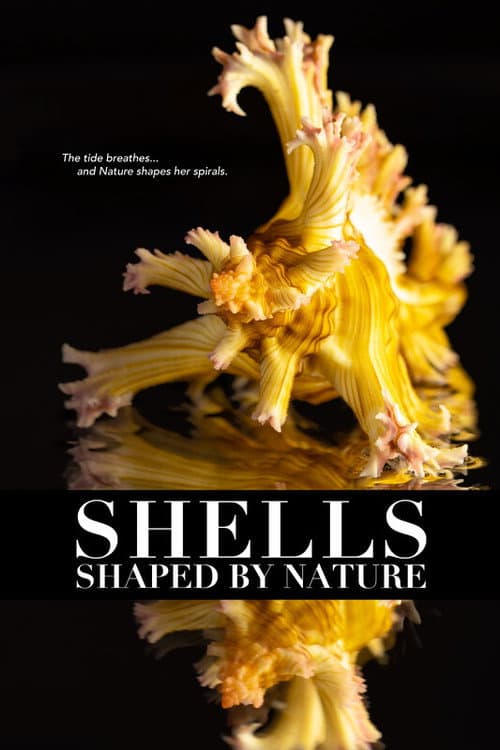
Shells: Shaped by Nature
A 50-minute documentary that makes math look beautiful
Shells: Shaped by Nature is a 2026 documentary that does something deceptively tricky: it takes seashells — something you've probably walked past a thousand times on a beach — and makes you actually see them. Terra Mater Factual Studios, working with Rooted Media and FrogFoot Films and Graphics, built this film around the snails and mollusks living in Africa's coastal marine environments. But here's the thing — it's not just marine biology. The documentary weaves together shell formation, mathematical patterns (hello, Fibonacci spirals), and the cultural history of shells as art, adornment, and currency across African and global trade systems. Runtime: 50 minutes. Year: 2026. Currently available on select OTT platforms — check Movie OTT's where-to-watch widget for your region.
What's striking is how the film refuses to separate the science from the culture. Too many nature docs treat African waters as scenic backdrop for universal lessons. This one keeps its geographic specificity front and center — these shells belong to specific marine realms, specific communities, specific histories. The camera work lingers on shell geometry the way a painter might study a subject before putting brush to canvas. You're not just told the Fibonacci spiral appears in nautilus chambers; you're given time to actually absorb it.
Why festival juries took notice in 2026
The film's festival run has been genuinely impressive for a television-length documentary. Grand Prix at the PAF Tachov Festival (Czech Republic). Special Jury Award at the International Ocean Film Festival in San Francisco — one of the most respected ocean-focused film events in North America. A prize at the AFO Academia Film Olomouc (another European science documentary circuit heavy hitter). Three major honors in a single cycle. That's rare for a 50-minute production.
The reason these festivals matter: they're not multiplexes. These are programmers and critics who watch hundreds of documentaries a year and pick the ones that actually do something different. The fact that Shells: Shaped by Nature landed awards across multiple continents suggests it's hitting something real — not just pretty cinematography, but a formal approach to its subject that feels considered.
Beyond festival screenings, the film is part of the Ocean Film Festival World Tour 2026, which means it's reaching audiences through event-style theatrical exhibitions rather than a quiet streaming debut. That's a distribution model that respects the film's visual language — you're meant to see this on a decent screen, not squeezed into a phone.
What actually happens in the 50 minutes
Honestly, here's what nobody mentions enough: the hard part isn't filming mollusks. It's making their shells feel urgent. The documentary doesn't just catalog species or chart migration patterns. It sits with individual shells — cone snails, nautiluses, spiral forms from the African coast — long enough that you start to understand viscerally why human artists have been copying these geometries for thousands of years. There's a sequence showing shell construction from the inside out that moves at its own pace. No rush. That kind of pacing is increasingly rare in documentary.
The film also treats shells as historical objects — not just biological ones. Currency systems. Adornment practices. The way shells moved through ancient African economies and shaped trade routes. This dual focus (science + culture) is what separates it from the typical "here's how mollusks work" nature film. It's asking: why have humans always been obsessed with these things?
Where to watch, and what the availability picture looks like
Streaming availability is still rolling out. Check the real-time where-to-watch widget at the top of this page — regional access varies, and platform listings update weekly. Movie OTT aggregates current SVOD and AVOD availability across major services, so you don't have to hunt across six different apps. If Shells: Shaped by Nature has landed in your region on Netflix, Amazon Prime, a specialty documentary platform, or anywhere else, it'll show up there.
Given Terra Mater's track record placing productions on high-profile international broadcasters — they've got strong relationships with public broadcasters across Europe and beyond — wider streaming distribution is likely coming as the festival window closes. Hard to say exactly when, but the momentum suggests the pipeline is moving.
Who should actually watch this
Start here if you're drawn to nature documentaries that aren't afraid of their own visual ambition. If you've watched Our Planet or Life and wanted something smaller, tighter, and more formally inventive — this lands differently. It's also strong for anyone curious about African marine ecosystems or the history of materials in human culture.
Not looking for a heavy educational lift? Don't worry. The 50-minute runtime means no filler, no detours. The editing keeps momentum clean without feeling rushed (a balance most documentaries can't quite nail). Younger viewers curious about ocean biology will find it accessible. Anyone drawn to the intersection of mathematics, art, and natural history — basically, anyone who's ever spent 20 minutes staring at a seashell and wondered why it looks the way it does — this is for you.
Next step: Check Movie OTT's where-to-watch tracker for current availability in your region. It's worth seeking out while the film still carries festival momentum.