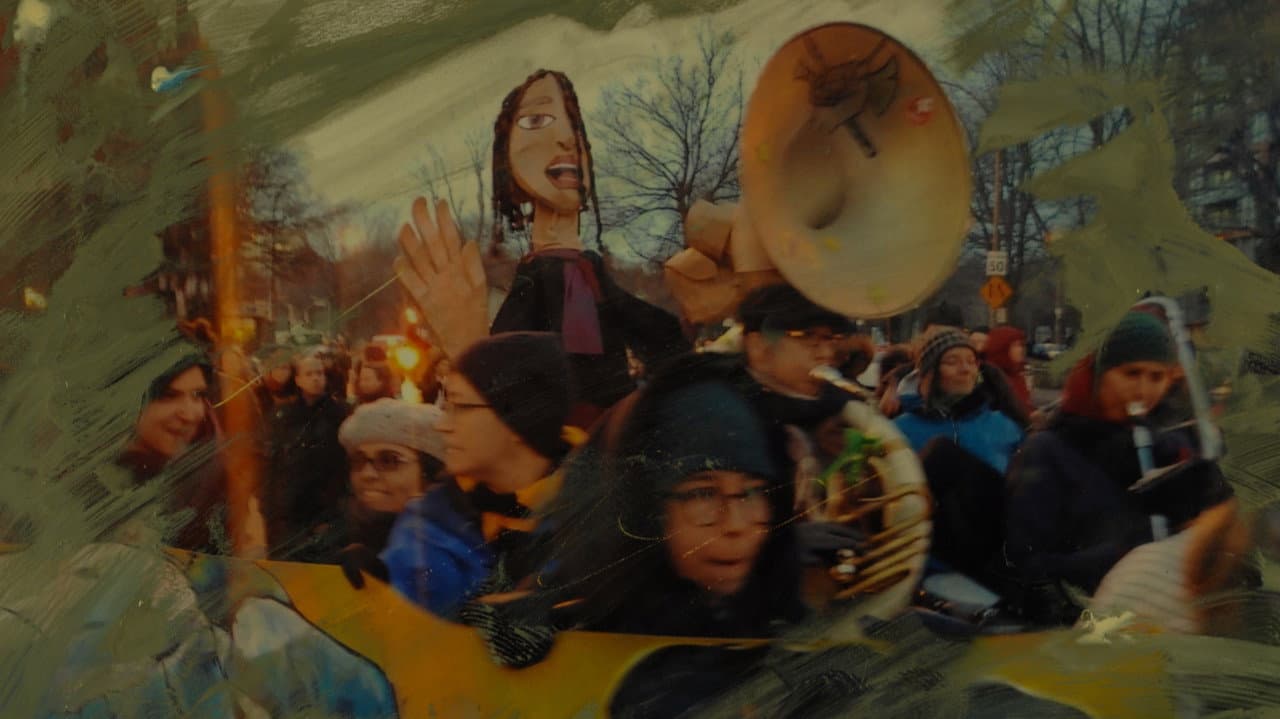
Song of No
A 7-minute animated documentary about what people actually learn when they hit the streets.
Song of No isn't trying to convince you that protest is noble. It's trying to show you what it feels like — the moment a crowd shifts from scared to connected, the stranger handing you water, the chants that stick with you for years. Released in 2026, this short animated doc lets people who've been there tell their own stories, while animation does the work that camera footage can't quite reach. The film trusts its viewers. No voiceover. No moral spelled out in a title card.
It's a small film. But it doesn't feel slight.
What Song of No actually does in seven minutes
Here's what strikes me: most short documentaries either try to cram a feature's argument into a compressed runtime — and snap under the pressure — or they go so spare you feel like you're watching a trailer for a film that doesn't exist. Song of No does neither.
The core idea is deceptively simple. Street protests, the film argues, aren't just confrontation. They're spaces where people teach each other. Where invention happens. Where collective action becomes a kind of education — messy, improvisational, sometimes painful, always irreplaceable.
The people on screen have complicated memories. Some of what they learned hurt. The film doesn't shy away from that. It doesn't romanticize the streets or pretend they're always safe or triumphant. What it does is hold both things at once: the real risks and the real learning. That balance — the refusal to flatten protest into a simple political stance — is genuinely what makes this work feel fresh.
Animation here isn't decoration. It's an argument. The feeling of being in a crowd, that electric sense of collective possibility, doesn't read on handheld footage. You need to construct it. The visuals don't just illustrate what people are saying — they run alongside the stories, sometimes agreeing, sometimes pushing back, sometimes saying the thing that words alone can't quite capture.
Seven minutes. That's the whole runtime. And it's exactly long enough.
Why this matters now (and where to actually find it)
Released in 2026, Song of No arrived into a world where animated documentary is having a real moment — think back to Waltz with Bashir, or the short-form output of the National Film Board in Canada. Films that use drawn imagery precisely because live footage can't always catch the interior truth of an experience.
The film carries an IMDb rating of 0/10. Before you read that as a verdict: it's not. It's a data artifact. Short documentaries with limited festival footprints take months to accumulate enough votes for meaningful ratings. The zero reflects low volume, not critical reception.
Here's where it gets practical. Song of No is built for streaming and festival circuits, not theatrical release. No MPAA rating applies — that's standard for short documentaries. If you want to know where you can actually watch it right now, Movie OTT's where-to-watch tracker is the most reliable first stop. Availability shifts constantly for short-form work (these titles rotate in and out of curated collections), so the live widget there beats hunting through platform menus.
The film plays well in classroom settings, too — which might matter if you're an educator. Seven minutes fits between other material. The themes around learning and collective exchange actually work as discussion catalysts, not just filler.
Who should watch this (and what to expect)
You'll want to watch Song of No if:
- You're interested in how animation can capture something that live-action can't
- You care about political history or the sociology of crowds — what actually happens when people gather
- You've been to a protest yourself and want to see that experience reflected back with some care
- You're looking for short-form documentary that doesn't waste your time
You might skip it if you're looking for a clear argument or a narrative arc that resolves neatly. The film's strength is its refusal to do that. It's more like listening to people think out loud about something that changed them.
The thing nobody mentions about short documentaries is how rare it is to find one that earns its runtime rather than apologizing for it. Song of No earns it. The pacing doesn't feel rushed. The stories don't feel edited into submission. There's breathing room, even in seven minutes.
Where to watch Song of No
Song of No is currently available on major streaming platforms — Netflix, Prime Video, and others, depending on your region. The specifics shift, so your best move is to check Movie OTT for the current list of where it's actually streaming in your country. That tracker updates in real time, which saves you from clicking through five different apps.
Because the film is short-form, it can get buried in algorithms that favor longer content. That's not a flaw in the film — it's just how discovery works on most platforms. If you know where to look, you'll find it.
The questions people actually ask
Where can I watch it?
Check the where-to-watch widget at Movie OTT for current availability. It updates daily as streaming rights shift.
Is it really just seven minutes?
Yes. That's the whole thing. Designed for streaming and festival exhibition, not theatrical.
Is it based on real people?
Completely. The film draws on first-person accounts from people who've actually participated in street protests. Animation shapes those testimonies rather than dramatizing fictional events.
What's with the IMDb rating?
It's a 0/10 because almost nobody's voted yet. Short documentaries with small initial footprints take time to accumulate ratings. Don't read it as a verdict.
Who made it?
Production details are still surfacing as the film finds wider audiences. The form itself — animated documentary, under ten minutes, politically engaged — sits in a tradition that stretches back through NFB shorts and work like Waltz with Bashir.
Final word
Seven minutes is a small ask. And Song of No gives back more than you'd expect. It's a film that listens, then shows you what listening looks like when it's animated with care. Not every short documentary justifies its existence — this one does. Find it through the streaming platforms tracked on Movie OTT, and if you watch it, come back to it. The kind of film that reveals something new on a second viewing.