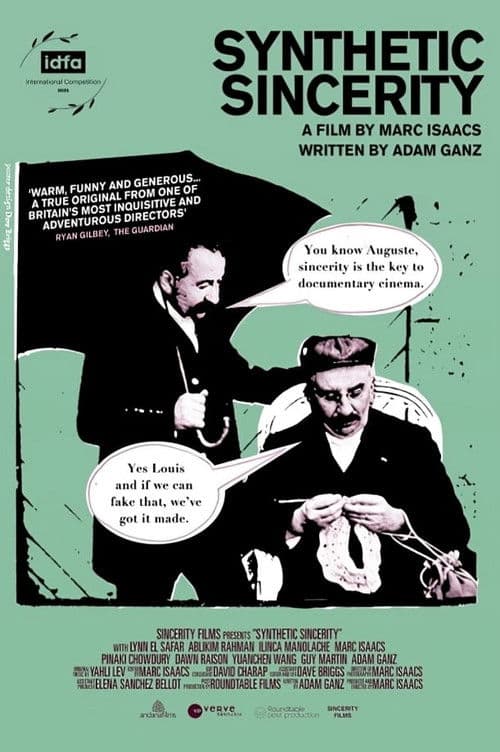
Synthetic Sincerity
A Fake Lab, Real Questions About Documentary Truth
Synthetic Sincerity is Marc Isaacs doing something he's never done before — building an entire film around a deliberate fiction. The 2026 documentary opens with a straightforward deal: Isaacs partners with the Synthetic Sincerity Lab (invented) at the University of Southern England (doesn't exist) to film researchers attempting to teach AI characters authentic human emotion. They want to use real subjects from Isaacs' earlier work — including a Uyghur refugee chef — as emotional templates. In return, they get a camera crew documenting the process. What unfolds is part documentary, part hoax, entirely fascinating because it refuses to choose sides.
The lab is fake. The researchers are actors. The ethical questions the film raises are completely genuine.
Why IDFA 2025 Took This Seriously
A film built on staged fiction doesn't typically get slots at Amsterdam's International Documentary Film Festival — one of the most selective platforms in non-fiction cinema. But Isaacs' work landed there anyway, which tells you something about how the documentary world is reckoning with questions of constructed truth. The international competition isn't a participation trophy. Screening there alongside the year's most talked-about non-fiction work gave Synthetic Sincerity immediate critical momentum heading into 2026.
Isaacs himself brings real credibility to the table. His earlier films — Lift (2001) and All White in Barking (2008) — built a reputation for patient, observational portraiture, the kind where you sit with ordinary people long enough to catch something quietly extraordinary. This new work marks a sharp turn. It's self-reflexive, playful, openly skeptical of its own methods in ways his earlier films weren't.
The film then traveled to the Antenna Documentary Film Festival in Sydney, where Isaacs spoke openly about the fictions he'd constructed and the uncomfortable ethics of using real documentary subjects inside a staged scenario. That kind of critical examination — the filmmaker interrogating their own practice — doesn't happen by accident.
What Makes This Different From Other AI Documentaries
Here's what strikes me: nobody mentions how genuinely funny this film is. Not jokey-funny, but absurdly, gently funny in a way that keeps the philosophy from feeling like a lecture. Researchers in lab coats trying to quantify and replicate human sincerity? That's inherently comic. Isaacs leans into it without ever letting the humor become cheap.
But the real move is the self-critique. By staging a fake lab to criticize AI's inability to capture authentic human experience, Isaacs is also quietly indicting documentary itself — which has always claimed a special relationship with truth that the film suggests is at least partially constructed. The fiction isn't a detour from the argument. It is the argument.
Modern Times Review flagged the use of the Uyghur refugee as emotional data for the AI — either a pointed commentary on how documentary subjects get instrumentalized or a genuinely uncomfortable ethical choice, depending on how you read it. Hard to say if Isaacs fully resolves that tension. I'd argue the film is more interesting for leaving it open.
Visually, there's nothing flashy here. The cinematography is deliberately plain, almost bureaucratic — which suits the pseudo-scientific setting perfectly. That restraint is its own formal statement.
Runtime, Rating, and Where This Actually Streams
Runtime: 71 minutes. Tight. No padding.
Rating: The film carries a 6.0/10 on IMDb from an initial user pool — modest enough that the number doesn't mean much yet as more viewers discover it.
Where to watch: Synthetic Sincerity is on major OTT platforms, though availability varies by region since it's moved through festivals before landing on streaming. Check Movie OTT's where-to-watch widget for current availability in your territory — it pulls live data across services, so you're not hunting through five different apps. If it's not on your preferred platform yet, set a watchlist alert. Festival titles at this caliber typically find streaming homes within a year of their premiere.
Movie OTT also tracks rating updates as they come in, which is useful for titles like this that don't get the marketing push of wide theatrical releases and can be easy to miss if you're not actively looking.
Questions You'll Have
Is the Synthetic Sincerity Lab real?
No. Isaacs has confirmed in interviews that the lab and university are invented — central to the film's whole argument about constructed truth.
Who directed this?
Marc Isaacs, British documentary filmmaker. This represents a significant departure from his earlier observational work.
How long is it?
71 minutes. The brevity feels intentional — Isaacs makes his points and exits before the concept overstays its welcome.
Should I watch it if I'm not into theory?
Yes. Don't let the conceptual framework fool you. This isn't a lecture. It's strange, funny, and the questions it raises stick with you whether you're thinking about epistemology or just thinking about what you just watched.
Did it win awards at IDFA?
The international competition slot itself is significant recognition. Specific award wins from that festival haven't been confirmed in available sources, but its continued festival presence through 2026 suggests sustained critical interest.
Who Should Actually Watch This
Watch Synthetic Sincerity if you've ever wondered whether cameras capture truth or manufacture it. Also watch it if you've never thought about that question but want something genuinely strange to sit with for 71 minutes. Not a casual watch — but not inaccessible either.
If you've liked other formally adventurous documentaries that question their own methods — Errol Morris, Joshua Oppenheimer, that kind of territory — this will speak to you. Even if you haven't seen those, this film works as a standalone provocation. The ask is modest in length. The payoff is a genuine puzzle you'll keep turning over.