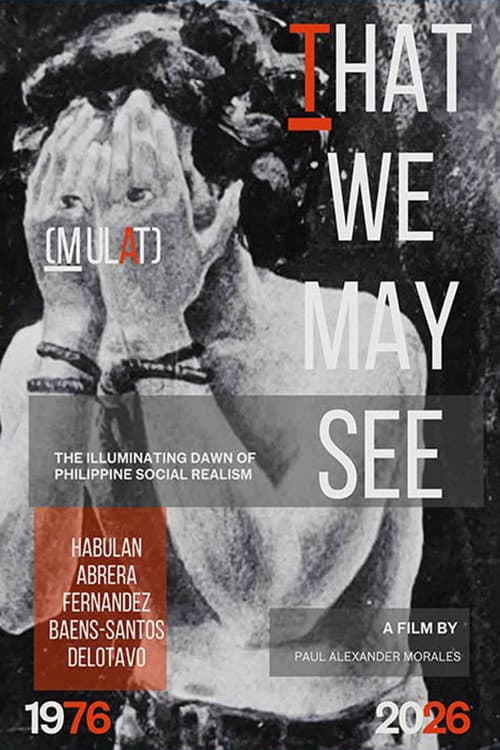
That We May See
A documentary about five Filipino artists who refused to look away during Martial Law. 2026 release. 75 minutes.
What you need to know before watching
That We May See arrives in 2026 as a portrait of five painters — Renato Habulan, Egai Fernandez, Pablo Baens-Santos, Jess Abrera, and Antipas Delotavo — who founded KAISAHAN in 1976 and became the backbone of the Philippine Social Realist movement. The film doesn't dramatize or sentimentalize what they did. It just shows the work, and the people behind it.
Here's what matters: if you care how artists survive dictatorship, or what happens to a protest movement once the dictatorship ends, this is for you. If you want spectacle and swelling strings, keep scrolling. The documentary runs 75 minutes, was funded by the National Commission for Culture and the Arts, and is currently available on major OTT services — check Movie OTT's where-to-watch tracker for the latest platform availability in your region.
Why CAYA matters more than you'd think
Most histories of the Philippine Social Realist movement skip over CAYA — the Center for the Advancement of Young Artists — or mention it in passing. That's a mistake, and this documentary corrects it.
CAYA wasn't just a studio space. It was the incubator where a generation of young artists learned to see their work as something other than decoration. Before CAYA, you might paint. After CAYA, you were a witness. You were testifying. The five artists at the center of this film all came through CAYA's doors, and the documentary tracks that connection with real curiosity — not as a footnote, but as the actual engine of the movement.
What's striking is how the film doesn't treat this as settled history. One of the artists reflects on the years after Marcos fell, and the question hanging in the room becomes: what does protest art do when there's nothing obvious left to protest? The documentary won't hand you an answer. But that's exactly why it matters.
The five artists, and why they're not interchangeable
Renato Habulan carries a restrained gravity when he speaks. Antipas Delotavo — whose murals became some of the most recognizable images of the Martial Law era — speaks with the measured confidence of someone who's spent decades defending why political art still matters. Egai Fernandez, Pablo Baens-Santos, Jess Abrera: each brings a different temperament to the screen.
The temptation here would've been to blend them into a single heroic narrative. "Five artists. One movement. One vision." Flattened. But the filmmakers resist that. They let the tensions breathe. These five shared a commitment to social realism as a mode of witness, but their paths diverged — sometimes sharply — in how they understood what that commitment meant after the regime fell. Hard to say whether every editorial choice lands perfectly, but the pacing rarely drags across the 75-minute runtime.
How this documentary sees what it's looking at
The craft here is understated. No dramatic reconstructions. No heavy-handed score manipulating you into feeling something. The filmmakers trust the material, which is a form of respect for both the subjects and the audience. (Social realism as a philosophy says: look at reality without flinching. The documentary adopts that same discipline.)
Personal reflections are intercut with historical context in a way that feels organic rather than textbook. Contemporary perspectives woven throughout give the sense that this story isn't finished — these artists are still alive, still working, still thinking. What I keep coming back to is a single moment where one artist talks about the gap between what they were trying to do in 1976 and what's actually possible now. That gap. That's the real subject.
The production has institutional backing from the National Commission for Culture and the Arts, which lends it a credibility that independent documentaries often spend years trying to earn. It's not perfect — I'm not sure the film fully grapples with some of the internal disagreements that split the movement in the 1980s — but it's genuinely interested in its subject rather than reverential toward it.
Where to watch it, and when
That We May See is currently streaming on major OTT platforms. The exact availability shifts depending on your region and which services you subscribe to, so your best move is to check the where-to-watch widget on Movie OTT, which updates when the film moves between platforms.
For a documentary this focused — 75 minutes, no filler — watch it on the largest screen you have access to. The paintings deserve to be seen. The faces of the artists as they talk about their work deserve to be seen. It's not a phone-scroll kind of film.
Common questions
Q: Is this appropriate for general audiences, or just art students?
It's a documentary about painters and political history. You don't need to be an artist to care about it. But if you're the kind of person who thinks "art history" sounds boring, this won't change your mind. If you're interested in how people create meaning under repression, though — watch it.
Q: How does this compare to other Philippine documentaries?
There's no direct equivalent. It's closer in spirit to documentaries about Latin American muralists or Eastern European dissidents than to anything else in the Philippine canon. If you've seen The Art of the Real (Sundance series) or documentaries about Käthe Kollwitz, you'll recognize the tone.
Q: What's the historical context I should know going in?
Ferdinand Marcos declared Martial Law in the Philippines in 1972. It lasted until 1986. KAISAHAN formed in 1976, during the heaviest repression. The movement's whole purpose was to make art that couldn't be ignored while people were suffering. That's the spine of the film.
Q: Do I need to watch anything else first?
No. The documentary is self-contained. But if you want to go deeper afterward, look for books on Philippine contemporary art in the 1970s-80s. Movie OTT's critical resources sometimes links to further reading on films in this vein.
Why this film exists now, in 2026
There's something about the timing of this release. We're far enough from Martial Law that it's become history rather than lived trauma. Close enough that the five artists are still here to speak about it. The documentary captures something that won't exist in another decade: their voices, their recollections, their unresolved questions about what their work meant and means.
It's not essential viewing in the way a canonical masterpiece is essential. But for anyone trying to understand how art survives authoritarianism — how it becomes a form of resistance and then, afterward, becomes something harder to name — it's close to indispensable. Catch it on a major streaming service. Don't skip the sections on CAYA. That's where the real story of the movement's survival lives.