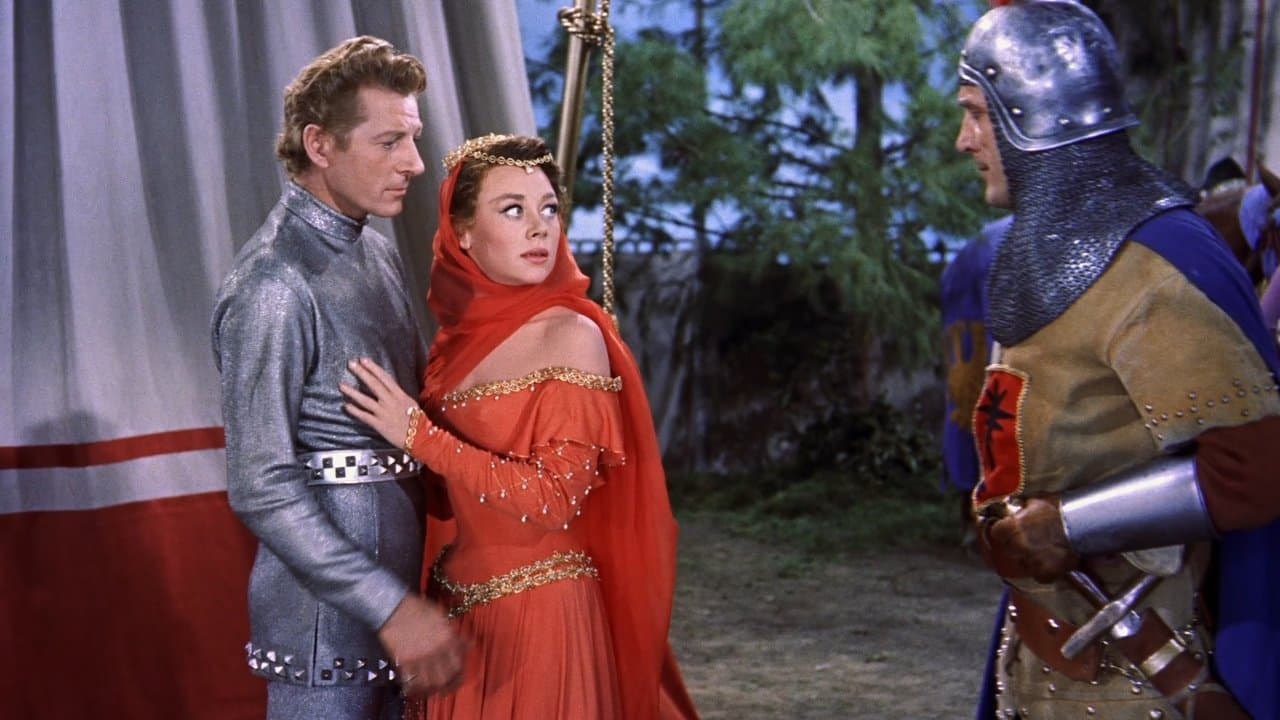
The story of The Court Jester
The Court Jester opens with a carnival performer—hapless, well-meaning, and utterly out of his depth—who gets swept up in a plot to overthrow a usurper and restore the rightful king of England to his throne. What sounds like a straightforward adventure actually becomes something far more interesting: a vehicle for controlled chaos. Kaye's character doesn't waltz into the castle as a trained spy or seasoned warrior. He stumbles in, literally and figuratively, masquerading as the court jester while trying to navigate a world of courtly intrigue, sword fights, and the kind of physical comedy that only Danny Kaye could pull off. The plot itself isn't what matters most here—it's the excuse for Kaye to do what he does best: sing, dance, mime, and somehow convince you that a bumbling carnival act is exactly what a medieval court needs.
Behind the making of The Court Jester
The Court Jester came together as something of a passion project. Directed by Norman Panama and Melvin Frank, who also wrote and produced the film, it was crafted specifically as a showcase for Danny Kaye—a rare kind of Hollywood collaboration where the material was built around the star's particular gifts rather than the other way around. Released by Paramount Pictures in 1955, the film was shot in Technicolor and VistaVision, the widescreen format that was still relatively novel at the time. The production boasted an impressive ensemble: Glynis Johns brought elegance and charm, Basil Rathbone lent gravitas as the villain, and Angela Lansbury added star power in a supporting role. Cecil Parker rounded out a cast that felt like a who's-who of mid-century Hollywood. Here's the thing that doesn't get mentioned often enough—the film lost close to two million dollars on its theatrical release, a significant financial disappointment despite its later critical rehabilitation. That initial box office failure is almost beside the point now; the film's IMDb rating of 7.276/10 reflects how audiences have come to appreciate it over the decades, even if 1955 moviegoers weren't entirely sure what to make of it.
What makes The Court Jester stand out
What's striking about The Court Jester is how it refuses to stay in one lane. It's a spoof of swashbuckling adventure films—particularly The Adventures of Robin Hood—but it's also genuinely romantic, genuinely funny, and genuinely musical without ever winking at the audience too hard. Kaye's performance is the linchpin. He's capable of delivering a perfectly timed pratfall one moment and then pivoting to a serene, almost ethereal vocal performance the next. His ability to shift between manic energy and unexpected tenderness is what makes the film work; without that range, the whole thing collapses into mere silliness. The supporting cast doesn't phone it in either. Rathbone plays the villain with enough conviction that you actually believe the stakes matter, even when Kaye's character is stumbling around in a jester's outfit. Glynis Johns is particularly stunning—and serviceable as both love interest and fellow conspirator, giving her scenes genuine weight. What nobody mentions is how the film manages to be a family picture that doesn't condescend to kids while also offering enough satirical wit to keep adults entertained. It's an adventure, a comedy, a romance, and a musical all at once, and somehow it doesn't feel bloated or scattered. The pacing keeps everything moving; you're never bored, even when the plot takes a turn that doesn't quite make logical sense.
Where to stream The Court Jester online
The Court Jester is currently available on major OTT services, and if you're looking to track down exactly which platform has it in your region, Movie OTT maintains up-to-date listings across all the major streaming providers. The film's availability shifts occasionally depending on licensing agreements, so it's worth checking the Where to Watch widget at the top of this page to see your current options. Whether you're subscribed to a classic Hollywood catalog or a broader streaming service, there's a solid chance The Court Jester is within reach. The Technicolor and VistaVision restoration on modern streaming platforms is genuinely worth experiencing; the film's visual palette—all those rich jewel tones and wide-screen compositions—looks significantly better than it might on a standard definition broadcast.
Frequently asked questions
Q: Who directed The Court Jester?
Norman Panama and Melvin Frank directed the film, and they also wrote and produced it. The film was distributed by Paramount Pictures.
Q: Is The Court Jester based on a true story?
No. While it's set in medieval England and involves a real historical premise—the restoration of a rightful king—the plot is entirely fictional and designed specifically as a comedic vehicle for Danny Kaye.
Q: How long is The Court Jester?
The film runs 101 minutes, making it a brisk adventure that doesn't overstay its welcome despite juggling multiple genres and comedic set pieces.
Q: What's the official tagline for The Court Jester?
Paramount's tagline was playfully self-aware: "We asked Shakespeare and Francis Bacon would they declare which one wrote this and they both said, 'Get outta here!'"—a tongue-in-cheek acknowledgment that the film wasn't trying to be high art.
Q: What genres does The Court Jester blend?
The film combines music, adventure, and comedy, functioning as a musical comedy-adventure that works as a family film without being saccharine.
Final thoughts on The Court Jester
The Court Jester deserves to be seen by anyone who enjoys classic Hollywood entertainment that doesn't take itself too seriously. It's the kind of film that rewards rewatching—you'll catch new gags, appreciate the supporting performances more deeply, and understand why it's become a cult favorite despite its initial commercial stumble. Danny Kaye fans absolutely need to see it, but honestly, you don't need to be a Kaye devotee to get swept up in the charm. It's a reminder that sometimes the best movies are the ones that simply want you to have fun, and they're willing to work hard—really hard—to make that happen.