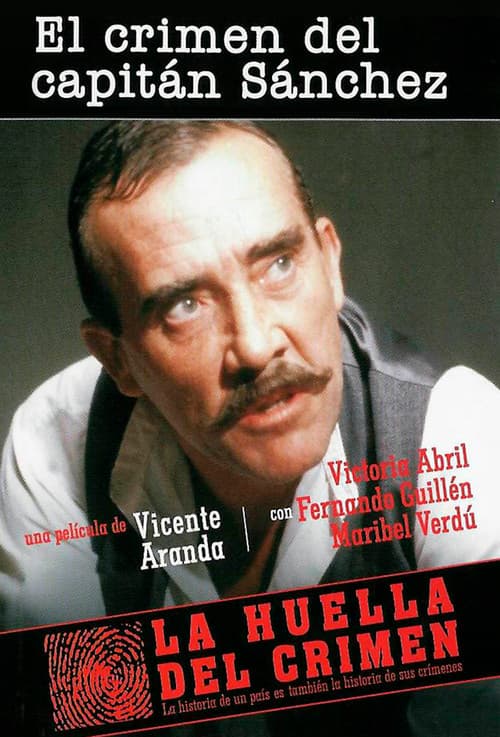







The story of The Crime of Captain Sánchez
The Crime of Captain Sánchez unfolds in Madrid during the spring of 1913, a period of social tension and shifting power in Spain. The narrative centers on a pivotal moment at a casino where a 50-year-old widower of considerable wealth encounters a strikingly beautiful 20-year-old woman. What begins as a passing glance becomes something far more dangerous—a fixation that will pull both characters into circumstances neither could have anticipated. The film doesn't present this as a simple romance or seduction story; instead, it frames the encounter as the opening move in a game where the stakes are measured not in pesetas but in reputation, freedom, and life itself. The age gap, the class difference, the setting of the casino—all of these elements create an atmosphere where desire and criminality become indistinguishable. Without spoiling the trajectory, what's worth knowing is that this isn't a film about love conquering obstacles. It's about what happens when obsession meets opportunity, and how quickly civilization's thin veneer can crack.
Behind the making of The Crime of Captain Sánchez
The Crime of Captain Sánchez was produced in 1985 by Pedro Costa P.C. and TVE, Spain's national television broadcaster, a partnership that signals the film's roots in European television production of that era. The 63-minute runtime reflects its origins as a made-for-TV production, a format that was common in Spain during the 1980s when state television invested in original dramatic content. This wasn't a theatrical release with studio backing or international distribution—it was a domestic Spanish production designed for broadcast audiences. The decision to set the story in 1913 rather than the contemporary 1980s creates a kind of historical distance that allows the filmmakers to explore timeless themes of class, power, and moral transgression through a period lens. The film's modest budget and television production values don't diminish its ambition; if anything, the constraints forced a focus on character and dialogue over spectacle. IMDb users have rated it 4.3 out of 10, which suggests the film has found a particular audience rather than achieving broad appeal—the kind of niche European crime drama that Movie OTT helps connect with viewers hunting for something beyond mainstream fare.
What makes The Crime of Captain Sánchez stand out
What's striking about The Crime of Captain Sánchez is how it treats its premise without melodrama or moral hand-wringing. The film doesn't ask you to sympathize with the widower or condemn him outright; instead, it observes his choices with the precision of a clinical eye. The 1985 production values—the grainy stock, the deliberate pacing—actually serve the material well, creating an atmosphere that feels authentically period without relying on expensive set decoration. There's a restraint here that's almost uncomfortable to watch. The performances anchor everything; the actors playing the widower and the young woman carry the weight of the entire narrative through their glances, their hesitations, their moments of calculated vulnerability. I keep coming back to how the film uses the casino setting not just as a backdrop but as a metaphor—a space where people risk everything on chance, where social rules are temporarily suspended, where fortunes shift in an instant. The script doesn't waste words; every scene moves the story forward, and there's no subplot padding out the runtime. For viewers accustomed to modern crime dramas with their intricate plotting and ensemble casts, The Crime of Captain Sánchez might feel spare, even austere. But that sparseness is intentional. It forces you to pay attention to the subtext, to read what isn't being said. Movie OTT's streaming availability makes it easy to discover films like this one—European productions from the 1980s that don't get theatrical distribution but deserve an audience.
Where to stream The Crime of Captain Sánchez online
The Crime of Captain Sánchez is currently available on major OTT services, and you can check the Where to Watch widget at the top of this page to see which platforms are carrying it in your region right now. Streaming availability changes frequently, so that widget is your best resource for real-time information about where you can access the film. Since it's a 1985 Spanish production with a relatively modest profile outside Europe, it's the kind of title that pops up on different platforms depending on licensing agreements and regional catalogs. The 63-minute runtime means it won't demand a huge time commitment—you could watch it in a single evening. If you're building a list of lesser-known European crime dramas, this one's worth adding. Movie OTT tracks current streaming availability across dozens of platforms, making it simple to find obscure titles like this one without having to search five different apps.
Frequently asked questions
Q: What year was The Crime of Captain Sánchez released?
The Crime of Captain Sánchez was released in 1985. It was produced by Pedro Costa P.C. and TVE, Spain's state television broadcaster.
Q: How long is The Crime of Captain Sánchez?
The film has a runtime of 63 minutes, which reflects its origins as a made-for-television production rather than a theatrical release.
Q: What's the IMDb rating for The Crime of Captain Sánchez?
The Crime of Captain Sánchez has an IMDb rating of 4.3 out of 10, indicating it's found a niche audience rather than achieving broad critical consensus.
Q: Is The Crime of Captain Sánchez based on a true story?
The film is set in Madrid during the spring of 1913 and explores a crime rooted in obsession and class conflict, but there's no indication it's directly adapted from a specific historical event.
Q: Where can I watch The Crime of Captain Sánchez?
The Crime of Captain Sánchez is available on major OTT services. Check the Where to Watch widget at the top of this page to see which platforms are currently streaming it in your region.
Final thoughts on The Crime of Captain Sánchez
The Crime of Captain Sánchez isn't a film for everyone. It's deliberately paced, visually spare, and morally ambiguous in ways that can feel unsatisfying to viewers expecting clear heroes and villains. But that's precisely what makes it worth seeking out. It's a film that trusts its audience, that doesn't explain or justify the characters' actions, that lets tension build through what's left unsaid. If you're tired of contemporary crime dramas with their rapid cuts and constant exposition, this Spanish television production from 1985 offers something different—a slow burn that rewards patient attention. It's the kind of discovery that makes streaming services valuable, the kind of film that wouldn't find you through algorithms alone but might change how you think about the crime genre.