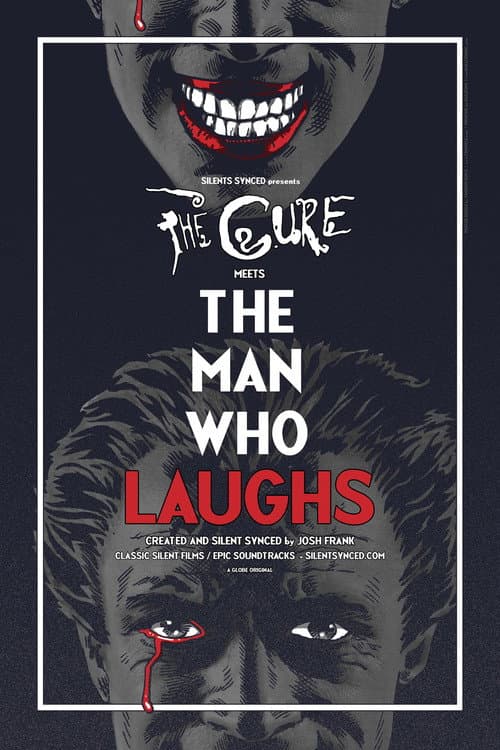
The Cure Meets The Man Who Laughs
A 1928 silent film gets a new life with a post-punk soundtrack that somehow makes perfect sense.
What you're actually watching
The Cure Meets The Man Who Laughs is a re-scored version of Paul Leni's 1928 German Expressionist masterpiece, now paired with music from The Cure. The original film follows Gwynplaine, an 18th-century clown whose face has been carved into a permanent, grotesque grin as punishment by a cruel king — and who becomes the unlikely star of a traveling carnival. Nothing in the narrative changes. Every frame remains exactly as Leni shot it. What's different is what you hear.
The Cure's catalogue — decades of gothic post-punk, synthesizer melancholy, and Robert Smith's voice like a wound that won't close — turns out to be an eerie fit for Leni's jagged shadows and carnival torchlight. It's not a novelty. It feels inevitable, the way certain pairings do after they exist.
The film premiered at SXSW London in 2026 as a special event screening, positioned somewhere between a festival presentation and a concert. Runtime: 130 minutes — the full restored cut, not a trimmed highlight reel. That matters. Josh Frank, who directed this presentation and runs the "Silents Synced" series, isn't rushing you through.
Why The Cure works for this story better than you'd expect
What's striking is how little the music has to force anything. Smith's entire aesthetic — the smeared lipstick, the teased hair, the mournful melodies in minor keys — is Gwynplaine's dilemma set to guitar and synthesizer. A man whose outside screams one thing while his inside feels something else entirely. That's the core of The Cure's catalog. That's also the entire tragedy of this film.
During the carnival sequences, where crowds jeer at Gwynplaine's performance, the score does something clever: it pulls slightly against the image rather than simply underlining the drama. You don't just watch his dissociation — you feel it. The tension between what we're seeing and what we're hearing creates space for something more complex than melodrama.
I kept thinking about how most re-scored silents flatten the original by turning it into an elaborate music video. This one doesn't. The cinematography by Gilbert Warrenton — the composition, the shadows, the way a face can register an entire world of emotion — stays in the foreground. The Cure surrounds it, doesn't consume it.
Where to watch and how to find it
The Cure Meets The Man Who Laughs is currently available on major streaming platforms, though availability shifts as licensing windows open and close. Movie OTT's where-to-watch tracker pulls live data across services daily, so if it's moved platforms since this piece went up, you'll see the current location right there.
Because this project lives outside the normal theatrical release pipeline, it's worth checking whether your platform offers it in a higher-quality audio presentation. The score is the entire point. It deserves good speakers.
For Cure fans coming to silent film for the first time: start here. You won't need to know anything about German Expressionism or Victor Hugo's novel. For silent film buffs revisiting Leni: you'll find a fresh reason to sit with it again — a conversation between two artists separated by a century, working in languages that shouldn't translate but do.
The backstory: how this even happened
Josh Frank has quietly built the "Silents Synced" series into something genuinely unusual — pairing classic films with contemporary musicians in ways that feel like collaboration rather than decoration. Previous pairings have matched silents with Radiohead, R.E.M., and Pearl Jam. This Cure edition is the most ambitious yet.
The original 1928 film was itself an adaptation of Victor Hugo's 1869 novel L'Homme qui rit (The Man Who Laughs). It's a work of fiction, not history — though Leni's visual language makes it feel documentary-real. The disfigurement, the carnival, the impossible love story tangled through it all — these are Hugo's inventions, rendered in German Expressionist aesthetics that still haven't been equaled.
What nobody mentions about re-scored silents is how much curatorial skill they demand. You're not just playing music over pictures. You're making thousands of micro-decisions about timing, volume, emotional temperature. Frank's choices here suggest someone who understands both The Cure and silent cinema deeply enough to know when not to match them up too perfectly.
Questions you probably have
Should I watch this if I don't know The Cure? Yes. The music works even if you've never heard Smith's voice before.
Is this the original film or something new? It's the original film, 1928, every frame intact. The score is the only new element.
How do I know where it's actually streaming right now? Movie OTT updates streaming availability daily. That's your fastest answer.
Do I need to know anything about the story going in? An 18th-century boy, a disfigured face, a carnival, a love story that can't work. That's enough. Leni doesn't waste time on exposition.
Is it dark? Yes. The imagery is beautiful and haunting and sometimes genuinely difficult to watch. Not for young kids.
Who should actually watch this
If you like The Cure, you'll recognize the emotional territory — that particular brand of melancholy that feels almost religious in its commitment to minor keys and synthesizer wash. If you like silent film, you're in the presence of one of the era's most visually sophisticated directors. If you like stories about outsiders and spectacle and the gap between how the world sees you and who you actually are — which is most of us — you'll find something here that lands harder than expected.
The thing nobody mentions is that these kinds of experiments often fail. A re-scored silent can feel like a gimmick, the film reduced to a backdrop for the music, or the music reduced to background noise for the film. This one works because neither element yields. They push against each other just enough to create actual friction — the kind that generates heat instead of just noise.
Hard to say whether it'll find a path into major film awards cycles (its hybrid nature makes eligibility complicated), but the SXSW London premiere gives it genuine festival credibility from the start. More importantly, early responses from both Cure fans and cinema buffs suggest something rare: a project that doesn't ask you to choose which audience you belong to.
Watch it with the lights off. Don't scroll. Let it breathe. That's the whole thing.