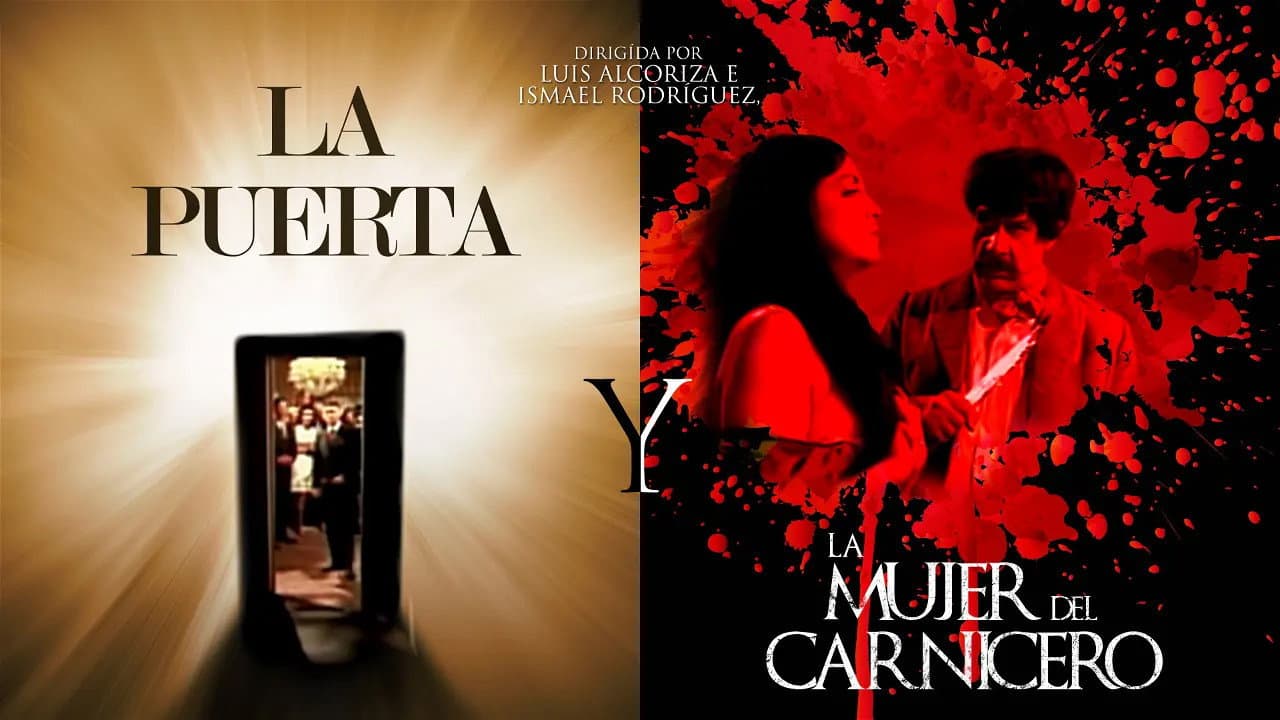


The Story of The Door and the Butcher's Wife
The Door and the Butcher's Wife is a 1969 horror anthology that refuses to play by conventional rules. Divided into two distinct narratives, the film operates as a kind of diptych—each segment exploring fear from a different angle, in a different world, yet both tapping into something primal about human dread. The first story, "La puerta" (The Door), unfolds at an elegant high-society gathering where the veneer of civilized conversation masks something far more sinister lurking just beyond a single doorway. When guests encounter what lies inside—a naked, menacing figure in a bizarre, impossible corridor—the social order fractures. The second segment, "La mujer del carnicero" (The Butcher's Wife), shifts us to the Mexican Revolution, where a lieutenant's guilt over a murder he's committed spirals into hallucinatory terror that blurs the line between what's real and what's punishment playing out in his fractured mind. What makes The Door and the Butcher's Wife stand out is its willingness to leave viewers unsettled without neat resolution. These aren't jump-scare vehicles; they're psychological rabbit holes.
Behind the Making of The Door and the Butcher's Wife
Produced by Películas Rodríguez, The Door and the Butcher's Wife emerged from Mexican cinema during a period when the country's film industry was experimenting with genre storytelling in ways Hollywood wouldn't explore until years later. The 82-minute runtime is lean and efficient—no fat, just bone and nerve. The film's construction as a two-part narrative was itself a bold choice in 1969, when anthology horror existed but wasn't yet the commercial staple it would become. While specific box-office figures are difficult to pin down for a regional Mexican release from that era, the film's survival in the cultural record and its 7.4 IMDb rating suggest it found an audience among serious horror enthusiasts willing to seek out work beyond Hollywood's output.
The production design and cinematography reflect the constraints and ingenuity of Mexican filmmaking at the time—there's a tactile, almost theatrical quality to the scares, which lends them a different kind of credibility than slicker, more effects-heavy contemporaries. The cast performances anchor both segments with a seriousness that refuses to wink at the audience. What's striking is how the film trusts the material; there's no camp, no irony, just conviction. If you're tracking down where to watch The Door and the Butcher's Wife, Movie OTT aggregates current streaming availability, which can shift seasonally depending on licensing deals across different regions.
What Makes The Door and the Butcher's Wife Stand Out
The Door and the Butcher's Wife works because it understands that horror isn't about gore or spectacle—it's about violation. The first segment, with its intrusion of the grotesque into a space of privilege and propriety, taps into class anxiety and the terror of the unknown that exists just beyond social boundaries. That naked figure in the corridor isn't explained; it simply is, and that refusal to rationalize it is what lingers. The second story operates differently, using the fog of guilt and the chaos of war as a canvas for internal dissolution. A lieutenant's mind becomes the monster. The hallucinations aren't described in detail—they're suggested, implied, which forces viewers to construct their own nightmares.
I keep coming back to how efficiently the film does this work. Eighty-two minutes. No bloat. The performances don't strain for effect; they're grounded in a kind of exhausted realism that makes the supernatural elements feel like intrusions into an already-difficult reality. In both segments, there's an understanding that the most effective horror happens in the gap between what we see and what we imagine we've seen. Critics have noted the film's influence on later Mexican and Latin American horror cinema, though it doesn't get the international recognition it deserves—perhaps because it arrived before the global streaming era made such discoveries routine. That's changing, slowly. Movie OTT tracks current streaming availability across major OTT services, making it easier than ever to hunt down titles like this that would've required VHS trading or festival screenings just a decade ago.
Where to Stream The Door and the Butcher's Wife Online
The Door and the Butcher's Wife is currently available on major OTT services—check the Where to Watch widget at the top of this page for real-time platform availability in your region. Streaming rights shift periodically, so if you're planning to watch, it's worth verifying which service has it before settling in. The film's 82-minute length makes it an ideal late-night watch, the kind of thing you can finish in a single sitting without it becoming a commitment. Because the film is structured as two separate stories, you could theoretically pause between them—though I'd recommend pushing through to feel the full weight of both narratives.
Frequently asked questions
Q: Is The Door and the Butcher's Wife based on a true story?
No, it's a fictional horror anthology. Both segments are original stories crafted specifically for the film, though the second story's setting during the Mexican Revolution draws on real historical events as a backdrop for its psychological horror.
Q: Who directed The Door and the Butcher's Wife?
The film was produced by Películas Rodríguez in 1969. While specific directorial credits for each segment aren't universally documented in English-language sources, the film represents a significant work from Mexican horror cinema of that era.
Q: What's the runtime of The Door and the Butcher's Wife?
The complete film runs 82 minutes, split between the two stories. It's a relatively compact experience that packs considerable psychological weight into a brief timeframe.
Q: Is The Door and the Butcher's Wife in English or Spanish?
The film is in Spanish, as it's a Mexican production. If you're watching on a streaming platform, check whether subtitles are available in your preferred language.
Q: Why is The Door and the Butcher's Wife rated 7.4 on IMDb?
The rating reflects appreciation from horror enthusiasts and critics who value its psychological approach and refusal to rely on conventional scares. It's a strong score for a regional horror film from 1969, indicating that viewers who seek it out tend to rate it favorably.
Final Thoughts on The Door and the Butcher's Wife
The Door and the Butcher's Wife deserves more attention than it typically receives. It's not a mainstream horror film, and it doesn't try to be—it's deliberately strange, deliberately unsettling, and deliberately ambiguous. If you're tired of formula horror and you're willing to sit with discomfort, this 1969 Mexican gem rewards the effort. The kind of film that stays with you. Seek it out.