The Whale and the Musician
An electronic composer and a humpback whale attempt to find common ground through sound
Here's the premise: electronic composer Rone boards a research vessel, sets up underwater speakers, plays his synthesizer music into the ocean, and waits to see if a humpback whale will respond. Not in a metaphorical sense — actually respond, adjusting its own vocalizations in something that resembles a conversation. The 2026 documentary The Whale and the Musician treats this not as sentimental fantasy but as a genuine inquiry: can non-human animals engage with human-made music as something other than noise?
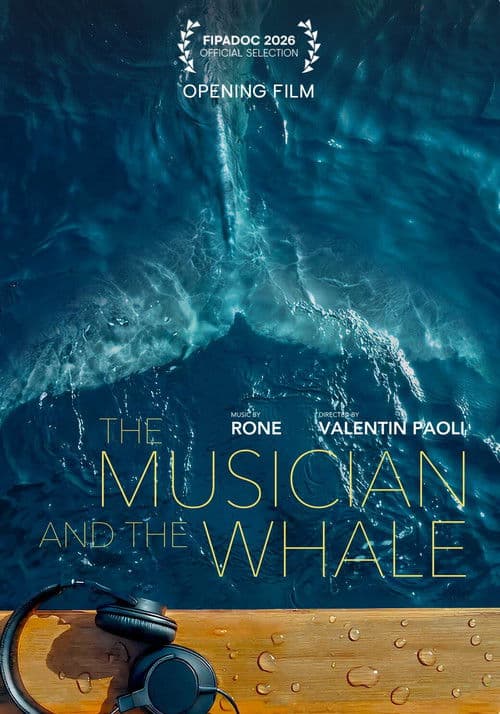
Director Valentin Paoli's film opened the 2026 FIPADOC festival (one of France's most prestigious documentary venues) and has since circulated internationally under an alternate English title, The Musician and the Whale. It runs 83 minutes and doesn't pretend to have answers — which, honestly, is what makes it worth your time.
What actually happens: The film's structure and central experiment
The subject is Rone — Paris-based electronic artist whose real name is Erwan Castex — and his catalog already leans aquatic. Slow builds, reverb-soaked textures, music that genuinely sounds like it was composed for underwater playback. That's not accidental.
Paoli frames the journey as both a scientific expedition and an artistic quest, and he refuses to simplify either one. The film's strongest sequences are almost meditative: long, patient shots of the whale moving through water, lingering near the vessel longer than the scientists expected, long enough that you start doing what they're doing — reading intention into animal behavior while knowing you probably shouldn't.
What's striking is how little this resembles a traditional nature documentary. No David Attenborough narration. No extinction countdown. No manufactured crisis. Instead, Paoli sits with genuine uncertainty. Rone's compositions become the film's structural spine, and the moments where his music is played through underwater speakers and the whale's response is recorded feel less like a science experiment and more like two musicians in separate rooms trying to find the same key.
The cinematography matters here. It doesn't chase the whale — it waits for it. That patience is a directorial choice that pays off. For 83 minutes, the film asks real philosophical questions about consciousness, about what "communication" actually requires, about whether art is uniquely human or just particularly self-aware. Hard to say the film arrives at definitive answers. That's the point.
Where to watch The Whale and the Musician
Theatrical release in France: June 17, 2026 via distributor Jour2fête.
For current streaming availability across VOD platforms, check Movie OTT's where-to-watch tracker, which updates in real time as the film moves through its release window. The tracker covers major services in your region — since streaming rights shift quickly after theatrical runs close, that widget is faster than searching platform-by-platform yourself.
The film hasn't reached broader VOD circulation yet given its June 2026 release, but that window typically opens within 2–4 months of a film's cinema run closing. Movie OTT will flag it the moment it becomes available.
If you've watched Rone before, or loved music documentaries
You don't need to know Rone's existing work going in, though fans of his catalogue will recognize the sonic DNA immediately. If you've watched documentaries like My Octopus Teacher (the patient, meditative approach to animal observation) or Fantastic Fungi (the willingness to sit with open questions rather than manufacturing revelation), this operates in that same register.
What you do need: comfort with ambiguity. The film doesn't hand you a clean answer about interspecies communication. It earns its runtime honestly instead.
The backstory: Production and festival premiere
La baleine et le musicien comes from production company Valdés. Paoli built the project around Rone's existing aesthetic — aquatic, textural, already cinematic — and the two collaborated on a research voyage where actual whale-music interaction was documented. The film opened FIPADOC 2026 before being programmed at CPH:DOX, Denmark's major documentary festival, where international distributors began settling on the English branding.
What's worth noting: FIPADOC doesn't premiere safe bets. Opening their 2026 edition signals the festival circuit took this seriously as a work of cinema, not just science outreach.
As of now, aggregated review scores don't exist on Rotten Tomatoes or Metacritic — the film's too new and too specialized for those engines to have caught up. Box office figures haven't been reported (it's still in its theatrical window). What exists is festival buzz and early coverage from outlets like Sortiraparis, which positioned it as an all-ages but primarily adult documentary about art, science, and the limits of human communication.
Who should actually watch this
Anyone who's wondered whether music means something outside the human brain. That's a wider audience than the premise suggests.
What you're getting: 83 minutes of patient observation, underwater cinematography that's genuinely beautiful without being showy, and a question that's hovered at the edge of marine biology for decades. The film doesn't oversimplify it. There's no cheap sentimentality, no whale-as-spiritual-symbol shorthand — just water, sound, and uncertainty treated with real respect.
If ambiguous endings frustrate you, skip it. If they intrigue you, you'll find something here worth the investment.