The story of Toni: Immigrants, desire, and tragedy in Provence
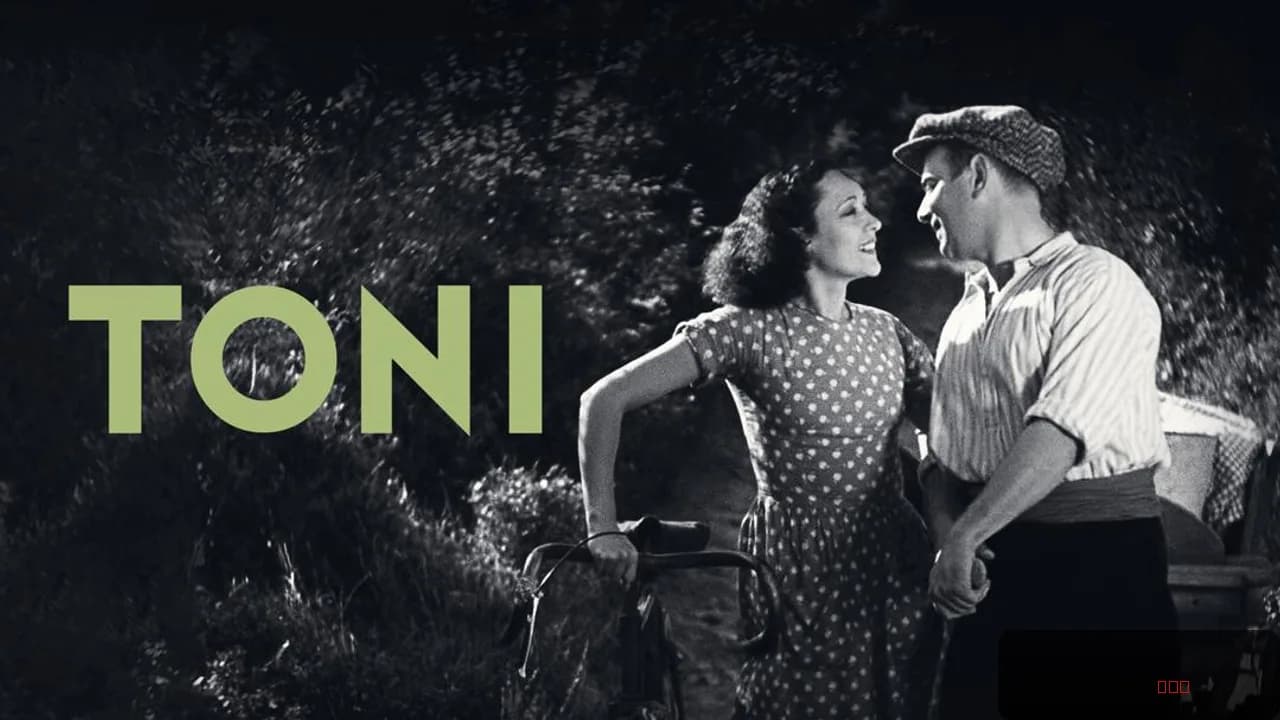
Jean Renoir's Toni (1935) isn't a film that announces itself with grandeur. It's deliberately modest—a 90-minute story about working-class immigrants laboring in the quarries and farms of Provence, their entangled romantic lives, and the violence that erupts when desire meets desperation. The narrative follows Toni, an Italian immigrant, as he navigates relationships with fellow workers and a woman named Marie, all while the harsh rhythms of manual labor and class tension simmer beneath every frame. What makes Toni remarkable isn't plot complexity; it's the way Renoir chose to tell this story—with real people in real places, letting the landscape and the workers' actual lives do the talking rather than relying on studio artifice or melodramatic flourish.
The film opens with documentary-like precision. We see the quarry before we see the characters. We understand the work before we understand the people. This choice—prioritizing environment over personality—was radical for 1935, when most European cinema still trafficked in theatrical staging and star power. Toni doesn't care about stars. It cares about texture, about how sunlight falls on workers' faces, about the casual brutality of economic survival.
Behind the making of Toni: Non-professional casting and location shooting that changed cinema
Renoir's approach to Toni was unconventional from the start. Working from a story by Jacques Levert, Renoir and co-writer Carl Einstein (though only Levert received initial credit) chose to cast the lead role of Toni with Charles Blavette, an actor with minimal previous experience, rather than a established star. The supporting cast—Celia Montalván, Jenny Hélia, Max Dalban, Andrex, Édouard Delmont, and Michel Kovachevitch—were largely non-professional or semi-professional performers, many drawn from the actual communities where the film was shot.
This decision to cast outside the studio system wasn't born from budget constraints alone; it was an artistic philosophy. Renoir believed that authenticity required real faces, real accents, real bodies that matched the world he was depicting. He shot the entire film on location in the Provence region, working with the actual landscape rather than against it, incorporating the rhythms of real work and real life into the narrative structure. The camera observes more than it directs. The actors move like people who actually inhabit these spaces—because many of them did.
The film's production was modest by any standard, and it didn't generate significant commercial success or major awards recognition at the time. However, what Toni achieved was something more durable than box-office returns: it established a methodology. Film historians and critics would later recognize this 1935 film as a crucial precursor to Italian neorealism, which would emerge in the 1940s with films like Rome, Open City and Bicycle Thieves—works that similarly rejected studio artifice in favor of location shooting and non-professional actors exploring working-class life. The influence rippled forward as well, shaping the aesthetic and ethical commitments of the French New Wave filmmakers of the late 1950s and 1960s, who'd cite Renoir's willingness to trust real people and real places as foundational to their own rebellion against conventional cinema.
What makes Toni stand out: Neorealism before neorealism existed
What's striking is how Toni doesn't feel dated, even nearly 90 years later. The IMDb rating of 6.7/10 doesn't quite capture why serious film scholars and critics return to it repeatedly—it's because the film does something that's deceptively difficult: it makes us care about people we'd normally overlook. These aren't heroes. They're not particularly articulate or self-aware. They're workers trying to survive, caught in economic systems they don't control, making mistakes born from loneliness and desire.
The performances work precisely because they're not performances in the theatrical sense. Blavette as Toni doesn't deliver speeches about his immigrant experience or his feelings; he looks at people. He works. He drinks. He wants something he can't have. Montalván as Marie carries a different kind of weight—the burden of being desired by multiple men, of having limited choices, of knowing that whatever decision she makes will hurt someone. These aren't showy roles, and that's exactly the point.
Renoir's direction here is almost invisible. He's not calling attention to his technique; he's letting the camera sit in rooms with these people, letting scenes breathe, letting awkward silences exist. There's a scene early on where workers are eating lunch together—just ordinary conversation, nothing "cinematic" about it—and yet it establishes more about class dynamics, camaraderie, and tension than pages of expository dialogue could manage. The thing nobody mentions is how much restraint this kind of filmmaking requires. It's harder to be subtle than to be loud.
The film also doesn't shy away from the darker impulses simmering beneath working-class life. Crime and violence aren't treated as plot devices; they're presented as almost inevitable consequences of economic desperation and emotional frustration. This unflinching approach to how ordinary people can commit extraordinary harm—and how quickly circumstances can spiral—was genuinely uncommon in 1930s cinema, which tended to either romanticize working-class life or condemn it from a distance.
Where to stream Toni online
Toni is currently available to stream on Disney+, making Renoir's landmark film accessible to viewers who might not have easy access to theatrical revival screenings or physical media. If you're tracking where this title lives across platforms, Movie OTT maintains up-to-date information on streaming availability, so you can verify current options before you start watching. The film's 90-minute runtime makes it manageable for a single sitting, though you'll likely find yourself wanting to revisit it—Toni is the kind of film that reveals different layers on second viewing, once you're no longer trying to follow the plot and can instead absorb the texture and mood.
Frequently asked questions
Q: Who directed Toni?
Jean Renoir directed Toni in 1935. Renoir is widely considered one of cinema's greatest filmmakers, and Toni represents a crucial turning point in his career—the moment when he began experimenting with neorealist techniques that would influence filmmakers for decades.
Q: Is Toni based on a true story?
The film is based on a story by Jacques Levert, though it isn't a direct adaptation of a specific real-world event. Rather, it's a dramatized account of immigrant life in Provence during the 1930s, grounded in the actual conditions and social tensions of the period and region.
Q: Who stars in Toni?
The film features Charles Blavette in the lead role, alongside Celia Montalván, Jenny Hélia, Max Dalban, Andrex, Édouard Delmont, and Michel Kovachevitch. Most of the cast were non-professional or semi-professional actors, which was part of Renoir's deliberate strategy to achieve authenticity.
Q: Why is Toni considered important to film history?
Renoir's use of non-professional actors, location shooting, and focus on working-class life made Toni a precursor to both Italian neorealism and the French New Wave. It demonstrated that cinema could achieve emotional truth through authenticity rather than studio artifice.
Q: How long is Toni?
Toni runs 90 minutes, making it a relatively compact drama that doesn't overstay its welcome despite its emotional weight.
Final thoughts on Toni
If you're interested in understanding how cinema evolved—how filmmakers learned to trust real people and real places, how they discovered that restraint could be more powerful than spectacle—Toni is essential viewing. It won't dazzle you with technical showmanship or sweep you away with romantic fantasy. Instead, it'll quietly insist that ordinary lives, carefully observed, are enough. That's a radical claim in any era. Don't skip it.