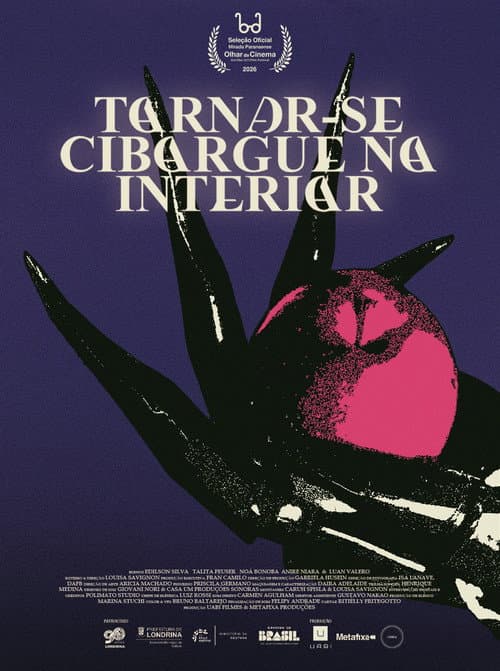
Tornar-se Ciborgue no Interior
A 20-minute short film about rural Brazil, queer neighbors, and what happens when stability cracks
Tornar-se Ciborgue no Interior — "Becoming Cyborg in the Interior" — is a 2026 Brazilian short film that takes a simple setup and stretches it into something genuinely unsettling. Leo and Julia own a rural property. They want children. Then a lesbian couple, Ava and Mia, moves next door. That's the whole premise. What the film does with it is another thing entirely.
The title does heavy lifting before you press play. "Interior" refers to Brazil's vast agricultural heartland — the place where traditional ideas about land, family, and nature carry enormous cultural weight. "Cyborg" implies something that's been altered, hybridized, something that doesn't fit cleanly into its assigned category. That tension between the organic (rural, reproductive, "natural") and the constructed (chosen identity, queerness, the body that refuses its role) is exactly what the film seems to be chasing.
For a drama-fantasy hybrid running just 20 minutes, that's ambitious conceptual work.
What makes the premise actually unsettling
I keep coming back to how quietly the conflict builds. There's no villain here — no one sits down to make a speech about morality or tradition. Instead, the film works through glances, silences, the way neighbors regard each other across a fence line. Leo and Julia's infertility has already strained something between them (neither fully articulates it on screen). Ava and Mia's arrival simply destabilizes whatever equilibrium they'd convinced themselves existed.
The fantasy element is intriguing. Most realist dramas stay tethered to social realism — but this one reportedly bends into something else at some point. That genre slippage does real work: it externalizes interior psychological states that straight realism can't quite hold. What's happening internally gets permission to happen on screen.
Hard to say exactly what form that takes without wider critical documentation, but it's worth noting that short films often use genre inflection not as spectacle but as a pressure valve — a way to make emotional truth visible.
Production details and where to find it
The film was produced through a three-way collaboration: UABI Filmes, Metafixa Produções, and Cinea Filmes — the kind of resource-pooling arrangement that's become standard in Brazilian independent cinema. When you're making shorts on modest budgets, you bundle with other small houses or you don't make them at all.
As of mid-2026, publicly available crew information remains sparse. Director and cast credits haven't circulated widely in English-language press. Letterboxd's member log shows zero ratings logged so far, which tells you the film hasn't had a broad theatrical or streaming rollout yet — that's normal for Brazilian shorts, which typically circulate through domestic festival circuits for months before international availability gets confirmed.
The three-production-company structure suggests some institutional backing that could ease distribution down the line. Movie OTT tracks streaming availability across platforms in real time, so if the film lands on a major service, that's where you'll see it updated first. Right now? You're likely looking at festival screenings or regional Brazilian platforms.
No box office data (expected for shorts). No MPAA rating (also expected). Awards nominations haven't been documented in accessible sources yet.
Why the title matters more than you'd think
Look — the genius of "Becoming Cyborg in the Interior" is that it refuses to resolve its own contradiction. You can't be fully cyborg and fully of the interior. You can't blend those worlds without losing something in both. The film seems interested in what happens when people try anyway — when Ava and Mia, by simply existing next door, force Leo and Julia to confront what they've been avoiding about themselves and each other.
The fantasy designation suggests the film doesn't stay in pure realism. Something slips. Something bends. Whether that's a magical event or just the externalization of what's already cracking emotionally — that's the kind of ambiguity that works best in a 20-minute form. Compression forces clarity. You don't have time for explanation.
For viewers comfortable sitting with a film that asks more than it answers, this one's worth tracking. As critical coverage develops through the festival season, Movie OTT will continue updating availability as streaming deals get confirmed across regions.
If you liked... you might want to see this
If you've gravitated toward intimate rural dramas that treat landscape as character — things like Cafarnaum or The Farewell — this one's conceptual territory. It's not quite the same tone, but that interest in how small human conflicts play out against larger social structures is there.
If you've watched films that use genre inflection to externalize internal states — where the fantastic serves psychological truth rather than plot — this is working in that tradition. Think less Hereditary spectacle, more the way a film like The Lighthouse uses its formal strangeness to make psychological deterioration visible.
Where to stream it (once it's available)
Tornar-se Ciborgue no Interior isn't currently on major streaming platforms — it's still in the festival window. Availability for shorts shifts fast, especially when distribution rights are still being negotiated. Check the where-to-watch widget on Movie OTT for region-specific listings as they're confirmed. Streaming availability for shorts can change week to week during festival season.
If it's not showing in your region yet, bookmark this page. The three-production-house backing suggests a release is coming — just unclear when.
The basics you need to know
- Runtime: 20 minutes
- Genres: Drama, Fantasy
- Year: 2026
- Plot: Leo and Julia face fertility struggles on their rural property. Ava and Mia, a lesbian couple, move next door. Their arrival creates tension with the neighbors.
- Status: Festival circuit (as of mid-2026)
- Where to watch: Check Movie OTT for current availability in your region
What's actually worth your time here
A short film that doesn't explain itself. Doesn't apologize for its ambiguity. Doesn't hand-deliver its themes in dialogue. That's rare — and harder to pull off than it sounds. Twenty minutes. Two couples. A fence line that becomes a fault. If you're the kind of viewer who doesn't need everything spelled out, this one's worth the wait for a proper release.