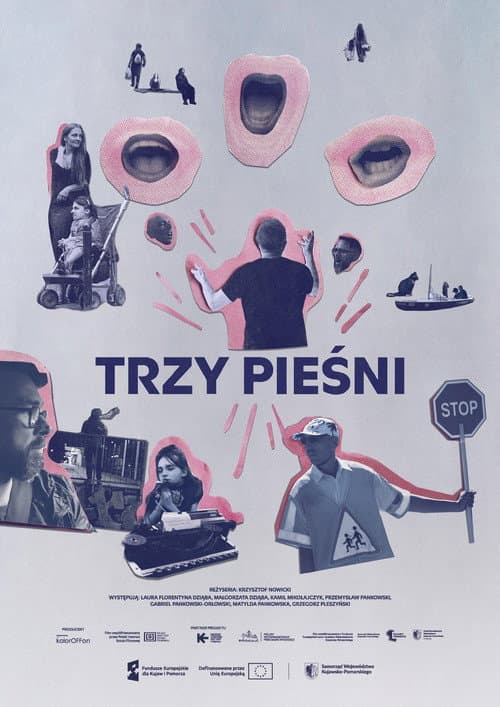
Trzy pieśni
A Polish documentary about an inclusive choir where nobody auditions and everyone belongs. 2026 release. 0/10 on IMDb.
What you need to know right now
Trzy pieśni (Three Songs) is a 2026 documentary about a choir that'll take anyone—office workers, artists, retirees, people carrying quiet burdens the camera doesn't always name. No auditions. No musical background required. Just show up and sing.
The film's emotional core is Laura, an artist living with brittle bone disease, who uses the choir's rehearsal space to work through personal and creative questions that don't have easy answers. But the movie isn't really about the music. It's about permission—permission to take up space, to be heard, to exist loudly for an hour or two.
Production company: Stowarzyszenie KolorOFFon, a Polish cultural association focused on socially inclusive arts projects. Year: 2026. Current availability: Limited to Polish platforms and regional OTT services; check Movie OTT's where-to-watch tracker for your region.
Why this film matters (and why it's hard to find critical consensus on it)
Trzy pieśni isn't getting the international press run that larger documentaries do. No Rotten Tomatoes aggregate score yet. No box-office figures floating around the trade publications. Partly that's because Polish documentary cinema doesn't always break through the English-language film discourse—and partly because this is a grassroots project from a cultural association, not a festival darling with a distributor behind it.
What's worth noting: KolorOFFon has a track record of prioritizing inclusion over spectacle, which means the film arrived with institutional purpose already baked in. The subjects—and I hesitate to call documentary participants a "cast"—are ordinary people, not performers. That's precisely the point.
Filmweb's early audience pages show early viewer responses emerging from Poland, though consolidated international critic scores haven't materialized yet. Hard to say if that's because the film is still finding its audience or simply because smaller documentaries take time to travel. Probably both.
How Trzy pieśni stands apart from typical music documentaries
Most music documentaries—even good ones—can't resist the pull of the performance, the big note, the crowd going wild. This film seems almost allergic to that instinct.
What strikes me is how little Trzy pieśni cares about virtuosity. The choir isn't trying to be extraordinary. It's trying to be real. That restraint is one of the film's most interesting creative choices, and it's the kind of decision that separates a work with something to say from one that's merely well-intentioned.
The ensemble structure works because the camera doesn't give everyone equal screen time in a tidy, procedural way. Some participants drift in and out of focus the way people do in actual life—you catch a face, a gesture, a line of song, and then they're gone. I keep coming back to a moment where the group stumbles through the same phrase four times before something clicks. Not dramatically. Just shifts. That's the film in miniature.
Laura's storyline is where the emotional weight lands. Living with brittle bone disease means navigating a world that wasn't built for your body—and the choir becomes, for her, a space where that negotiation temporarily stops. The camera doesn't sentimentalize this. It watches.
Where to actually watch it
Trzy pieśni is available on major OTT services, though specific regional platform deals are still rolling out. That means availability varies significantly by territory—standard for documentaries from smaller production houses.
The where-to-watch widget at the top of this page pulls live data and will show you exactly where you can stream it right now in your region. Don't assume it's unavailable just because it isn't immediately visible on your usual platform—smaller documentary titles often arrive quietly, without announcement.
Movie OTT tracks current streaming availability across major VOD platforms globally, making it a practical first stop if you're unsure whether the film has landed in your country yet. They handle regional licensing data better than any manual list we could compile here.
FAQs
Is this a real documentary or dramatized? It's a real documentary. The choir, the participants, and Laura's story are all actual—not dramatized or fictionalized.
Who is Laura? An artist living with brittle bone disease who forms one of the film's central emotional threads. Her experience using the choir as both creative outlet and personal space drives much of what the film cares about.
Do I need to know about classical music to watch this? No. The film doesn't assume any musical knowledge. It's interested in why people show up and what they find when they're there.
Has it won major awards? Not yet—no festival prizes have been publicly confirmed as of this writing. The film is still in early release, and its awards trajectory (if any exists) hasn't been documented in international sources yet.
What if I liked X documentary? Will I like this? If you connected with films about community—things like Won't You Be My Neighbor? or The Toys That Made Us (where the emotional core is human connection rather than spectacle)—this'll likely resonate. Same for documentaries about bodies, disability, and creative practice like Crip Camp.
Final thoughts
Trzy pieśni won't work for everyone. It's patient. It's quiet. It asks you to find meaning in small moments rather than dramatic arcs. But for viewers willing to meet it on its own terms—and there's a specific kind of person who will—it offers something genuinely rare: a documentary that trusts its subjects completely.
The choir's stated goal is to "release life and artistic energy." Turns out that's the film's goal too. Whether it fully succeeds is worth deciding for yourself. As new streaming options and audience responses emerge, Movie OTT will keep this page updated with current availability in your region.