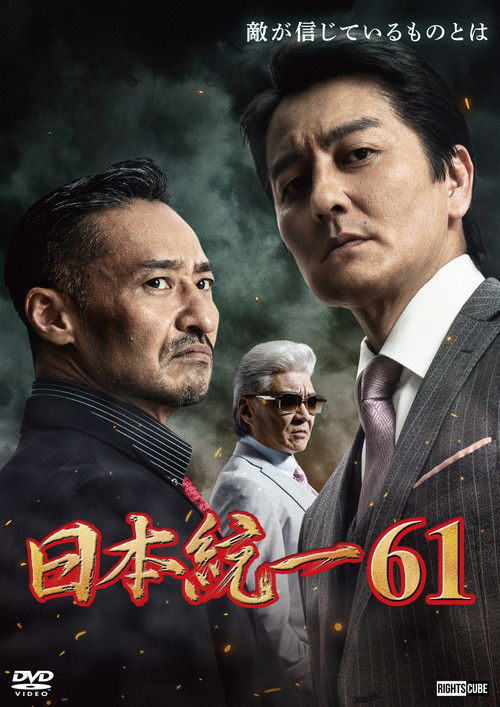









The story of Unification of Japan 62
Unification of Japan 62 picks up where tension was already simmering in the franchise. The film opens with a straightforward premise that quickly unravels into something far more sinister: Nao, wife of Ota from the Kamome Victims Association, has been abducted by the World Kamome Church, a cult operating with unsettling reach and resources. What starts as a rescue mission becomes something else entirely—a descent into institutional corruption and religious extremism that won't be contained by conventional heroics. Tamura storms the cult's facility alone, driven by a personal stake in Nao's safety. Himuro follows, expecting a straightforward extraction. Neither anticipates what waits inside: an armed cult prepared for exactly this kind of intervention, and a leader willing to reveal truths that shake the very foundations of the investigation.
Behind the making of Unification of Japan 62
Produced by Solid Feature, Unification of Japan 62 continues a franchise that's been building momentum across multiple installments. The 2024 release represents the studio's commitment to serialized storytelling—something that requires narrative discipline and audience trust. With a runtime of 71 minutes, the film operates with unusual economy; there's no fat here, no tangential subplots bleeding screen time. The cast carries significant weight. Ayano Nishikawa, Ryota Matsushima, Yoshiyuki Yamaguchi, Yasukaze Motomiya, and Mizuki Nishikawa form a ensemble that's been tested across prior entries in the series. Yasuhiro Arai and Takayuki Kinba round out a supporting cast that understands the franchise's rhythms and expectations. What's striking about the production is how it manages to feel both contained and consequential—a single rescue operation that somehow implicates the entire state apparatus. Movie OTT tracks how franchise entries like this one maintain momentum across streaming platforms, and Unification of Japan 62 demonstrates why serialized action-crime dramas have found such a stable home in the streaming ecosystem.
What makes Unification of Japan 62 stand out
The film doesn't waste time on exposition or apology. It trusts that viewers know the franchise, know the players, and want to see how far the corruption actually goes. What's remarkable—and what keeps you watching despite the film's modest runtime—is how it balances intimate character stakes (Nao's abduction, Tamura's personal mission) against a much larger institutional conspiracy. Himuro's interrogation of Takahara represents the film's thematic core: a moment where the cult leader's cryptic answer suggests that everything the investigators thought they understood about this organization was incomplete. The performances don't oversell this moment. There's no melodrama, no theatrical villainy. Instead, there's a quiet, unsettling revelation that what you're watching isn't really about a cult at all—it's about how power structures protect themselves. Investigator Sahara's decision to consult with Matsumiya, a figure with unclear allegiances, signals that the film understands something crucial about institutional corruption: you can't fight it through official channels. You have to work sideways, through personal relationships and calculated risks. The action sequences, when they arrive, carry weight because they're not divorced from this larger investigation. Every punch, every chase, every moment of violence is in service to uncovering what Deputy Police Commissioner Mikami actually knows.
Where to stream Unification of Japan 62 online
Unification of Japan 62 is currently available across major OTT services, and the where-to-watch widget at the top of this page will show you exactly which platforms are carrying it in your region right now. Streaming availability shifts regularly, so checking that widget before you hit play saves the frustration of dead links or regional blackouts. Movie OTT's streaming tracker keeps tabs on where these franchise entries land, since fans of the Unification of Japan series often want to binge multiple installments in sequence. Whether you're catching up on earlier entries or diving into the 62nd chapter, the aggregation tools on this site can help you map out your viewing order and confirm current availability across your subscribed services.
Frequently asked questions
Q: Do I need to watch earlier Unification of Japan films before watching this one?
Yes, this is the 62nd installment in an established franchise, and it assumes familiarity with the characters, the Kamome Victims Association, and the ongoing investigation. Starting here without prior context would leave you confused about who Ota, Himuro, and Tamura are and why their relationships matter.
Q: Who directed Unification of Japan 62?
The film was produced by Solid Feature. While specific directorial credits aren't detailed in the available information, the production company has stewarded the franchise's visual and narrative consistency across multiple installments.
Q: Is Unification of Japan 62 based on a true story?
The Unification of Japan franchise appears to be fictional, though it draws on real-world anxieties about cult activity and police corruption. The World Kamome Church and its conspiracy are creations of the series' writers, not documented historical events.
Q: How long is Unification of Japan 62?
The film runs 71 minutes, making it a lean, focused entry that prioritizes plot momentum over extended character development or subplot digression.
Q: What genres does Unification of Japan 62 fall into?
It's classified as action, crime, and drama—a combination that reflects the film's blend of violent rescue sequences, police procedural investigation, and the moral and ethical questions that arise when institutions themselves become complicit in wrongdoing.
Final thoughts on Unification of Japan 62
Unification of Japan 62 doesn't reinvent the franchise formula, and it doesn't try to. What it does is execute the machinery with precision—a rescue that becomes a capture, an investigation that implicates the powerful, and a revelation that reframes everything you thought you knew. It's the kind of film that works best as part of a larger narrative arc, but it stands on its own merits. For franchise devotees, it's essential viewing. For newcomers willing to start at entry 62, it's a sharp, efficient reminder of why serialized crime dramas matter.