Filmmaker
Jack Webb
1 film on Movie OTT · 1 as director
Jack Webb was born on April 2, 1920, in Santa Monica, California, and spent the better part of four decades building one of the most distinctive careers in American entertainment — one that moved fluidly between radio, television, and film while remaining anchored to a single, instantly recognizable sensibility. He is best known as the creator and star of Dragnet, the procedural crime franchise that began on radio in 1949 and translated with unusual fidelity to television, where it ran through much of the 1950s and again in the late 1960s. His portrayal of Sergeant Joe Friday — clipped, methodical, morally exacting — defined a certain vision of American law enforcement on screen for a generation of viewers and shaped the grammar of the police procedural as a genre.
About Jack Webb
Jack Webb was born on April 2, 1920, in Santa Monica, California, and spent the better part of four decades building one of the most distinctive careers in American entertainment — one that moved fluidly between radio, television, and film while remaining anchored to a single, instantly recognizable sensibility. He is best known as the creator and star of Dragnet, the procedural crime franchise that began on radio in 1949 and translated with unusual fidelity to television, where it ran through much of the 1950s and again in the late 1960s. His portrayal of Sergeant Joe Friday — clipped, methodical, morally exacting — defined a certain vision of American law enforcement on screen for a generation of viewers and shaped the grammar of the police procedural as a genre.
The breakthrough came not from a single film but from the accumulation of a method. Webb understood early that realism, or at least the convincing texture of realism, was more arresting than melodrama. Dragnet on television stripped away the orchestral swells and theatrical pauses common to crime drama of the era and replaced them with flat affect, documentary-style narration, and the rhythm of actual police procedure. The result was something audiences had not quite seen before. Webb directed many of the episodes himself, developing a visual shorthand — tight close-ups, rapid cutting between faces, minimal camera movement — that gave the series a compressed, almost claustrophobic intensity. That directorial instinct, honed across hundreds of television episodes, carried directly into his feature film work.
On the theatrical side, Webb worked consistently as both actor and director, and the two roles informed each other in ways that set him apart from performers who simply stepped behind the camera as a vanity exercise. He brought to his directing the same economy he demanded of himself as an actor: no wasted motion, no excess sentiment. His productions tended toward genre material — crime, military, procedural drama — and he gravitated toward stories built around institutional loyalty, duty, and the friction between individual conscience and organizational structure. These were not accidental preoccupations. They ran through nearly everything he touched, giving his body of work a coherence that transcends any single title.
That coherence is visible in The Last Time I Saw Archie, the 1961 comedy in which Webb served as both director and lead actor. The film is a departure in tone — lighter, more self-aware than the Dragnet material — and finds Webb playing against type in a story set among military personnel during World War II. His willingness to take on The Last Time I Saw Archie as a comedic vehicle suggests an artist interested in testing the limits of his own screen persona rather than simply reinforcing it. As a director on the same project, he managed to balance the comedic register demanded by the material with the clean, efficient staging that characterized his best work. The film is not a reinvention so much as a controlled experiment, and it holds up as evidence that Webb's directorial range extended beyond the procedural mode he had made his own.
Webb's place in film and television history rests on something harder to quantify than box office performance or awards recognition. He built a production infrastructure — Mark VII Limited — that gave him sustained creative control at a time when such autonomy was rare for a television practitioner. That control meant his projects, whatever their individual merits, bore a consistent authorial stamp. The influence of the Dragnet template on subsequent police dramas, from the gritty realism of later network procedurals to the clipped dialogue rhythms that persist in crime television today, is substantial. Webb did not simply perform in or direct a body of work; he engineered a style and then industrialized it, producing it at scale across multiple decades. That is a different kind of achievement, and one that rewards closer attention from anyone tracing the development of American genre television and its relationship to the crime films that preceded it.
Currently streaming
1 of 1 on platforms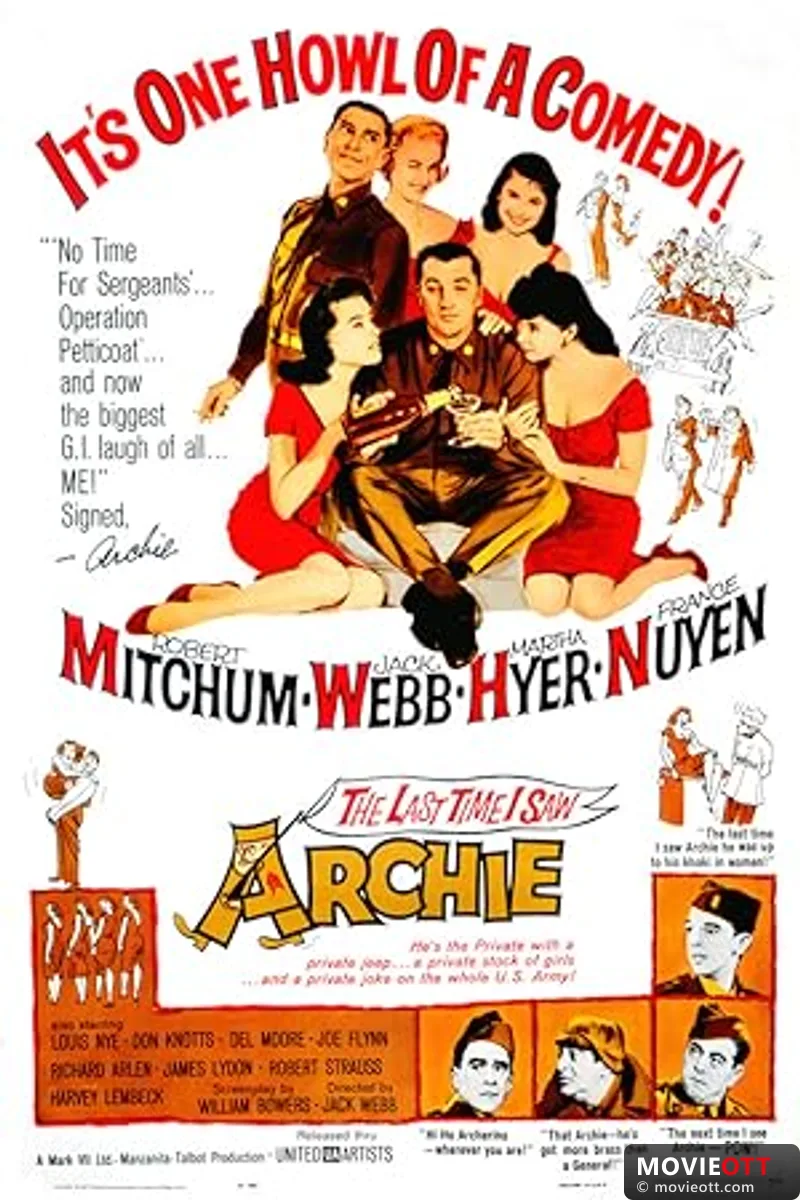
Filmography
Frequently asked questions
When and where was Jack Webb born?
Jack Webb was born 1920-04-02 in Santa Monica, California, USA.
What films is Jack Webb known for?
Jack Webb has 1 title indexed on Movie OTT, including The Last Time I Saw Archie.
Where can I watch Jack Webb's films?
1 of Jack Webb's films are currently streaming, available on Prime Video.
Has Jack Webb directed any films?
Yes — Jack Webb has 1 directorial credit indexed on Movie OTT.