Full Phil Review: Can Dupieux's Absurdist Father-Daughter War Actually Cross Over?
TL;DR: Quentin Dupieux's Full Phil pairs Woody Harrelson and Kristen Stewart as a mutually contemptuous father and daughter trapped in a Parisian hotel suite. It premiered at Cannes 2026, runs 78 minutes, and is the French surrealist's most star-powered swing yet — though whether that star power translates into genuine mainstream traction is, to put it honestly, debatable.
Why Dupieux Betting on Harrelson and Stewart Matters
Here's the thing about Quentin Dupieux: he's spent his entire career making movies for a self-selecting audience of dedicated weirdos, and the question being floated around Cannes 2026 is whether bolting two recognizable Hollywood names onto his particular brand of French absurdism actually changes anything. The answer, I keep thinking, is probably not.
But the attempt itself is worth watching.
Dupieux has never made a film designed to cross over. Rubber (2010) is about a sentient tire that kills people with telekinesis—literally, that's the entire plot. Deerskin (2019) centers on a man who becomes pathologically obsessed with a vintage fringed suede jacket. Both earned festival acclaim and respectable arthouse runs. Both made almost no money. So when production companies cast Harrelson and Stewart in Full Phil, they were essentially asking: can two marquee names pull viewers who would never independently seek out a Dupieux film?
The film's own critical reception—mixed-to-positive out of Cannes—suggests the answer might be "not automatically."
What the Variety Review Actually Says (and Doesn't)
Variety's Owen Gleiberman published his verdict on May 18, 2026, and it's worth reading carefully, because what he praises and what he avoids saying tells you everything.
Gleiberman describes Full Phil as "middle-drawer mishegas"—a phrase doing a lot of work. It signals watchable but not essential. Not a triumph. Not a turning point. Just... something you might enjoy on a slow Tuesday evening if you're already predisposed to Dupieux's sensibility. He positions it below Rubber and Deerskin in the director's own hierarchy, which is damning in its specificity.
What Gleiberman does acknowledge—somewhat grudgingly—is that Dupieux seems to be "coming on like he has something to say" this time around. That's a departure from the pure prankster mode that defines most of his work. Whether that ambition actually lands is another matter entirely.
The Actual Plot: A Toilet Gag as Character Study
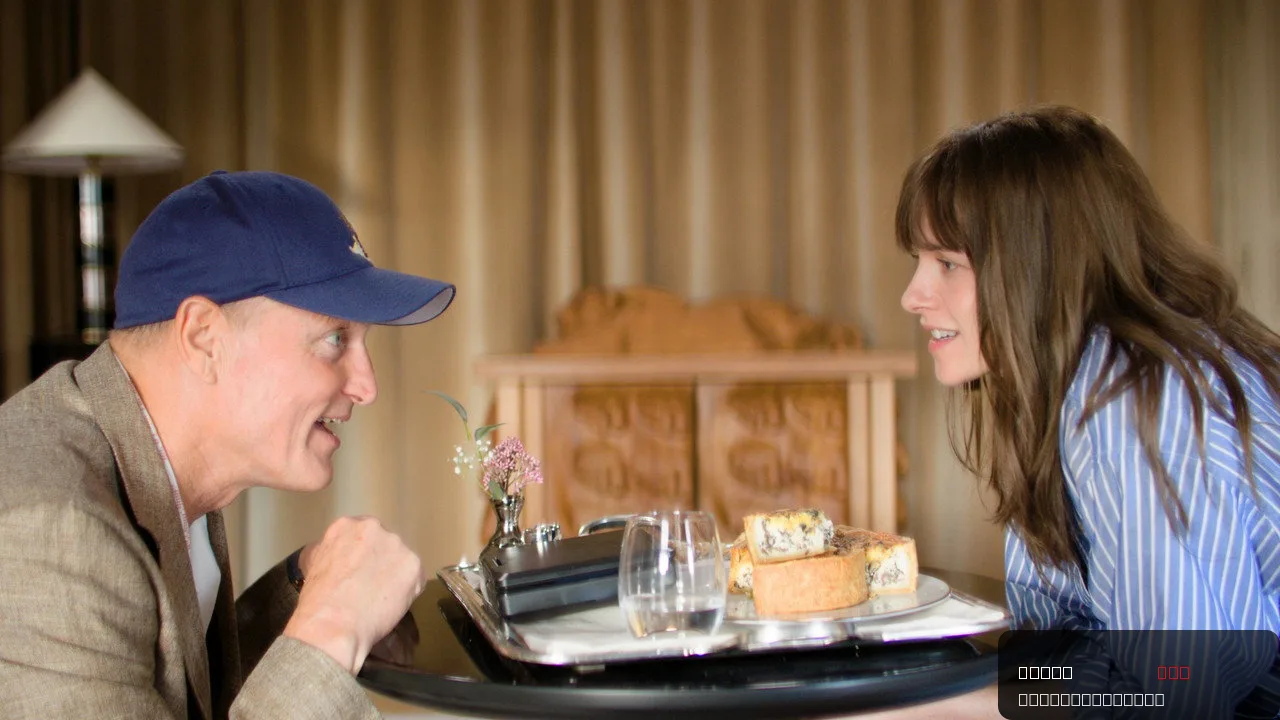
Philip Doom (Harrelson) is a wealthy American industrialist attempting to reconnect with his estranged 32-year-old daughter Madeleine (Stewart) during a luxurious trip to Paris. Sounds touching. It isn't.
Harrelson plays Philip as a declaiming, grinning, control-hungry patriarch who refuses to call hotel maintenance about a blocked toilet because he finds it embarrassing. That's not a throwaway detail—the toilet becomes a kind of physical manifestation of his need to dominate situations he can't actually control. Very Dupieux. Very specific. Possibly very funny, depending on your tolerance for bathroom humor deployed as existential commentary.
Stewart, per Gleiberman's account, plays Madeleine as a straight-shooter who spends much of the film eating—visibly, constantly, and apparently for real (he speculates they "must not have done too many takes"). The eating has a payoff: the more Madeleine consumes, the more Philip's belly physically expands. A woman eating and a man bloating. Make of that what you will.
Charlotte Le Bon plays Lucie, a hotel worker who inserts herself into their conflict, escalating tensions rather than resolving them. Tim Heidecker and Eric Wareheim appear in a deliberately cheap black-and-white '50s monster movie framing device featuring a papier-mâché gill creature eating people's heads—which reportedly defies any coherent allegorical explanation, even by the film's own internal logic.
The Allegory Problem: When Satire Gets Too On-the-Nose
Here's what nobody's quite saying out loud, but most reviews are circling: Full Phil wants to be a culture-war parable dressed as a hotel-room farce, and that combination is more likely to alienate both halves of a potential audience than to unite them.
Dupieux positions Philip as a stand-in for a generation of domineering men—Madeleine as the generation of women whose rejection of that dominance is "pitiless as a steel blade"—and Lucie as the "woke scold" surveilling and condemning Philip's behavior, thereby intensifying it. Gleiberman is careful to note that Dupieux doesn't stage this didactically. He's reaching for Luis Buñuel's cinema of the absurd, where bourgeois social rituals get stretched until they snap.
That's a legitimate ambition.
The problem? Buñuel built his satire on precise, cold observation. Full Phil, by all accounts, is broad. Very broad. Broad enough that the allegory reads more like a Twitter argument than The Discreet Charm of the Bourgeoisie. The real comp here isn't Buñuel at all — it's Ruben Östlund's Triangle of Sadness (2022), which won the Palme d'Or by doing the exact same eat-the-rich-via-bodily-fluids routine, except Östlund committed to the cruelty where Dupieux keeps winking at the camera. That film grossed $30 million worldwide, proof the appetite for gross-out class satire exists, but it also had a 147-minute runway to build its world. Dupieux is trying to land the same plane in 78 minutes, and the rushed allegorical scaffolding shows. Audiences who want sharp class critique will find it underdeveloped. Audiences who just want a comedy will find the message-mongering intrusive.
The Runtime, Release Status, and Where to Actually Find This
78 minutes. That's not a throwaway detail—it's short enough that Dupieux can sustain the bit without wearing out his welcome, but long enough that he's trying to build something resembling a three-act structure. The film premiered out of competition at Cannes 2026 and was directed, written, shot, and edited by Dupieux himself. He genuinely does everything, which is either admirable or alarming depending on your tolerance for auteur maximalism.
Production credits: Chi-Fou-Mi Productions, Artémis Productions, and Samsa Film, with Hugo Sélignac producing. Music by Siriusmo.
As of this writing, no wide theatrical release date has been confirmed for North America or the UK. Streaming availability is still being negotiated across regions. For the most current information on where Full Phil lands in your territory—and whether a dubbed or subtitled track is available—Movie OTT's distribution tracker is tracking announcements as they happen.
What Indian Audiences Should Know About Availability
Dupieux has essentially zero name recognition in the Indian mainstream market, which means the film's commercial hook depends entirely on how much Harrelson and Stewart's profiles translate locally. Both are respected actors, but neither commands the first-tier draw that a Marvel or Nolan property would.
Based on Dupieux's previous distribution pattern, Indian streaming availability will likely come via one of the major international platforms—Netflix India or MUBI (which has been aggressively acquiring festival-circuit French cinema) are the most probable homes. MUBI India added Deerskin and Mandibles to its library within eight months of their respective Cannes premieres, which makes it the frontrunner here. Prime Video India is a secondary possibility depending on territorial licensing.
No Hindi, Tamil, or Telugu dubbed track is expected, given the film's niche positioning. Subtitled release only, almost certainly. For Indian cinephiles already familiar with Dupieux through Rubber or Deerskin, this is a genuine event. For everyone else, the marketing challenge is significant.
A Q3 or Q4 2026 streaming window is the reasonable expectation based on how other Cannes acquisitions move to platforms. Check Movie OTT for confirmed India availability as distribution deals finalize.
The Crossover Question: Why It Probably Won't Happen
Here's the honest outlook: Full Phil will do the festival circuit, pick up a distribution deal for limited theatrical in the US, UK, and France, and land on a streaming platform within six to nine months. Whether it becomes Dupieux's "crossover" moment depends almost entirely on whether Harrelson and Stewart are willing to do sustained press—and whether that press translates into actual viewership rather than just social media impressions.
No sequel setup. No franchise infrastructure. No IP to spin off. This is a standalone 78-minute provocation. The risk for Dupieux is that bringing in recognizable stars raises audience expectations in ways his deliberately lo-fi aesthetic can't satisfy. The risk for Harrelson and Stewart is that the film's limited commercial ceiling makes this an interesting footnote rather than a career pivot.
I keep thinking about what Gleiberman said: "Some will want to see it." Not exactly a ringing endorsement. It's the sound of a critic hedging his bets. And that hedging is probably the most honest thing anyone's said about Full Phil so far.
How This Compares to Dupieux's Other Work
If you've seen Deerskin and wanted something with broader commercial appeal, Full Phil is the closest Dupieux has come to meeting you halfway. It's still deliberately absurd—still committed to stretching plausible situations into surreal ones. But it's working with bigger stars and, arguably, more recognizable emotional stakes (a father and daughter actually trying to connect, even as they drive each other insane).
That said, if you're coming to this expecting something like a conventional father-daughter reconciliation drama with absurdist flourishes, you're going to be disappointed. This isn't On Golden Pond with a toilet gag. It's Dupieux doing Dupieux, just with A-list casting.
What Comes Next
Watch for a US distribution announcement in the coming weeks. Trailer drops will likely come within the month. Reviews from other major outlets will tell you whether the critical consensus lands closer to "cult gem" or "expensive misfire."
For streaming and theatrical release confirmation across all regions, Movie OTT is tracking all announcements as they're officially confirmed. We'll see whether Dupieux's biggest commercial gamble pays off—or simply confirms what his entire filmography already suggests: he's not particularly interested in crossing over. And honestly? That might be exactly the point.