An Inconvenient Truth at 20: The $50M Documentary That Rewired Climate Policy
TL;DR: Twenty years after its May 2006 theatrical debut, An Inconvenient Truth remains the highest-grossing climate documentary ever made — $50 million worldwide on what was essentially a filmed lecture. Director Davis Guggenheim now admits the conditions that made it possible won't happen again. Here's where to stream it, why it still matters, and what changed since.
Twenty years is a long time to sit with a number like $50 million.
For context: that's what a mid-range studio comedy pulls in domestically on opening weekend. An Inconvenient Truth — a 95-minute PowerPoint presentation, some personal memoir footage, no narrative arc — pulled it in globally across its entire theatrical run. It won the Academy Award for Best Documentary Feature. It won Best Original Song. And then director Davis Guggenheim watched the thing become a shared cultural moment in a way that no climate film has managed since.
"You had companies changing their policies, politicians making [climate issues] a priority. It was incredible," Guggenheim told Variety on the film's anniversary. "It'll never happen that way again."
That last line is worth sitting with.
What made a lecture film break box office records in 2006
The structural facts first: An Inconvenient Truth premiered at Sundance in January 2006, hit theaters May 24, 2006, and was produced under the Participant Media banner with Paramount Classics handling distribution. Runtime: 95 minutes. Director: Davis Guggenheim. Producer: Lawrence Bender and Laurie David.
Here's what's genuinely striking — the whole thing came together in under six months. Jeff Skoll, Participant Media's founder, saw one of Al Gore's slideshow presentations and issued a single directive: "Do it fast." Guggenheim had literally handed in his notice as a Participant executive when Bender and Laurie David approached him. Lean. Urgent. Unpolished in the best possible way.
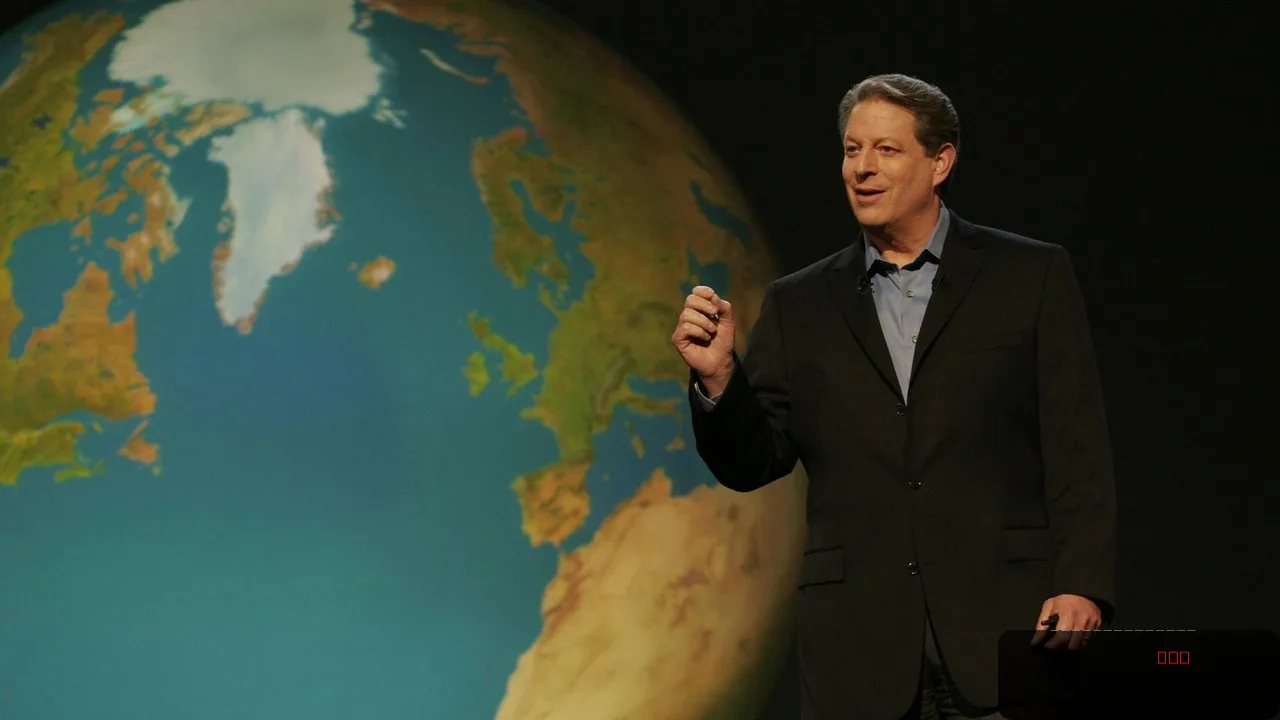
The film was, structurally, almost nothing. No antagonist. No third-act reversal. Just Gore delivering complicated climate science to an audience using charts, graphs, and the kind of folksy delivery that somehow made atmospheric CO2 concentrations feel urgent. Guggenheim's job wasn't to create drama — it was to recognize that Gore's presentation was already a polished performance and capture it honestly.
The marketing campaign, helmed by then-Paramount executive Megan Colligan, positioned a lecture film as a must-see theatrical event. By conventional distribution logic, that should have been impossible. It wasn't.
The media moment that won't repeat
Here's what Guggenheim knows that most filmmakers won't admit: the conditions for An Inconvenient Truth's success were structural, not creative. In 2006, cable news still amplified a single story for weeks. Social media hadn't fragmented the public's attention into a thousand warring feeds. Climate science was still something approaching a bipartisan concern.
"It also had to do with all these forces that had nothing to do with us," he told Variety.
That's honesty. And it points to something real. The film arrived in a media ecosystem that doesn't exist anymore. A filmmaker releasing identical content in 2026 would face a fundamentally different landscape, one where a single documentary can't command shared national conversation the way An Inconvenient Truth did. Guggenheim acknowledged this directly: "It would have a harder time if it was released today."
Not pessimism. Diagnosis.
The proof is in the sequel. An Inconvenient Sequel: Truth to Power landed in 2017 and grossed $3.5 million worldwide. A 93% drop. Same director. Same star. Same issue. But the moment had passed. Most coverage frames that sequel failure as a story about audience fatigue; the more revealing read is financial. Participant Media's entire model depended on social-impact documentaries generating enough theatrical revenue to justify P&A spend, and by 2017 that model was collapsing across the board. Participant would shut down entirely in 2023. The sequel didn't just lose the cultural moment. It lost the business infrastructure that made the original viable.
Why Davis Guggenheim was the only director for this project
Guggenheim's father was Charles Guggenheim, a six-time Oscar-nominated documentary filmmaker best known for political campaign films and historical documentaries. That lineage matters — Davis grew up understanding that non-fiction advocacy could work without sacrificing credibility, a balance most issue docs never find.
Before An Inconvenient Truth, Guggenheim had directed television (episodes of Deadwood, The Shield, NYPD Blue). After it, he'd direct Waiting for Superman (2010) and the Obama campaign doc It Might Get Loud (2008). But this film is his defining credit — the one his entire career gets measured against.
Al Gore, for his part, had been delivering that climate slideshow for years before the film. The genius wasn't inventing something new. It was recognizing that Gore's presentation was already cinema — and simply letting the camera do the work.
The box-office anomaly nobody has fully explained
Fifty million dollars on a 95-minute lecture. Consider what that means in context:
- Michael Moore's Fahrenheit 9/11 (2004): $222 million globally — but that was a polemical feature with narrative drive
- An Inconvenient Sequel (2017): $3.5 million
- Before the Flood (2016, Leonardo DiCaprio): didn't crack $10 million
- Seaspiracy (2021, Netflix): no theatrical release
The film holds a 96% on Rotten Tomatoes and an 80 Metascore on Metacritic. No comparable climate documentary since has come close on either metric. The box office gap isn't close. It's a chasm.
I keep coming back to what this says about the moment itself. The film didn't just catch the zeitgeist — it was the zeitgeist. And zeitgeists don't repeat. They transform into something else, splinter into a thousand smaller conversations, get weaponized by competing interests. By 2017, climate science had become a political litmus test in ways it wasn't in 2006. The shared space where An Inconvenient Truth could operate no longer existed.
Where to watch it now (and why the streaming picture matters)
Current availability varies by region. In India, the film is:
- Netflix India: Available (check Movie OTT's where-to-watch tracker for current status)
- Amazon Prime Video India: Verify regional availability
- Disney+ Hotstar / JioCinema / SonyLIV / Zee5: Not currently listed
Streaming licenses rotate — sometimes quarterly — so it's worth a quick check on Movie OTT before subscribing to a platform for a single title.
The Hindi-dubbed version isn't widely confirmed across platforms, but the original English cut with subtitles is accessible wherever it's currently licensed.
For Indian audiences specifically, this film carries relevance that wasn't fully visible in 2006. India is now among the world's top five carbon emitters and faces some of the most acute climate risks globally — flooding in coastal cities, glacial retreat in the Himalayas, escalating heat events in the Indo-Gangetic plain. For Indian viewers, the more relevant comp today isn't Gore's sequel or DiCaprio's Before the Flood; it's Shaunak Sen's All That Breathes (2022), which won the Grand Jury Prize at Cannes, grossed modestly but proved that Indian audiences will engage with environmental documentary storytelling when the craft justifies the ticket. Gore's 2006 data visualizations, while dated, map directly onto projections that Indian climate scientists have been publishing for a decade.
For students, policy researchers, or anyone working in sustainability communications, this remains foundational. Dated data doesn't make a foundational text less foundational.
Why the film's specific predictions aged unevenly
Gore made some calls in 2006 that haven't played out the way he predicted. Some ice sheets have melted faster than his models suggested. Others slower. Hurricane patterns didn't follow the exact trajectory he outlined. The film's scientific credibility — which was never in serious question among climate scientists — has become a political football in ways it wasn't when the movie premiered.
But here's what matters: the film's core argument — that human activity is warming the planet at an accelerating rate and that this poses systemic risks — has only been reinforced by two decades of additional data. The specific predictions may need updating. The direction was right.
Guggenheim himself notes something else worth flagging. Twenty years ago, "we were struggling at the end to find solutions we could offer the audience. We had a shot of a Prius and a shot of a windmill." Today, the green-tech market has evolved to the point where market forces, not political will, drive most climate solutions. Tesla exists. Solar costs dropped 89% between 2010 and 2020. Wind power is cheaper than coal in most markets. The film couldn't have predicted that evolution because it happened after the film's release.
The sequel tried to capture that evolved landscape and failed at the box office. Sometimes the original captures something that can't be recaptured.
Should you actually watch this?
Yes. Even if you've seen it before.
The craft holds. The presentation is cleaner than you remember. And there's something genuinely useful about watching a filmmaker make a case — any case — with this kind of clarity and structural simplicity. No manipulation through editing. No manufactured emotional beats. Just a guy explaining why he thinks the world should pay attention to something. (The moment where Gore steps onto the mechanical lift to trace the CO2 curve above the graph's frame is still the single best piece of data visualization I've seen in any documentary, before or since.)
95 minutes. Available on Netflix India and select other platforms (check Movie OTT for your region). Directed by Davis Guggenheim. Won the Oscar for Best Documentary Feature in 2007.
Watch it. Then watch Before the Flood (available on National Geographic/Disney+) to see how climate communication evolved in the decade after. The two films together tell a story about how documentary filmmaking itself changed — and how the conditions that made one film a cultural phenomenon made the next one nearly invisible.
Watch the official trailer: