Titanic Ocean at Cannes: A Debut That Cost Everything
Konstantina Kotzamani's feature premiere lands May 20, 2025, at Cannes Un Certain Regard. Shot entirely in Japan with a Japanese cast, it follows a teenage mermaid trainee whose newfound voice and desire upend everything. Streaming home: unconfirmed. Availability timeline: probably 12–18 months.
When a Greek director spends three years away from home shooting a feature in Japan about a girl training to become a professional mermaid, the press cycle practically writes itself. Sirens, desire, forbidden longing, the sea as metaphor — it's the kind of premise that makes festival programmers reach for their notepads.
But let's be honest about what's also happening here: the marketing narrative around Titanic Ocean is engineered to signal suffering-as-credibility. Decade-long development. Burnout confessions. Six-country co-production chaos. We've heard this origin story before, and it doesn't always end well.
What's striking is that Kotzamani doesn't soft-pedal the cost. "I was away from home for almost three years," she told Variety ahead of the premiere, "which came with a real emotional cost and periods of burnout." Producer Maria Drandaki matched that honesty: the six-country co-production — Greece, Germany, Romania, Spain, France, and Japan — was "incredibly creative and often explosive."
Ten years in development. Three years on location. Two continents. Either this is a masterpiece or a cautionary tale about what happens when a debut filmmaker's vision outpaces her resources. Probably both.
What Titanic Ocean Actually Shows Us — Plot and Premise
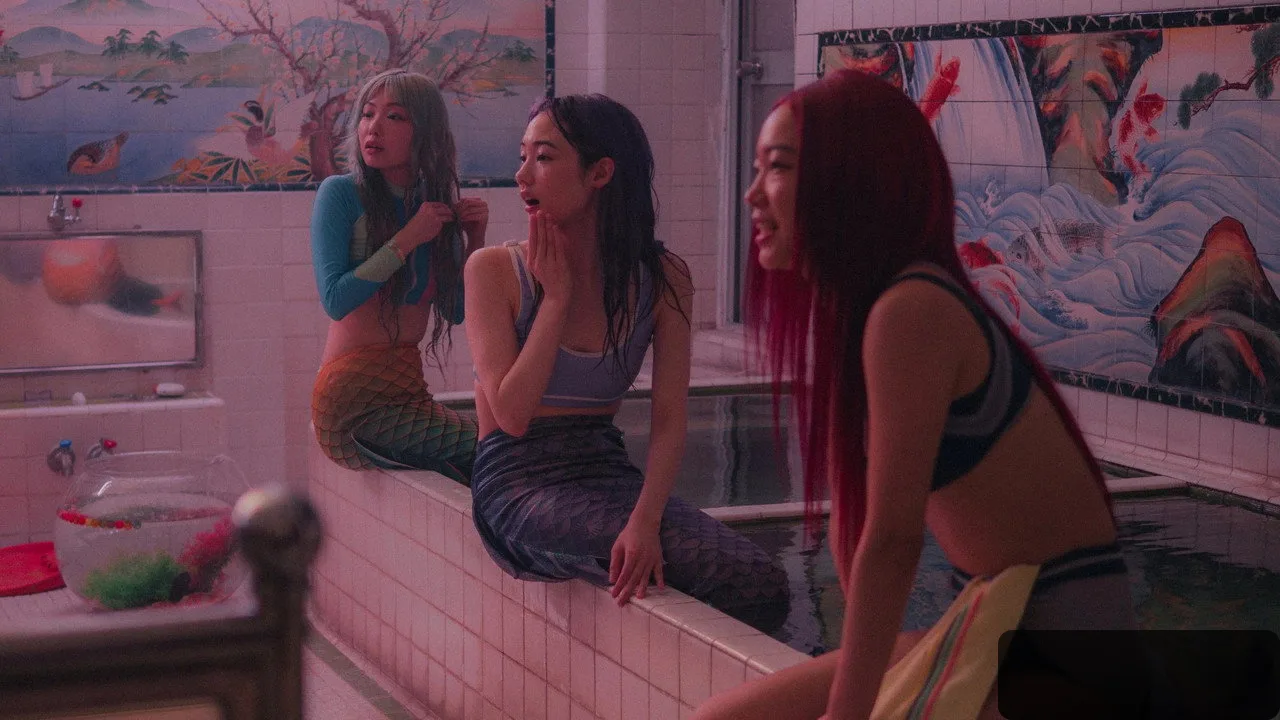
The film follows Kyoko, a 17-year-old Japanese girl enrolled in a boarding school where teenagers train to become professional mermaids — underwater performers for paying audiences. Her coach performs mouth-to-mouth resuscitation on her during training. That's the pivot point. Desire awakens. She finds what the film calls her "mermaid voice," and from there, things get complicated.
The setup invokes two mythologies at once. There's The Little Mermaid on the surface, sure, but underneath it's the ancient Greek myth of the Sirens — those creatures (not Disney mermaids, actual monsters) who lure men toward the sea through their voices, toward desire, surrender, and the unknown. Kotzamani told Variety: "When I started writing about this mermaid school, the tale of 'The Little Mermaid' emerged, but even more strongly the ancient Greek myth of the Sirens: these monstrous yet deeply feminine creatures."
It's an ambitious artistic statement. It's also exactly what a debut filmmaker says when she wants critics to take the work seriously. The real question — the one that matters if you actually want to watch this thing — is whether the film delivers on the concept, or whether it's a gorgeous-looking arthouse puzzle that disappears six months after the standing ovation.
Behind the Production: Why This Took a Decade to Make
Kotzamani's short films — Limbo (2016), Electric Swan (2019), and What Mary Didn't Know (2024) — built a small but devoted following among festival programmers drawn to her visual language around water, bodies, and female interiority. Electric Swan, in particular, earned festival attention for its hypnotic, nearly wordless approach to urban alienation.
But here's the thing: jumping from a 15-minute short to a feature shot in a foreign language with a 10-year development arc is enormous. Plenty of celebrated short filmmakers have stumbled on exactly this transition. (Xavier Dolan didn't. Most others did.)
What keeps Titanic Ocean from being just another ambitious-but-uneven debut is the specificity of its engine. The mermaid school isn't metaphor for its own sake — the story turns on a real dramatic problem: mouth-to-mouth resuscitation that awakens desire in Kyoko, her coach becoming the object of forbidden longing complicated by institutional hierarchy. She's becoming something other than human, which means her feelings become dangerous. That's a usable premise.
The closest recent comparison is probably The Fits (2015), Anna Rose Holmer's debut about a girl in a Cincinnati boxing gym who begins exhibiting mysterious seizure-like movements — similar focus on female adolescent bodies, transformation, and the institutions that shape them. The Fits was stunning in short bursts and felt slight at 72 minutes. Titanic Ocean will need to sustain its own weight across feature length. The uncomfortable precedent that nobody in the festival press seems eager to raise: Holmer hasn't directed a second feature in the ten years since The Fits premiered. A visionary debut can be a launchpad or a dead end, and the six-country financing structure behind Titanic Ocean — with its territory-by-territory obligations and competing creative stakeholders — looks more like the kind of arrangement that exhausts a filmmaker than the kind that sustains one.
Where You Can Watch It — And When
Right now? Nowhere.
Titanic Ocean has no confirmed streaming home, which isn't unusual for a Cannes premiere still in its first week of festival circulation. But it does mean that if you're in India — or anywhere outside Japan and major Western markets — you're looking at a wait of anywhere from 6 to 18 months before a distribution deal lands.
Here's what's realistic:
- MUBI India — the most likely destination. MUBI has been aggressively acquiring Un Certain Regard titles for its subscriber base, and Titanic Ocean's arthouse profile fits perfectly.
- Netflix India — possible but less likely. Netflix has picked up Un Certain Regard films before (Atlantics, Sick of Myself), but not consistently.
- Prime Video India, JioCinema, Hotstar, SonyLIV — very unlikely. These platforms rarely acquire Japanese-language, non-commercial debuts from first-time European directors.
No Hindi, Tamil, or Telugu dub has been announced. English subtitles are the realistic expectation. Indian cinephiles who follow the festival circuit — the audience that engaged with The Blue Caftan or Ryusei when those eventually hit MUBI — are the core Indian viewership here.
Movie OTT tracks where-to-watch data across India, the US, the UK, and Spain. Once distribution deals are confirmed, you'll see them listed there first.
What Cannes Will Determine (And What It Won't)
Un Certain Regard is not the Palme d'Or competition. That distinction matters for distribution. Titles that win or place in Un Certain Regard tend to attract art-house distributor attention, but they don't trigger the kind of global streaming bidding wars that a Competition title might generate.
Watch for sales reports in the days immediately following the May 20 premiere. If a North American or UK distributor picks up the film within the first 72 hours, that's a strong signal. If it's still unsold a week after the festival closes, the path to streaming gets longer and more uncertain.
Box office expectations are minimal by design. A film like this — Japanese-language, no major stars, directed by an unknown Greek filmmaker — isn't tracking at multiplex level anywhere. Its commercial life will be almost entirely on streaming, likely in specialized tiers. For context, last year's Un Certain Regard winner, The Shameless by Konstantin Bojanov, took over eight months to secure broad streaming availability outside its home territory, and it had the advantage of the section's top prize. A film that doesn't win faces an even steeper climb. MUBI, OVID, or a festival-on-demand window through platforms like Fandango at Home are the realistic theatrical-adjacent scenarios.
Here's the thing nobody mentions in the festival press cycle: most Un Certain Regard premieres don't have confirmed streaming homes when they screen. The gap between Cannes buzz and actual viewer access is often 12 to 18 months. Titanic Ocean, given its six-country co-production structure, will likely require territory-by-territory deals rather than a single global pickup. That means slower rollout, but also more stable long-term availability once it does arrive.
The Festival Trajectory and What Comes Next
The real story isn't what happens at Cannes. It's what happens after.
In the next 30 days, sales agents will pitch Titanic Ocean to distributors in every major market. Territorial deals will follow — sometimes quickly, sometimes not at all. A film like this doesn't land on Netflix globally. It lands on MUBI in some territories, on a boutique arthouse distributor in others, possibly on a festival-on-demand platform in the US. Each region negotiates separately. Each has its own timeline.
For Indian audiences specifically, MUBI's acquisition pattern suggests you should check Movie OTT starting around November 2025 or early 2026. That's when festival-circuit acquisitions typically appear in the OTT marketplace. If you're watching the film in a theater — and you should, if you can — it'll likely only play at dedicated arthouse venues in major metros, for maybe two weeks.
The production itself is worth noting: it was handled by Maria Drandaki's Homemade Films (Greece), with Japanese partners Happinet Phantom Studios and Mam Film. The entire shoot happened in Japan, with a Japanese cast and crew. It's either a bold artistic commitment or an enormous production gamble. Probably both. That level of international collaboration tends to produce either extraordinary films or deeply fractured ones.
Kotzamani's honesty about the cost — the burnout, the time away, the explosive creative tensions — suggests she knows which category this might fall into. Whether Cannes viewers agree is a question that gets answered in about three weeks. We shall see.