Raised by Wolves: How Ridley Scott Brought His Biggest Sci-Fi Obsessions to HBO Max
TL;DR: Raised by Wolves (2020–2022) is a two-season android drama on Max that fuses the philosophical DNA of Prometheus and Westworld. It aired for 18 episodes before HBO Max cancelled it, and you can stream both seasons now—though be warned, it ends on an unresolved cliffhanger. Worth watching anyway.
Here's what struck me: Ridley Scott spent four decades building one of the most coherent thematic bodies of work in science fiction cinema. Then, in 2020, he quietly migrated the whole project to television. Not as a cash-in. Not as a franchise extension. As a genuine creative choice, the kind that makes more sense the longer you sit with it.
Scott, the director behind Alien (1979), Blade Runner (1982), and Prometheus (2012), has executive produced over 40 television projects across his career. But he's only ever directed three TV episodes. Three. When HBO Max came calling and Scott not only signed on but personally directed the first two episodes of Raised by Wolves, that told you something. This wasn't a vanity credit. This was Scott finishing a conversation he'd been trying to have since the early 2010s.
Where to Watch It Right Now (and What You're Getting Into)
Raised by Wolves premiered on September 3, 2020, on HBO Max. Both seasons are available to stream on Max (the rebranded platform formerly known as HBO Max) in the United States. Outside the U.S., it's on Sky Atlantic/NOW TV in the UK and JioCinema in India—though licensing shifts regularly, so check Movie OTT's streaming tracker for current regional availability in your country.
Season 1 runs 10 episodes. Season 2 runs 8. Each episode is roughly 50–60 minutes, so you're looking at a solid 15-hour commitment. The show was cancelled in June 2022 as part of Warner Bros. Discovery's cost-cutting purge, which axed roughly $825 million worth of content in the span of a few months. So there's no Season 3 waiting. There's just an ending. A frustrating one, honestly, but an ending nonetheless.
What the Show Actually Is
The premise: two androids—Mother (Amanda Collin) and Father (Abubakar Salim)—are sent to the planet Kepler-22b to raise a new generation of human children after Earth is destroyed in a religious war. Travis Fimmel plays Marcus, a soldier whose grip on reality deteriorates as the series unfolds. The showrunner is Aaron Guzikowski, who wrote Prisoners.
It's atheism versus faith. Reason versus myth. And two androids trying to parent children while figuring out what parenting even means.
The cast is exceptional. Amanda Collin's performance as Mother is the spine of the entire show. She's playing an artificial being learning to simulate emotions, which sounds like a tricky acting problem (and it is), but Collin makes Mother's confusion feel genuinely alien. Abubakar Salim, who's also a BAFTA-winning video game developer (yes, really), brings a soft precision to Father. Travis Fimmel, fresh from Vikings, is clearly interested in playing men whose identities are dissolving, and he commits to it here with unsettling intensity.
Why Ridley Scott Directing Those First Two Episodes Matters
Scott directed Episodes 1 and 2 of Season 1 before handing the reins to a directing team that included Luke Scott, Sergio Mimica-Gezzan, and James Hawes. Watch them back to back and you can feel the handoff.
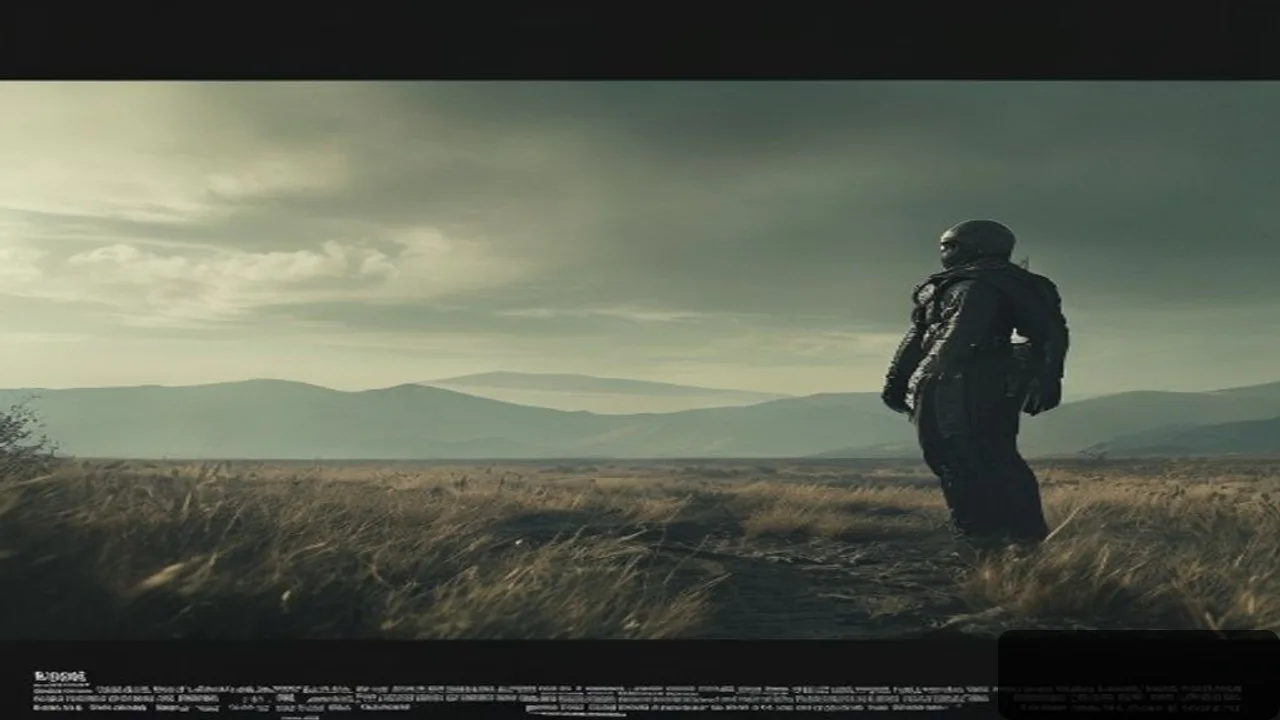
The opening episodes have a particular quality: cold, wide, almost geological in their framing. Scott shoots Kepler-22b's barren surface the way he shot the planetscape in Prometheus, with a sense that the landscape itself is indifferent to human survival. The colour grade is desaturated orange-grey. Silence is weaponized. When Mother commits her first violent act in Episode 1, Scott stages it with clinical economy. No score swell, just action and consequence.
That restraint doesn't entirely disappear when other directors take over, but the show does get stranger and more baroque. You'll notice it around Episode 4. Whether that's a feature or a bug depends on your tolerance for mythology-dense sci-fi that occasionally loses the thread of its own logic.
The Creative Lineage: Why This Show Exists
Ridley Scott's relationship with artificial intelligence goes back to Roy Batty's tears in the rain. Blade Runner asked whether a replicant could grieve. Prometheus asked who made us, and whether they regret it. Raised by Wolves fuses both questions into something rawer: what happens when the beings we create start asking questions we can't answer?
The thematic overlap with HBO's Westworld (2016–2022) is direct and worth naming. Both use android characters to interrogate consciousness, autonomy, and the violence embedded in creation itself. Westworld framed it through corporate exploitation; Raised by Wolves frames it through religion versus reason. What most coverage misses is that Raised by Wolves was the first prestige android show to strip away the theme-park metaphor entirely and plant its AI characters in a survival scenario with no corporate puppet-master, no park guests, no revenue model to critique. That's the more radical choice, and it's the reason the show feels lonelier and more philosophically exposed than anything Westworld attempted after its first season.
In an interview with The Hollywood Reporter around the show's premiere, Guzikowski described the android characters as "a mirror held up to humanity—they're trying to figure out what it means to be human by doing the things humans do, which is raise children and fight over belief systems." That framing holds. Mother and Father aren't villains or victims. They're students of humanity getting the answers wrong in ways that are completely understandable.
Scott himself told Deadline that television gave him "a much larger canvas" than film for exploring these ideas, that Prometheus had only scratched the surface of what he wanted to say about creation and faith. Hard to argue with that assessment. Prometheus had two hours. Raised by Wolves had 18 episodes and actually used them. From what I gather, Scott's Scott Free Productions had been shopping a serialized AI concept since at least 2017, and it was TNT that initially developed the project before HBO Max swooped in during the platform's aggressive 2019 launch-slate acquisitions (though that part is still rumour).
Why This Matters for Indian Audiences Specifically
Indian sci-fi audiences have been underserved at the prestige end of the genre. The Expanse found a cult following on Prime Video India; Westworld had its devotees on Hotstar. Raised by Wolves is the next logical recommendation, and it's currently accessible in India via JioCinema.
The show's central conflict—religious faith versus scientific rationalism—will likely read differently for Indian viewers than for Western ones. The Mithraic faction's fervour, their iconography, their willingness to die for inherited belief systems rather than examined ones: that's not abstract for audiences in a culture where the faith-versus-reason debate is lived daily.
There are no Hindi or regional language dubs confirmed as of this writing. The show streams in English with subtitles. Both seasons are complete and accessible. Movie OTT tracks language availability across Indian platforms, since these do shift. Worth checking if dubbed versions eventually roll out.
The Craft Stuff: Why Season 1 Feels Different
Here's what I keep noticing on rewatches: the early episodes have a visual discipline that gradually loosens. Scott's episodes favour long shots and geological stillness. Later episodes lean into close-ups and baroque production design. By Season 2, the show is almost camp. Not in a bad way, but in a way that suggests different creative hands steering the ship.
Episode 3 has a scene where Mother stands alone on a cliff looking down at the settlement below. Scott would've held that shot for 20 seconds. The later directors cut away in five. Small thing. But it compounds across 18 episodes.
The show's Rotten Tomatoes score sits at 81% critics, 82% audience. Respectable for a series that actively refuses to be easy viewing. What that score doesn't tell you is that the show gets weirder and more divisive as it goes. Season 1 is tighter. Season 2 is bolder but also more chaotic.
Should You Actually Watch This?
Yes. Unambiguously.
It's flawed in the way ambitious things are flawed: overreaching, occasionally incoherent in its mythology, cancelled before it could answer its own questions. But the ambition is real. The performances are exceptional. Collin's work alone justifies the investment. And there's nothing quite like it on television. That still counts for something.
Start with Season 1, Episode 1. If you're still engaged by Episode 3, you're in. If the mythology dump in the second half of Season 1 loses you, and it might, you'll know by then whether to push through.
For current streaming access, platform-specific details, and any new availability windows in your region, check Movie OTT's where-to-watch database. It updates as licensing agreements shift.