9 Temples to Heaven: The Thai Debut That Twenty-Three Years Built
Thai filmmaker Sompot Chidgasornpongse's feature debut world premiered at Cannes Directors' Fortnight 2026 and is now competing for the Caméra d'Or. The film follows a family of nine on a single-day Buddhist pilgrimage to nine temples, hoping to extend their grandmother's life — but the trip takes an unexpected turn. International sales are underway through Playtime; no theatrical or streaming dates confirmed yet.
On the Croisette in May 2026, while most of cinema's attention locked onto the Palme d'Or race, something quieter was happening in the Directors' Fortnight sidebar. And it's genuinely worth your time. A filmmaker who spent more than two decades in the shadow of one of world cinema's most celebrated directors finally stepped forward with a feature of his own. 9 Temples to Heaven isn't your typical debut. It's the kind of film that arrives with the weight of a real apprenticeship behind it.
The thing nobody mentions when talking about Sompot Chidgasornpongse: he isn't a newcomer in any meaningful sense. He's been assistant director on four major films by Apichatpong Weerasethakul — Tropical Malady (2004), Syndromes and a Century (2006), Cemetery of Splendour (2015), and Memoria (2021), which won the Jury Prize at Cannes and starred Tilda Swinton. That's not apprenticeship. That's a masterclass that lasted two decades.
What the film actually does: structure over story
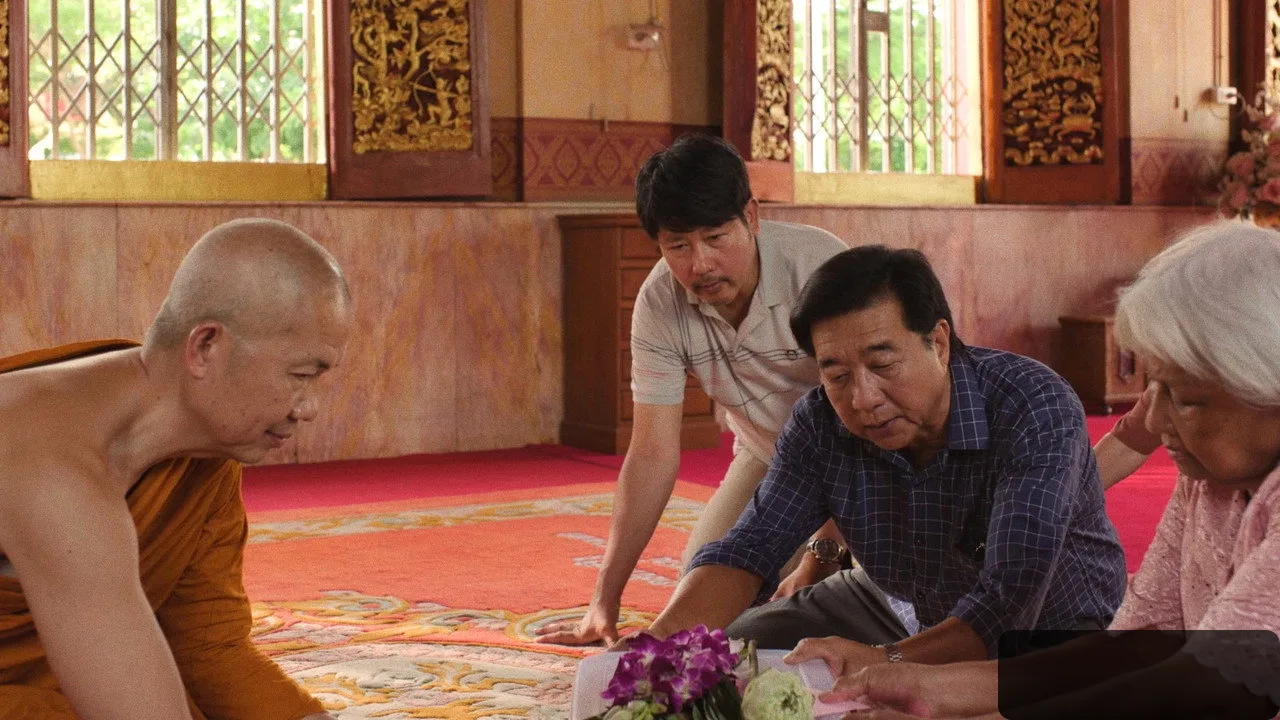
9 Temples to Heaven is built around a Buddhist ritual called Sangkatan, where devotees prepare containers of everyday items as offerings to monastic communities. A family of nine takes their grandmother on a merit-making trip across nine temples in a single day, hoping the practice will prolong her life. The trip doesn't go as planned.
Chidgasornpongse told Variety where this came from: "Making offerings at 9 temples within 1 day, which my family and many Thais also practice, feels like one of the ultimate manifestations of those beliefs. Though my critical side has always questioned the effectiveness of the promised outcomes, I continued to practice those rituals, sometimes simply to please my family, or to give myself peace of mind. I'm interested in those contradictions."
That tension — between inherited faith and rational doubt — is exactly the kind of friction that makes cinema matter. The director wasn't interested in spirituality as exoticism. He wanted "to capture the way things really are in contemporary Thai temples — the regular everyday things that can happen." No mythologising. No performance for foreign audiences.
Structurally, the film moves like a road movie. Dawn to nightfall. Real-time travel between temple visits. Geography first, then story — which makes sense when you learn Chidgasornpongse trained as an architect before moving into cinema. "We were trained to first think about the overall plan and layout before dealing with the details," he explained to Variety. "Perhaps because of that, I often see the structure of my films first, including my short films, even before I fully know the stories that will eventually exist within them."
That's a genuinely different way to build a narrative. Most screenwriters start with character. Chidgasornpongse starts with blueprint.
The political undercurrent nobody's talking about
The script took shape during Thailand's most turbulent period in recent memory — after King Bhumibol's death in 2016 and the generational fractures that followed. "It created many fractures within society and even within families, especially between the older and younger generations," Chidgasornpongse told Variety, "in terms of how differently they view established sacred institutions and where the country should be heading."
That's the real story buried in the premise. This isn't purely a spiritual meditation. It's a family drama caught between competing versions of what devotion means, what tradition means, whether institutions deserve the faith placed in them. What the trade write-ups miss: this is the first Thai Directors' Fortnight selection since Anocha Suwichakornpong's By the Time It Gets Dark played there in 2017, and the first from this particular production ecosystem (Kick The Machine) to premiere outside the main Competition since Cemetery of Splendour in Un Certain Regard a decade ago. That's not just a personal milestone. It signals that the pipeline from Weerasethakul's shop is producing distinct voices, not just disciples.
Where this film is actually coming from: the production breakdown
Director: Sompot Chidgasornpongse (feature debut)
World Premiere: Cannes Film Festival 2026, Directors' Fortnight
Competition: Caméra d'Or (best debut feature award)
Runtime: Not yet confirmed
Sales Agent: Playtime (France)
The production reads like a genuinely international undertaking:
- Kick The Machine Films (Thailand) — Apichatpong Weerasethakul's production company
- At A Time in Thailand (Thailand)
- E&W Films (Singapore)
- petit chaos (France)
- Needle in the Haystack (Norway)
- La Fonte (China)
- Square One Film (Hong Kong)
- Qun Films (Indonesia)
Six countries. Eight companies. That level of co-financing doesn't happen by accident — it means Chidgasornpongse and his producers built distribution relationships before the film was even finished. From what I gather, Playtime's involvement is the smart move here. They've placed difficult, formally ambitious films into markets that might otherwise ignore them (the word on the lot is they were circling this project as early as the rough-cut stage, though that part is still rumour). European theatrical looks likely, especially France, with petit chaos as co-producer. US distribution will depend on who picks it up post-Cannes.
Movie OTT tracks international deals as they're announced, so that's worth bookmarking if you want updates on where this lands.
Why this matters for Indian audiences (and where to watch)
Thai cinema has a surprising number of devoted viewers in India — especially people who discovered Southeast Asian arthouse through streaming. Uncle Boonmee Who Can Recall His Past Lives (2010) and Memoria (2021) both found audiences on MUBI India, which is where films like this tend to live.
The pilgrimage structure will land differently with Indian viewers than it does with European festival crowds. The idea of a family traveling to multiple sacred sites in a single day, the practice of merit-making through collective effort, the generational split between older devotional practice and younger skepticism — these aren't foreign ideas. They're familiar across Hindu, Buddhist, and Jain traditions in India. For Indian audiences, the more relevant comp isn't Weerasethakul's meditative pacing — it's something like Lijo Jose Pellissery's Churuli or even Raam Reddy's Thithi, films that used ritual and community as structural scaffolding while smuggling in sharp social commentary. That's the lineage this film belongs to, and it's why it won't feel like you're watching something distant. It'll feel close.
Where it'll probably show up:
- MUBI India — most likely, given the arthouse profile and Weerasethakul precedent
- Netflix India — possible if a major deal closes
- Amazon Prime Video India — has acquired international festival titles before
- No confirmed platform as of now
Indian subtitles (not dubbing) are the expected format. For real-time streaming availability across Netflix India, Prime Video, MUBI, Hotstar, and JioCinema, Movie OTT has the tracking data updated as deals close.
The Caméra d'Or factor: what comes next
Chidgasornpongse is competing for the Caméra d'Or — the festival's award for best debut feature — against first films from across Cannes. The prize has historically gone to formally ambitious, culturally specific debuts. Past winners went on to major careers. A win would accelerate distribution deals significantly.
But honestly? The more interesting story isn't whether he takes home the prize. It's whether this moment finally lets Chidgasornpongse be known as a director in his own right, not as "Apichatpong's assistant" (even though that association opened every door he's walked through). Twenty-three years is a long apprenticeship. This debut has clearly been earned.
When and where to actually watch it
9 Temples to Heaven is currently premiering at Cannes Directors' Fortnight 2026. Distribution announcements are expected in the weeks following the festival closing.
Confirmed so far:
- World premiere completed at Cannes
- Caméra d'Or decision pending
- International sales through Playtime ongoing
- Theatrical release dates: not yet announced for any territory
- Streaming platforms: not yet confirmed
Watch for announcements on:
- France — likely first, given the French co-producers
- UK and US — depends on which distributor picks it up
- India — MUBI India is the most probable landing spot, though not confirmed
For the moment deals are reported — theatrical dates, streaming platforms, release windows — Movie OTT aggregates that data in real time across Netflix, Prime Video, MUBI, Hotstar, JioCinema, and theatrical distributors. Worth setting a reminder to check back in June, when post-Cannes distribution moves typically get announced.